QUESTION IMAGE
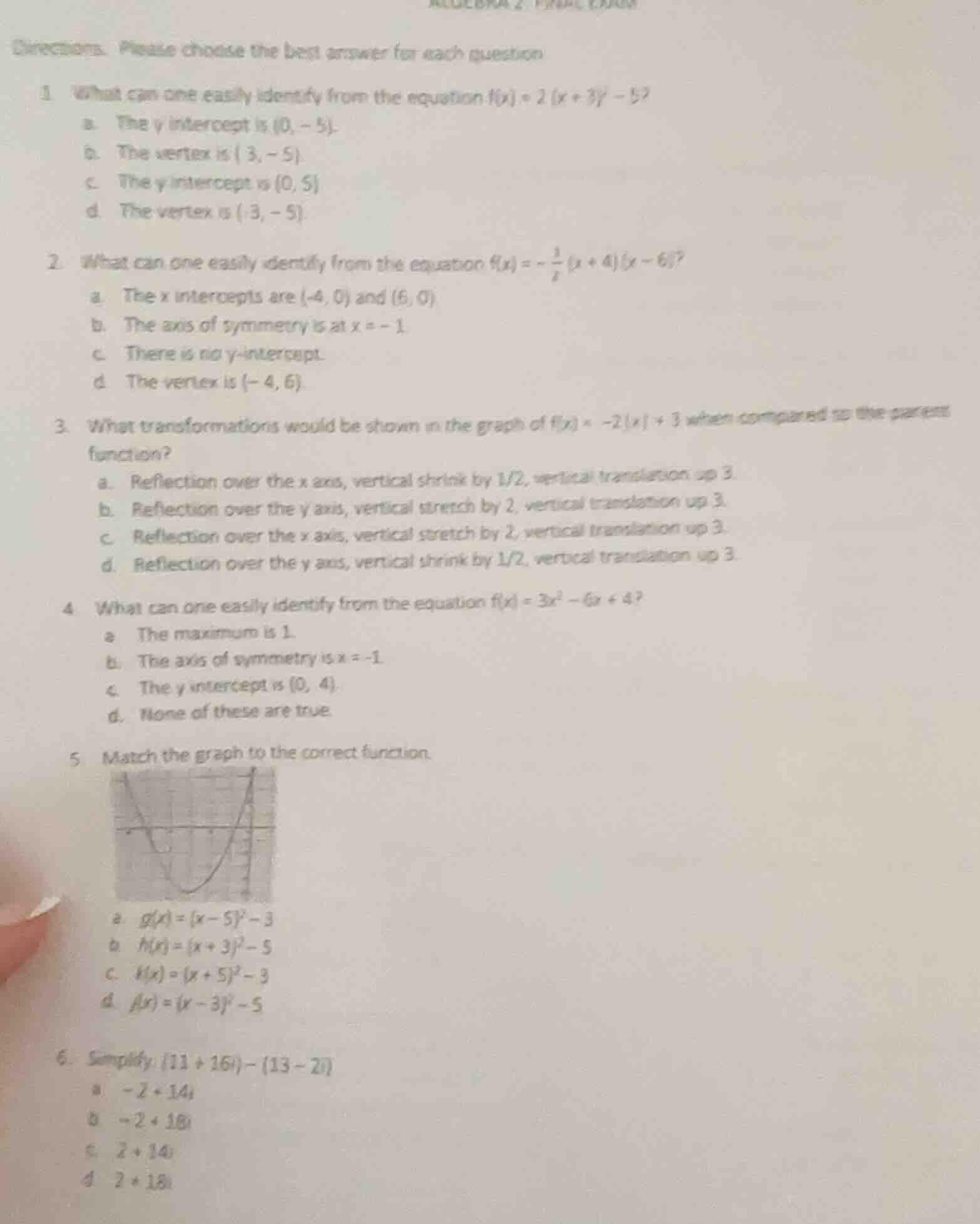
Question
directions. please choose the best answer for each question
- what can one easily identify from the equation $f(x)=2(x + 3)^2-5$?
a. the y intercept is $(0, -5)$.
b. the vertex is $(3, -5)$.
c. the y intercept is $(0, 5)$
d. the vertex is $(-3, -5)$.
- what can one easily identify from the equation $f(x)=-\frac{1}{2}(x + 4)(x - 6)$?
a. the x intercepts are $(-4, 0)$ and $(6, 0)$
b. the axis of symmetry is at $x = -1$
c. there is no y - intercept.
d. the vertex is $(-4, 6)$
- what transformations would be shown in the graph of $f(x)=-2|x| + 3$ when compared to the parent function?
a. reflection over the x axis, vertical shrink by $1/2$, vertical translation up 3.
b. reflection over the y axis, vertical stretch by 2, vertical translation up 3.
c. reflection over the x axis, vertical stretch by 2, vertical translation up 3.
d. reflection over the y axis, vertical shrink by $1/2$, vertical translation up 3.
- what can one easily identify from the equation $f(x)=3x^2-6x + 4$?
a. the maximum is 1.
b. the axis of symmetry is $x = -1$
c. the y intercept is $(0, 4)$.
d. none of these are true.
- match the graph to the correct function.
graph of a parabola
a. $g(x)=(x - 5)^2-3$
b. $h(x)=(x + 3)^2-5$
c. $k(x)=(x + 5)^2-3$
d. $j(x)=(x - 3)^2-5$
- simplify $(11 + 16i)-(13 - 2i)$
a. $-2 + 14i$
b. $-2 + 18i$
c. $2 + 14i$
d. $2 + 18i$
Question 1
Step1: Recall vertex form of quadratic
The vertex form of a quadratic function is \( f(x) = a(x - h)^2 + k \), where \((h, k)\) is the vertex. The given function is \( f(x) = 2(x + 3)^2 - 5 \), which can be rewritten as \( f(x) = 2(x - (-3))^2 + (-5) \). So, \( h = -3 \) and \( k = -5 \), so the vertex is \((-3, -5)\). Now check y - intercept: set \( x = 0 \), \( f(0)=2(0 + 3)^2-5=2\times9 - 5 = 18 - 5 = 13 \), so y - intercept is \((0,13)\), so options a, b, c are wrong, d is correct.
Step1: Analyze the factored form
The function is in factored form \( f(x)=a(x - r_1)(x - r_2) \), where \( r_1 \) and \( r_2 \) are the x - intercepts (roots). For \( f(x)=-\frac{1}{2}(x + 4)(x - 6) \), set \( f(x)=0 \), then \( x+4 = 0 \) or \( x - 6=0 \), so \( x=-4 \) or \( x = 6 \). So x - intercepts are \((-4,0)\) and \((6,0)\). Let's check axis of symmetry: for a quadratic in factored form \( f(x)=a(x - r_1)(x - r_2) \), the axis of symmetry is \( x=\frac{r_1 + r_2}{2}=\frac{-4 + 6}{2}=1 \), so option b is wrong. Every function has a y - intercept (set \( x = 0 \)), so option c is wrong. The vertex is not \((-4,6)\) (since when \( x=-4 \), \( f(-4)=0 \), and when \( x = 6 \), \( f(6)=0 \), vertex is at \( x = 1 \)), so option d is wrong.
Step1: Recall transformations of absolute value function
The parent function of absolute value is \( y = |x| \). For the function \( f(x)=-2|x|+3 \):
- The negative sign in front of the absolute value indicates a reflection over the x - axis.
- The coefficient 2 (greater than 1) in front of \( |x| \) indicates a vertical stretch by a factor of 2.
- The + 3 at the end indicates a vertical translation up 3 units.
So option c matches these transformations.

Snap & solve any problem in the app
Get step-by-step solutions on Sovi AI
Photo-based solutions with guided steps
Explore more problems and detailed explanations
d. The vertex is \((-3, -5)\)