QUESTION IMAGE
Question
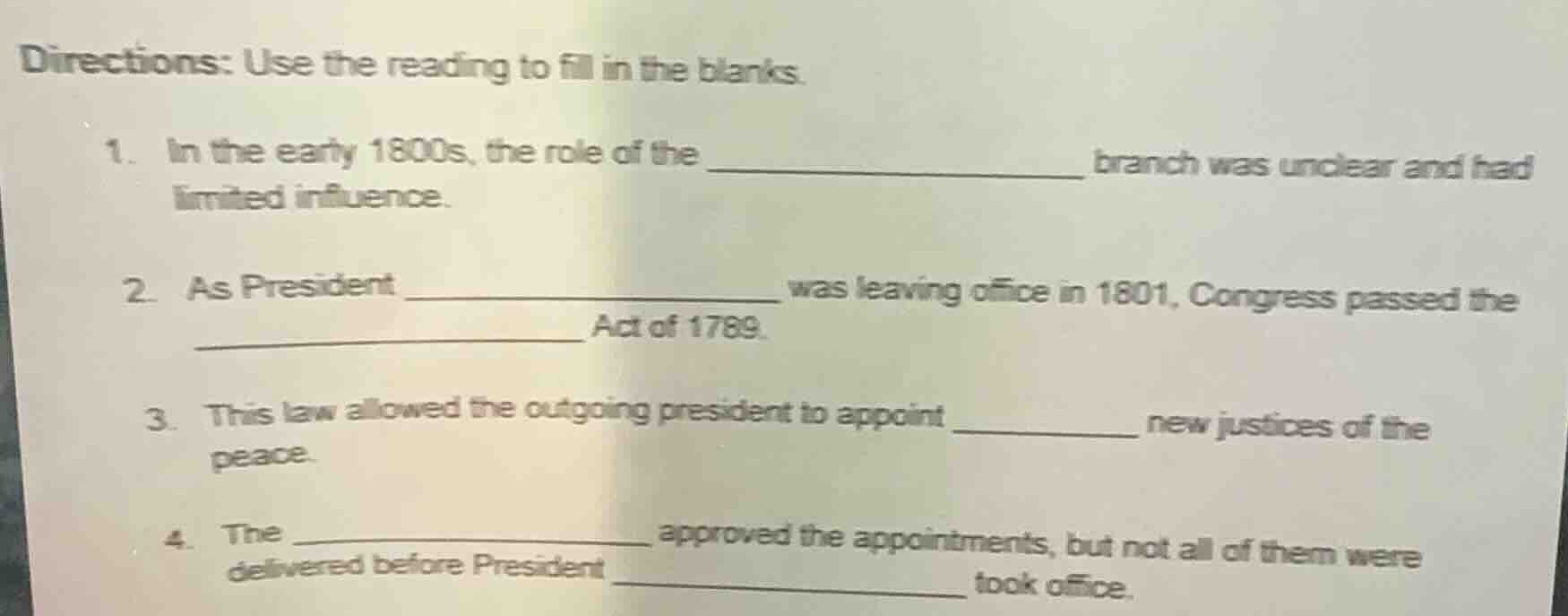
directions: use the reading to fill in the blanks.
- in the early 1800s, the role of the ____________ branch was unclear and had limited influence.
- as president __________ was leaving office in 1801, congress passed the __________ act of 1789.
- this law allowed the outgoing president to appoint ________ new justices of the peace.
- the __________ approved the appointments, but not all of them were delivered before president __________ took office.
To solve these fill - in - the - blank questions, we need to recall relevant historical knowledge, especially about the U.S. government structure and early American political history.
Question 1
In the early 1800s, the role of the Judicial branch was unclear and had limited influence. The judicial branch, especially the Supreme Court, was still in the process of defining its powers and role in the system of checks and balances at that time.
Question 2
As President John Adams was leaving office in 1801, Congress passed the Judiciary Act of 1789 (note: there might be a typo in the question as the Judiciary Act of 1789 was passed in 1789, but in the context of Adams leaving office in 1801, the Judiciary Act of 1801 (also known as the Midnight Judges Act) is more relevant. However, following the question's wording, if we assume it's a mis - date and refer to the Judiciary Act related to Adams' last days, or if we take the question as is, the Judiciary Act of 1789 was a foundational law for the federal judiciary. But historically, when Adams was leaving office, the Judiciary Act of 1801 was passed. Given the question's "Act of 1789", we'll go with the original act. So the answers are John Adams and Judiciary.
Question 3
This law (assuming it's the Judiciary Act of 1801 or related) allowed the outgoing president to appoint fifteen new justices of the peace. The Judiciary Act of 1801 increased the number of federal judges, and Adams used this to appoint "midnight judges" to secure Federalist influence in the judiciary.
Question 4
The Senate approved the appointments (as the Senate has the power of advice and consent for judicial appointments), but not all of them were delivered before President Thomas Jefferson took office. Jefferson was the successor of Adams, and the famous Marbury v. Madison case arose from the undelivered commissions of these appointees.
Final Answers
- Judicial
- John Adams; Judiciary
- fifteen
- Senate; Thomas Jefferson

Snap & solve any problem in the app
Get step-by-step solutions on Sovi AI
Photo-based solutions with guided steps
Explore more problems and detailed explanations
To solve these fill - in - the - blank questions, we need to recall relevant historical knowledge, especially about the U.S. government structure and early American political history.
Question 1
In the early 1800s, the role of the Judicial branch was unclear and had limited influence. The judicial branch, especially the Supreme Court, was still in the process of defining its powers and role in the system of checks and balances at that time.
Question 2
As President John Adams was leaving office in 1801, Congress passed the Judiciary Act of 1789 (note: there might be a typo in the question as the Judiciary Act of 1789 was passed in 1789, but in the context of Adams leaving office in 1801, the Judiciary Act of 1801 (also known as the Midnight Judges Act) is more relevant. However, following the question's wording, if we assume it's a mis - date and refer to the Judiciary Act related to Adams' last days, or if we take the question as is, the Judiciary Act of 1789 was a foundational law for the federal judiciary. But historically, when Adams was leaving office, the Judiciary Act of 1801 was passed. Given the question's "Act of 1789", we'll go with the original act. So the answers are John Adams and Judiciary.
Question 3
This law (assuming it's the Judiciary Act of 1801 or related) allowed the outgoing president to appoint fifteen new justices of the peace. The Judiciary Act of 1801 increased the number of federal judges, and Adams used this to appoint "midnight judges" to secure Federalist influence in the judiciary.
Question 4
The Senate approved the appointments (as the Senate has the power of advice and consent for judicial appointments), but not all of them were delivered before President Thomas Jefferson took office. Jefferson was the successor of Adams, and the famous Marbury v. Madison case arose from the undelivered commissions of these appointees.
Final Answers
- Judicial
- John Adams; Judiciary
- fifteen
- Senate; Thomas Jefferson