QUESTION IMAGE
Question
discussion topic
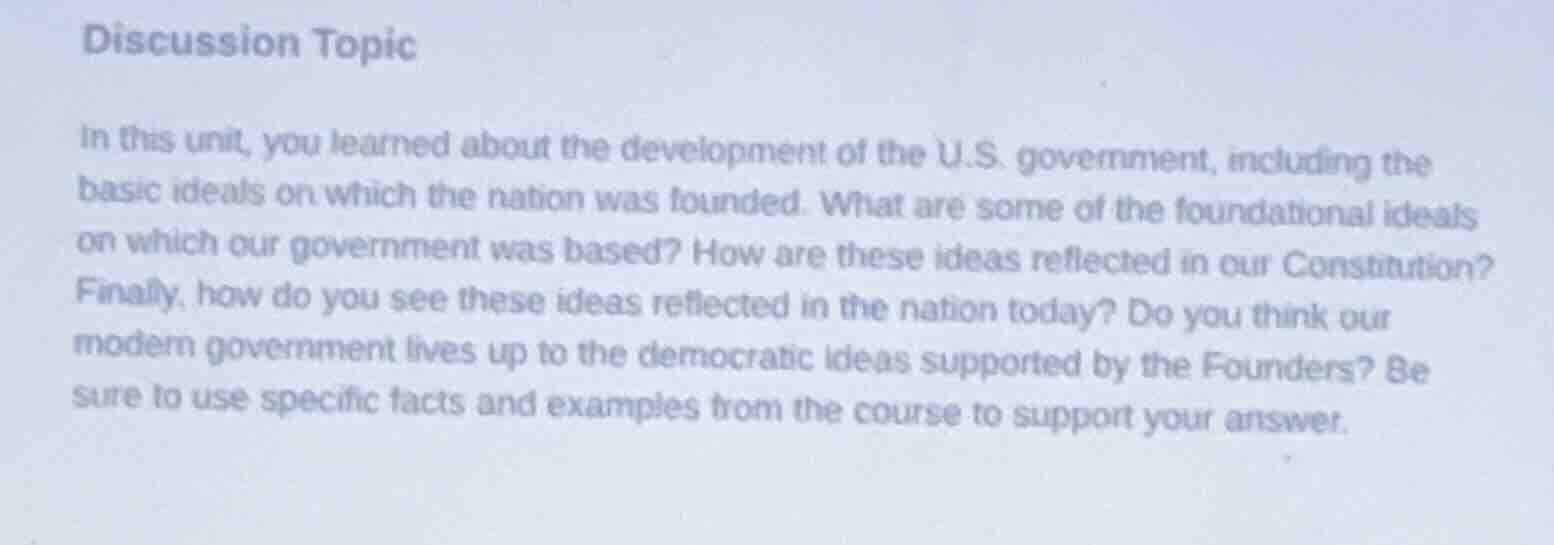
in this unit, you learned about the development of the u.s. government, including the basic ideals on which the nation was founded. what are some of the foundational ideals on which our government was based? how are these ideas reflected in our constitution? finally, how do you see these ideas reflected in the nation today? do you think our modern government lives up to the democratic ideas supported by the founders? be sure to use specific facts and examples from the course to support your answer.
- Foundational Ideals: The U.S. government was founded on ideals like popular sovereignty (power from the people), limited government (government powers restricted), federalism (division of power between state and national gov), separation of powers (legislative, executive, judicial branches), checks and balances (branches limit each other), and individual rights (e.g., Bill of Rights).
- Reflection in the Constitution:
- Popular sovereignty: Preamble starts with "We the People".
- Limited government: Articles outline specific powers, Tenth Amendment reserves powers not delegated to states/people.
- Federalism: Division of powers between national (e.g., regulate commerce) and state (e.g., education) governments.
- Separation of powers: Article I (legislative), Article II (executive), Article III (judicial).
- Checks and balances: President vetoes laws (executive check on legislative), Congress overrides veto (legislative check on executive), courts declare laws unconstitutional (judicial check on legislative/executive).
- Individual rights: Bill of Rights (First Amendment: freedom of speech, religion; Fourth Amendment: search and seizure protections, etc.).
- Reflection Today:
- Popular sovereignty: Elections allow citizens to vote, but issues like voter suppression and gerrymandering challenge it.
- Limited government: Debates over government surveillance (e.g., NSA) and regulatory power (e.g., environmental regulations) show tensions.
- Federalism: Issues like healthcare (ACA implementation, state Medicaid expansion) and marijuana legalization (state vs. federal law) highlight federal - state dynamics.
- Separation of powers: Impeachments, executive orders, and judicial appointments (e.g., Supreme Court) show interactions.
- Checks and balances: Congressional investigations (e.g., into executive actions), judicial rulings (e.g., on Trump's travel ban) demonstrate checks.
- Individual rights: Ongoing debates over LGBTQ+ rights, racial justice (e.g., Black Lives Matter, police reform) relate to equal protection (Fourteenth Amendment).
- Living Up to Democratic Ideals: The modern government has both successes (e.g., peaceful transfers of power, expansion of rights to more groups) and challenges (e.g., political polarization, money in politics, unequal representation). For example, the expansion of civil rights (e.g., Voting Rights Act, marriage equality) shows progress, but issues like partisan gridlock and unequal access to the political process show areas needing improvement.

Snap & solve any problem in the app
Get step-by-step solutions on Sovi AI
Photo-based solutions with guided steps
Explore more problems and detailed explanations
Foundational ideals of the U.S. government include popular sovereignty, limited government, federalism, separation of powers, checks and balances, and individual rights. These are reflected in the Constitution (e.g., "We the People" for popular sovereignty, separated branches for separation of powers). Today, they are seen in elections (popular sovereignty), federal - state policy debates (federalism), and rights - related movements (individual rights). The modern government has advanced democratic ideals (e.g., civil rights expansion) but faces challenges (e.g., political polarization, unequal representation).