QUESTION IMAGE
Question
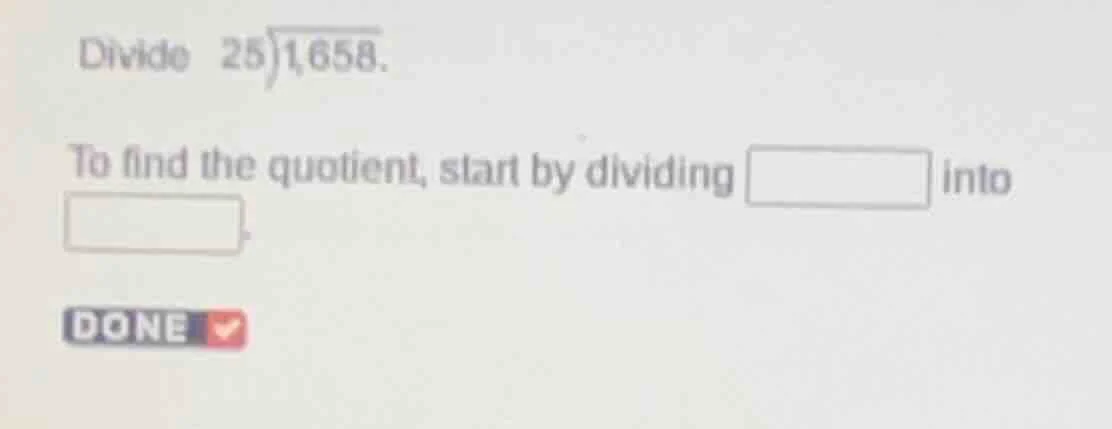
divide \\(25\enclose{longdiv}{1658}\\). to find the quotient, start by dividing \\(square\\) into \\(square\\).
Step1: Recall long division rules
In long division, when dividing a number by a two - digit divisor (here, 25), we start by looking at the first few digits of the dividend (1658) to see how many times the divisor can go into it. We start with the left - most digits of the dividend. The divisor is 25 (a two - digit number), so we look at the first two digits of the dividend first? Wait, no, the first two digits of 1658 are 16, which is less than 25. So we look at the first three digits, 165? Wait, no, the standard long - division process for a two - digit divisor: we start by dividing the divisor into the first two or more digits of the dividend such that the number formed is greater than or equal to the divisor. The divisor is 25, and the dividend is 1658. The first two digits of the dividend are 16 (16 < 25), so we take the first three digits? Wait, no, the correct approach is: when doing long division of a number by a two - digit divisor, we start by dividing the divisor (25) into the first two digits of the dividend if the first two digits are greater than or equal to the divisor. If not, we take the first three digits. But in terms of the initial step of long division for \(25\enclose{longdiv}{1658}\), we start by dividing 25 into 165? Wait, no, the first step is to look at how many times 25 goes into the first part of the dividend. The dividend is 1658, and the divisor is 25. The first two digits of the dividend are 16 (16 < 25), so we consider the first three digits, 165? Wait, no, actually, the standard long - division notation: for \(25\enclose{longdiv}{1658}\), we start by dividing 25 into the first two digits of the dividend? No, 16 is less than 25, so we take the first three digits? Wait, no, the correct initial step is that we divide the divisor (25) into the first two or more digits of the dividend such that the number is at least as big as the divisor. So for 1658 divided by 25, we start by dividing 25 into 165? Wait, no, the first two digits are 16, which is less than 25, so we take the first three digits? Wait, no, the dividend is 1658, and the divisor is 25. The first step in long division is to see how many times 25 can go into the first "group" of digits of the dividend. Since 25 is a two - digit number, we start with the first two digits of the dividend: 16. But 16 < 25, so we take the first three digits: 165? Wait, no, actually, the correct way is that we divide the divisor (25) into the first two digits of the dividend if the first two digits are greater than or equal to the divisor. If not, we take the first three digits. But in the context of the question, which is asking "To find the quotient, start by dividing [ ] into [ ]", the divisor is 25, and we start by dividing 25 into the first part of the dividend that is large enough. The first two digits of the dividend are 16 (16 < 25), so we take the first three digits? Wait, no, the dividend is 1658, and the divisor is 25. The first step is to divide 25 into 165? Wait, no, let's think again. The long - division process for \(25\enclose{longdiv}{1658}\):
We write the division as:
    66
25)1658
Wait, no, let's do it step by step. 25 times 60 is 1500, 25 times 66 is 1650. But the initial step: when we set up the long division, we look at how many times 25 goes into the first few digits of 1658. The first two digits are 16 (too small), so we take the first three digits, 165. But the question is asking "start by dividing [ ] into [ ]". The divisor is 25, and the part of the dividend we start with is the first two or three digits. But the correct initi…

Snap & solve any problem in the app
Get step-by-step solutions on Sovi AI
Photo-based solutions with guided steps
Explore more problems and detailed explanations
The first box should be filled with 25, and the second box should be filled with 165. So the answer is 25 and 165 (in the order of dividing 25 into 165).