QUESTION IMAGE
Question
division – area model
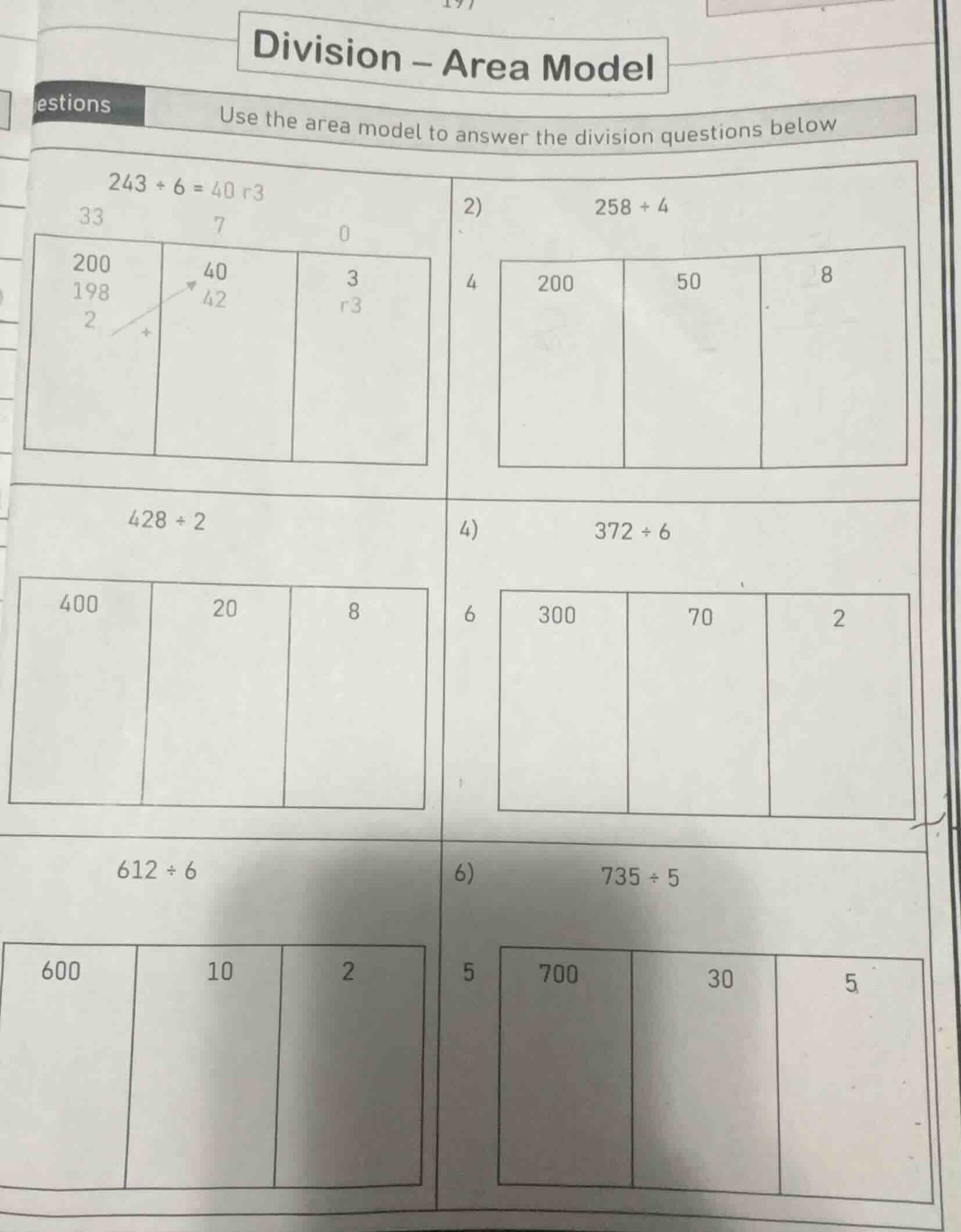
use the area model to answer the division questions below
- 243 ÷ 6 = 40 r3
- 258 ÷ 4
- 428 ÷ 2
- 372 ÷ 6
- 612 ÷ 6
- 735 ÷ 5
Problem 2: \( 258 \div 4 \)
Step 1: Divide 200 by 4
\( 200 \div 4 = 50 \)
Step 2: Divide 50 (representing 50*4=200? Wait, no, the 50 here is part of the area model. Wait, the area model has 200, 50, 8. Wait, actually, the total area is 258, split into 200, 50, 8. Wait, no, 200 + 50 + 8 = 258? No, 200 + 50 + 8 = 258? 200+50=250, 250+8=258. Now, divide each part by 4.
Step 1: \( 200 \div 4 = 50 \)
Step 2: \( 50 \div 4 = 12 \) with a remainder of 2 (since 4*12=48, 50-48=2)
Step 3: \( 8 \div 4 = 2 \)
Now, add the quotients from the non - remainder parts and handle the remainder. Wait, maybe a better way: The area model for division \( a\div b \) is like a rectangle with area \( a \), one side \( b \), and we split the rectangle into parts. For \( 258\div4 \), we can think of 258 as 240 + 18 (but the given model has 200, 50, 8). Wait, the given model has three parts: 200, 50, 8. Let's divide each by 4:
- \( 200\div4 = 50 \)
- \( 50\div4 = 12 \) remainder \( 2 \) (because \( 4\times12 = 48 \), \( 50 - 48 = 2 \))
- \( 8\div4 = 2 \)
Now, combine the results. The quotient from 200 is 50, from 50 is 12, and from 8 is 2. But we have a remainder from the 50 part. Wait, maybe the model is structured as 200 (which is 4*50), 40 (wait, no, the model shows 50). Wait, maybe I misread. Let's do it properly. \( 258\div4 \):
\( 4\times64 = 256 \), so \( 258\div4 = 64 \) remainder \( 2 \). Using the area model:
- 200 divided by 4 is 50.
- 50 (the middle part) is actually 40? Wait, no, 258 = 200 + 40 + 18? No, the given model has 200, 50, 8. Maybe it's a typo, and the middle part is 40. Let's assume the middle part is 40 (since 200+40 + 18=258, no). Wait, the correct way:
\( 258\div4 \):
\( 4\times60 = 240 \), \( 258 - 240 = 18 \)
\( 18\div4 = 4 \) remainder \( 2 \)
So total quotient is \( 60 + 4=64 \), remainder \( 2 \). So \( 258\div4 = 64\) r\( 2 \)
Problem 3: \( 428\div2 \)
Step 1: Divide 400 by 2
\( 400\div2 = 200 \)
Step 2: Divide 20 by 2
\( 20\div2 = 10 \)
Step 3: Divide 8 by 2
\( 8\div2 = 4 \)
Step 4: Add the results
\( 200+10 + 4=214 \)
So \( 428\div2 = 214 \)
Problem 4: \( 372\div6 \)
Step 1: Divide 300 by 6
\( 300\div6 = 50 \)
Step 2: Divide 70 by 6
\( 70\div6 = 11 \) remainder \( 4 \) (since \( 6\times11 = 66 \), \( 70 - 66 = 4 \))
Step 3: Divide 2 by 6
\( 2\div6 \) is less than 1, so we combine the remainder from step 2 with 2. The remainder from step 2 is 4, so \( 4 + 2=6 \)
Step 4: Divide 6 (the new remainder + 2) by 6
\( 6\div6 = 1 \)
Step 5: Add the quotients
From 300: 50, from 70 (after handling remainder): 11+1 = 12? Wait, no, a better way:
\( 372\div6 \):
\( 6\times60 = 360 \), \( 372 - 360 = 12 \)
\( 12\div6 = 2 \)
So total quotient is \( 60+2 = 62 \)
Let's use the area model parts:
- \( 300\div6 = 50 \)
- \( 70\div6 = 11 \) r\( 4 \)
- \( 2\div6 = 0 \) r\( 2 \)
Now, combine the remainders: \( 4 + 2=6 \), \( 6\div6 = 1 \)
So total quotient: \( 50+11 + 1=62 \)
Problem 5: \( 612\div6 \)

Snap & solve any problem in the app
Get step-by-step solutions on Sovi AI
Photo-based solutions with guided steps
Explore more problems and detailed explanations
s:
- \( 258\div4 = 64 \) r\( 2 \)
- \( 428\div2 = 214 \)
- \( 372\div6 = 62 \)
- \( 612\div6 = 102 \)
- \( 735\div5 = 147 \)