QUESTION IMAGE
Question
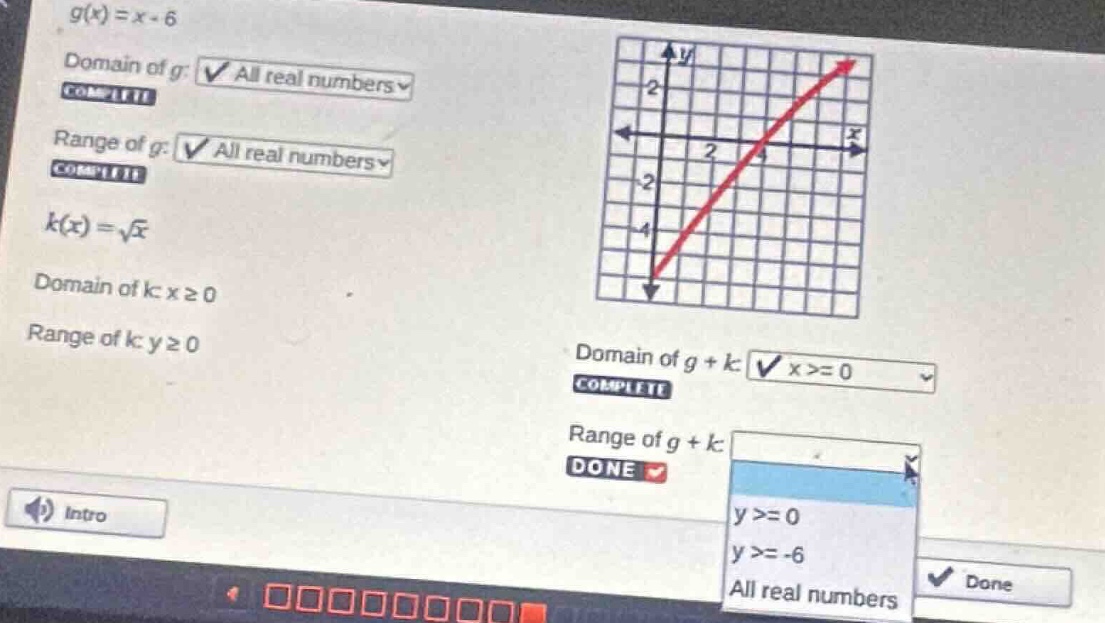
g(x) = x - 6
domain of g: all real numbers
range of g: all real numbers
k(x) = \sqrt{x}
domain of k: x \geq 0
range of k: y \geq 0
(image: graph of a line with a red segment)
domain of g + k: x >= 0
range of g + k: (dropdown with options y >= 0, y >= -6, all real numbers)
Step1: Analyze \( g(x) \) and \( k(x) \)
\( g(x)=x - 6 \) is a linear function, its range is all real numbers (\( (-\infty,\infty) \)). \( k(x)=\sqrt{x} \) has a range \( y\geq0 \) (since square root of non - negative \( x \) is non - negative).
Step2: Find the range of \( g(x)+k(x) \)
Let \( h(x)=g(x)+k(x)=x - 6+\sqrt{x} \). Let \( t = \sqrt{x} \), where \( t\geq0 \). Then \( x=t^{2} \), and \( h(t)=t^{2}-6 + t=t^{2}+t - 6 \), with \( t\geq0 \).
The function \( y = t^{2}+t - 6 \) is a quadratic function with \( a = 1\), \( b = 1\), \( c=-6 \). The axis of symmetry is \( t=-\frac{b}{2a}=-\frac{1}{2} \). Since \( a = 1>0 \), the function is increasing for \( t\geq-\frac{1}{2} \). For \( t\geq0 \), when \( t = 0 \), \( y=0^{2}+0 - 6=-6 \). As \( t \) increases, \( y=t^{2}+t - 6 \) increases (because the derivative \( y^\prime=2t + 1>0 \) for \( t\geq0 \)). So the minimum value of \( h(t) \) (when \( t = 0 \)) is \( - 6 \), and the range of \( h(t) \) (i.e., the range of \( g + k \)) is \( y\geq - 6 \).

Snap & solve any problem in the app
Get step-by-step solutions on Sovi AI
Photo-based solutions with guided steps
Explore more problems and detailed explanations
\( y\geq - 6 \)