QUESTION IMAGE
Question
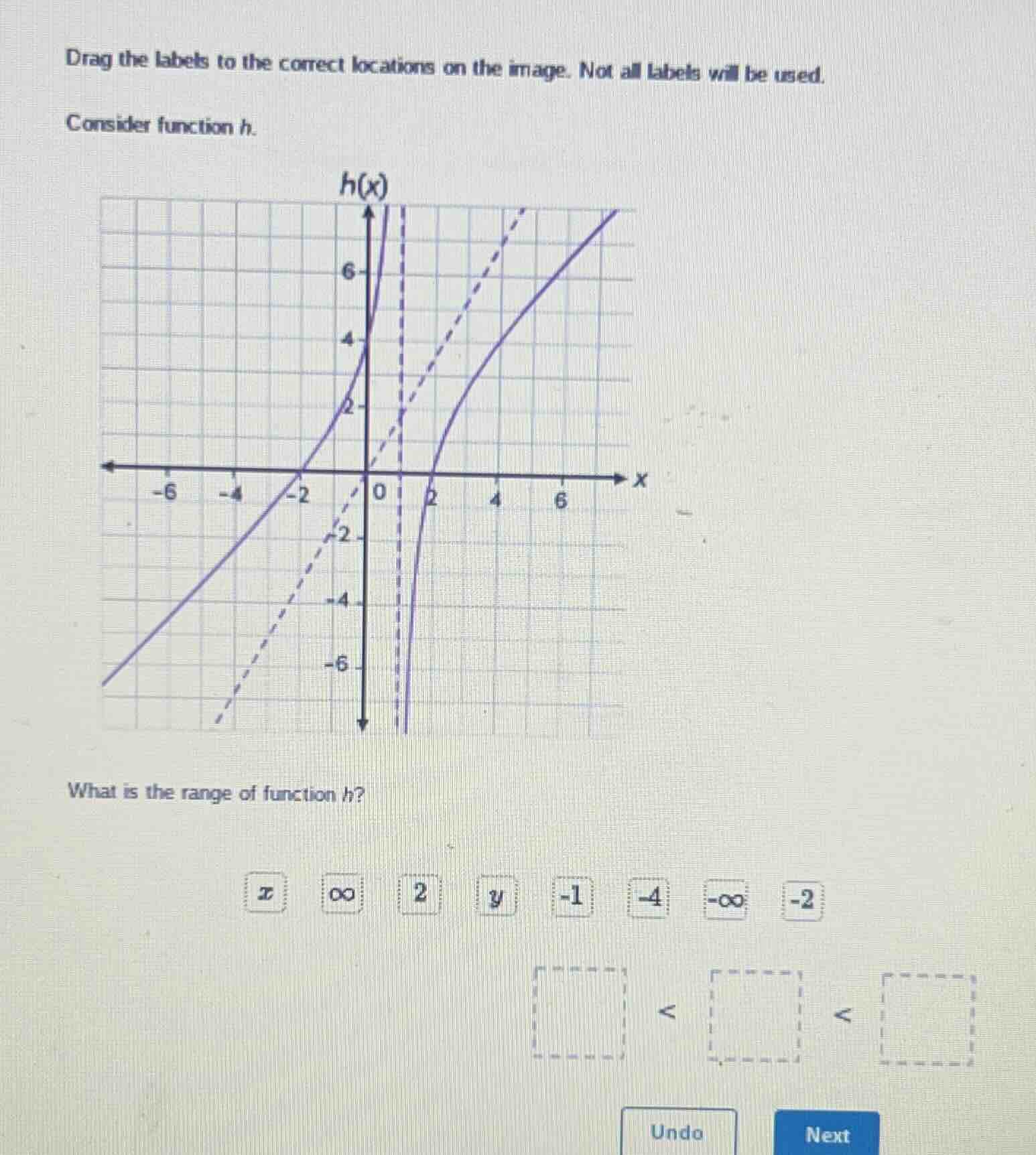
drag the labels to the correct locations on the image. not all labels will be used. consider function h. what is the range of function h? x ∞ 2 y -1 -4 -∞ -2
Step1: Identify the function's range
The graph of function $h(x)$ has a dashed oblique (slant) asymptote, which is the line $y=x-1$. The curves of $h(x)$ approach this line but never cross it, and the function takes all real values except those equal to the asymptote's output? No, observing the graph: the two branches of the hyperbola-like function are always above and below the line $y=x-1$, but actually, the range is all real numbers except the value that the asymptote excludes? Wait, no—looking at the graph, the dashed line is $y=x-1$, and the function $h(x)$ never equals $y=x-1$, but the range is all real numbers except... no, wait, the open intervals: the left branch goes from $-\infty$ to the asymptote, the right branch goes from the asymptote to $+\infty$. Wait, no, the asymptote is a slant line, so the range is all real numbers except... no, no, the slant asymptote means the function approaches $y=x-1$ but never reaches it, but the range is all real numbers? No, no, looking at the graph: the function has two parts, one on the left of $x=1$ (the vertical asymptote $x=1$) and one on the right. The left part goes from $-\infty$ to $+\infty$? No, no, the left part crosses the y-axis at (0,4), crosses x-axis at (-2,0), goes down to $-\infty$ as $x\to-\infty$, and up to $+\infty$ as $x\to1^-$. The right part goes from $-\infty$ as $x\to1^+$, crosses x-axis at (2,0), and goes up to $+\infty$ as $x\to+\infty$. But the dashed line is $y=x-1$, which the function approaches but never touches. Wait, no, the range is all real numbers except... no, no, the function takes every real value except the values on the asymptote? No, that's not right. Wait, the question gives labels: $-\infty$, $y$, $\infty$. Wait, no, the blanks are $\square < \square < \square$? No, no, the range is all real numbers, but the dashed line is $y=x-1$, so the function never equals $y=x-1$? No, no, looking at the graph, the left branch is above $y=x-1$ when $x<1$, and the right branch is below $y=x-1$ when $x>1$? No, at $x=0$, $h(0)=4$, $y=x-1=-1$, so 4 > -1. At $x=2$, $h(2)=0$, $y=2-1=1$, so 0 < 1. So the function never equals $y=x-1$, but the range is all real numbers except... no, no, the function can take any real number except the values on the asymptote? No, that's not possible. Wait, no, the range of a rational function with a slant asymptote is all real numbers except the value that the asymptote's y can't take? No, the slant asymptote is a line, so it covers all real y-values. Wait, no, I'm wrong. Let's re-examine: the graph shows that the function has two branches, and the dashed line is the slant asymptote. The range is all real numbers, but the question's blanks are $\square < \square < \square$? No, no, the labels are $-\infty$, $y$, $\infty$. Wait, the range is all real numbers, so $-\infty < y < \infty$.
Step2: Match to given labels
The available labels are $-\infty$, $y$, $\infty$, which fit the blanks.

Snap & solve any problem in the app
Get step-by-step solutions on Sovi AI
Photo-based solutions with guided steps
Explore more problems and detailed explanations
$-\infty < y < \infty$ (filling the blanks with $-\infty$, $y$, $\infty$ in order)