QUESTION IMAGE
Question
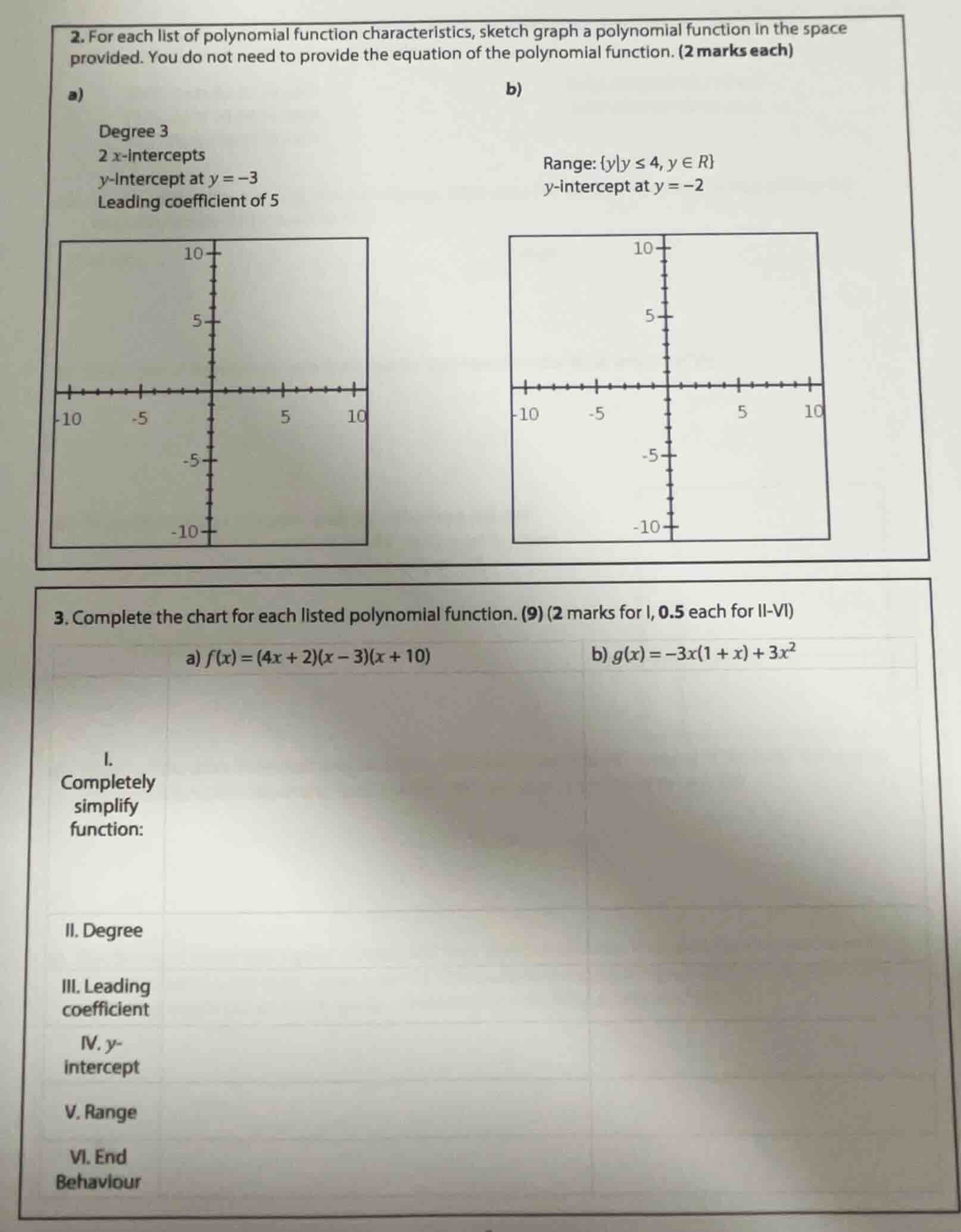
- for each list of polynomial function characteristics, sketch graph a polynomial function in the space provided. you do not need to provide the equation of the polynomial function. (2 marks each)
a)
degree 3
2 x-intercepts
y-intercept at y = -3
leading coefficient of 5
b)
range: {y|y ≤ 4, y ∈ r}
y-intercept at y = -2
- complete the chart for each listed polynomial function. (9) (2 marks for i, 0.5 each for ii-vi)
a) f(x) = (4x + 2)(x - 3)(x + 10) b) g(x) = -3x(1 + x) + 3x²
i. completely simplify function:
ii. degree
iii. leading coefficient
iv. y-intercept
v. range
vi. end behaviour
Part 2a) Sketching the Polynomial
Step1: Analyze End Behavior
A degree 3 polynomial with leading coefficient \( 5 \) (positive) has end behavior: as \( x \to \infty \), \( f(x) \to \infty \); as \( x \to -\infty \), \( f(x) \to -\infty \).
Step2: Plot Intercepts
- \( y \)-intercept: \( y = -3 \), so plot \( (0, -3) \).
- \( x \)-intercepts: 2 (one is a repeated root, since degree 3 with 2 intercepts implies a double root). Let’s assume roots (e.g., \( x = a \) (double), \( x = b \)). The graph touches at \( x = a \) and crosses at \( x = b \).
Step3: Sketch the Graph
Start from bottom left (since \( x \to -\infty \), \( f(x) \to -\infty \)), rise to touch the \( x \)-axis at the double root, cross at the other root, pass through \( (0, -3) \), and go to top right (as \( x \to \infty \), \( f(x) \to \infty \)).
Part 2b) Sketching the Polynomial
Step1: Analyze Range and End Behavior
Range \( y \leq 4 \) implies the parabola (since range is bounded above, degree 2) opens downward.
Step2: Plot Intercept
- \( y \)-intercept: \( y = -2 \), so plot \( (0, -2) \).
Step3: Sketch the Graph
Vertex at maximum \( y = 4 \) (since range is \( y \leq 4 \)), parabola opens downward, passing through \( (0, -2) \), symmetric about vertical line through vertex.
Part 3a) Analyzing \( f(x) = (4x + 2)(x - 3)(x + 10) \)
Step1: Simplify Function
First, expand the factors:
- Multiply \( (4x + 2)(x - 3) = 4x^2 - 12x + 2x - 6 = 4x^2 - 10x - 6 \).
- Then multiply by \( (x + 10) \):
\( (4x^2 - 10x - 6)(x + 10) = 4x^3 + 40x^2 - 10x^2 - 100x - 6x - 60 = 4x^3 + 30x^2 - 106x - 60 \).
Step2: Degree
The highest power of \( x \) is 3, so degree is 3.
Step3: Leading Coefficient
The coefficient of \( x^3 \) is 4, so leading coefficient is 4.
Step4: \( y \)-intercept
Set \( x = 0 \): \( f(0) = (0 + 2)(0 - 3)(0 + 10) = (2)(-3)(10) = -60 \), so \( y \)-intercept is \( -60 \).
Step5: Range
For a cubic function, range is \( \mathbb{R} \) (all real numbers), since it extends from \( -\infty \) to \( \infty \).
Step6: End Behavior
Leading term \( 4x^3 \), so as \( x \to \infty \), \( f(x) \to \infty \); as \( x \to -\infty \), \( f(x) \to -\infty \).
Part 3b) Analyzing \( g(x) = -3x(1 + x) + 3x^2 \)

Snap & solve any problem in the app
Get step-by-step solutions on Sovi AI
Photo-based solutions with guided steps
Explore more problems and detailed explanations
s:
2a) Sketch:
(Graph with end behavior down-left, up-right, passing through \( (0, -3) \), touching/crossing \( x \)-axis at 2 points.)
2b) Sketch:
(Downward-opening parabola, vertex at \( y = 4 \), passing through \( (0, -2) \).)
3a)
I. Simplified: \( 4x^3 + 30x^2 - 106x - 60 \)
II. Degree: \( 3 \)
III. Leading Coefficient: \( 4 \)
IV. \( y \)-intercept: \( -60 \)
V. Range: \( \mathbb{R} \)
VI. End Behavior: \( x \to \infty, f(x) \to \infty \); \( x \to -\infty, f(x) \to -\infty \)
3b)
I. Simplified: \( -3x \)
II. Degree: \( 1 \)
III. Leading Coefficient: \( -3 \)
IV. \( y \)-intercept: \( 0 \)
V. Range: \( \mathbb{R} \)
VI. End Behavior: \( x \to \infty, g(x) \to -\infty \); \( x \to -\infty, g(x) \to \infty \)