QUESTION IMAGE
Question
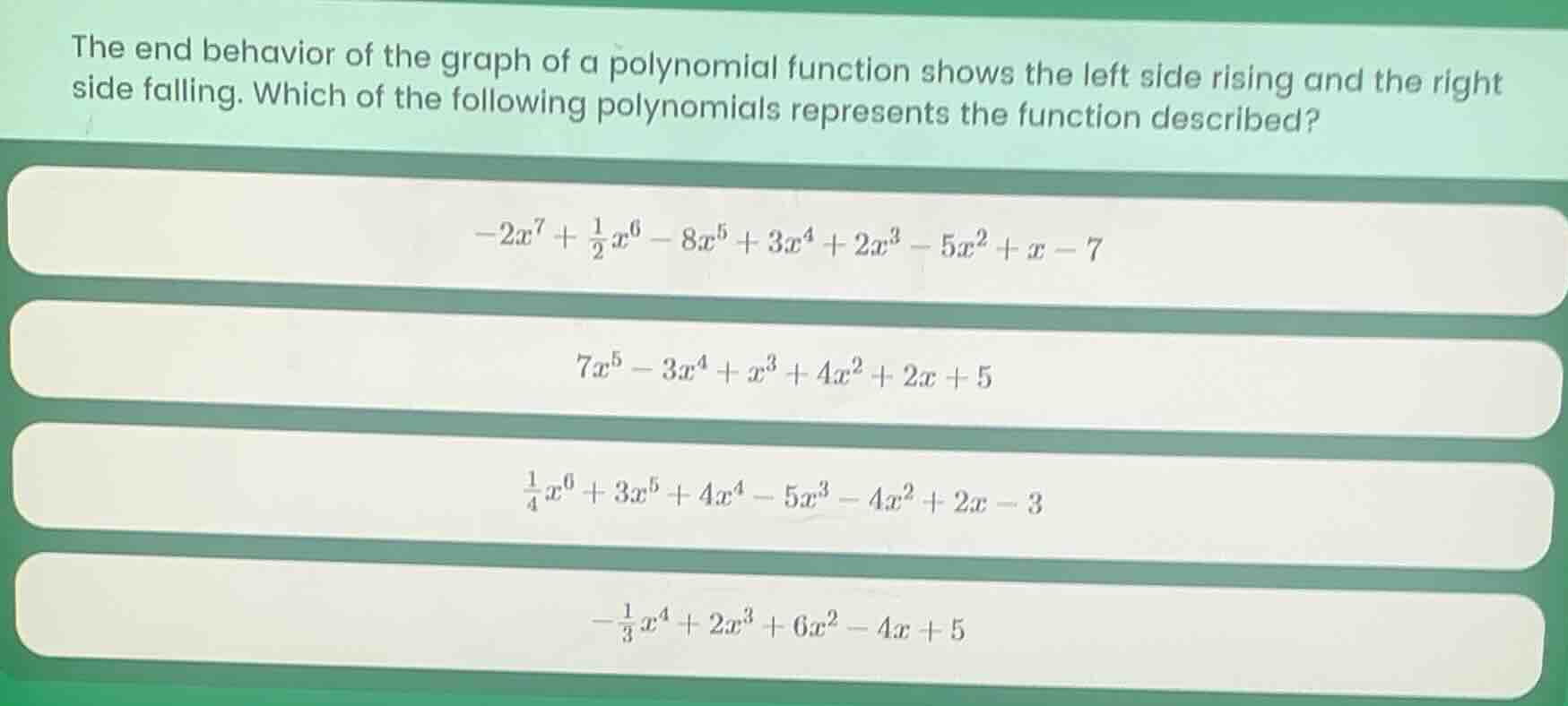
the end behavior of the graph of a polynomial function shows the left side rising and the right side falling. which of the following polynomials represents the function described? $-2x^{7}+\frac{1}{2}x^{6}-8x^{5}+3x^{4}+2x^{3}-5x^{2}+x - 7$ $7x^{5}-3x^{4}+x^{3}+4x^{2}+2x + 5$ $\frac{1}{4}x^{6}+3x^{5}+4x^{4}-5x^{3}-4x^{2}+2x - 3$ $-\frac{1}{3}x^{4}+2x^{3}+6x^{2}-4x + 5$
Step1: Recall End Behavior Rules
For a polynomial \( f(x) = a_nx^n + a_{n - 1}x^{n - 1}+\dots+a_1x + a_0 \), the end - behavior is determined by the leading term \( a_nx^n \) (the term with the highest power of \( x \)):
- If \( n \) is odd:
- If \( a_n>0 \), as \( x
ightarrow+\infty \), \( f(x)
ightarrow+\infty \) (right side rises) and as \( x
ightarrow-\infty \), \( f(x)
ightarrow-\infty \) (left side falls).
- If \( a_n < 0 \), as \( x
ightarrow+\infty \), \( f(x)
ightarrow-\infty \) (right side falls) and as \( x
ightarrow-\infty \), \( f(x)
ightarrow+\infty \) (left side rises).
- If \( n \) is even:
- If \( a_n>0 \), as \( x
ightarrow+\infty \) and \( x
ightarrow-\infty \), \( f(x)
ightarrow+\infty \) (both sides rise).
- If \( a_n < 0 \), as \( x
ightarrow+\infty \) and \( x
ightarrow-\infty \), \( f(x)
ightarrow-\infty \) (both sides fall).
We need a polynomial where the left - hand side (as \( x
ightarrow-\infty \)) rises and the right - hand side (as \( x
ightarrow+\infty \)) falls. This means the degree \( n \) of the polynomial must be odd and the leading coefficient \( a_n \) must be negative.
Step2: Analyze each polynomial
- First polynomial: \( - 2x^{7}+\frac{1}{2}x^{6}-8x^{5}+3x^{4}+2x^{3}-5x^{2}+x - 7 \)
- The leading term is \( - 2x^{7} \). The degree \( n = 7 \) (which is odd) and the leading coefficient \( a_n=-2<0 \).
- Second polynomial: \( 7x^{5}-3x^{4}+x^{3}+4x^{2}+2x + 5 \)
- The leading term is \( 7x^{5} \). The degree \( n = 5 \) (odd) but the leading coefficient \( a_n = 7>0 \). For this polynomial, as \( x
ightarrow+\infty \), \( f(x)
ightarrow+\infty \) (right side rises) and as \( x
ightarrow-\infty \), \( f(x)
ightarrow-\infty \) (left side falls), which does not match the required end - behavior.
- Third polynomial: \( \frac{1}{4}x^{6}+3x^{5}+4x^{4}-5x^{3}-4x^{2}+2x - 3 \)
- The leading term is \( \frac{1}{4}x^{6} \). The degree \( n = 6 \) (even). For a polynomial with even degree, the end - behavior of both sides is the same (both rise if \( a_n>0 \), both fall if \( a_n < 0 \)). Here \( a_n=\frac{1}{4}>0 \), so both sides rise, which does not match the required end - behavior.
- Fourth polynomial: \(-\frac{1}{3}x^{4}+2x^{3}+6x^{2}-4x + 5\)
- The leading term is \(-\frac{1}{3}x^{4} \). The degree \( n = 4 \) (even). For a polynomial with even degree, the end - behavior of both sides is the same. Here \( a_n=-\frac{1}{3}<0 \), so both sides fall, which does not match the required end - behavior.

Snap & solve any problem in the app
Get step-by-step solutions on Sovi AI
Photo-based solutions with guided steps
Explore more problems and detailed explanations
\( -2x^{7}+\frac{1}{2}x^{6}-8x^{5}+3x^{4}+2x^{3}-5x^{2}+x - 7 \)