QUESTION IMAGE
Question
eq: what is a parent function? how do we apply transformations to parent functions?
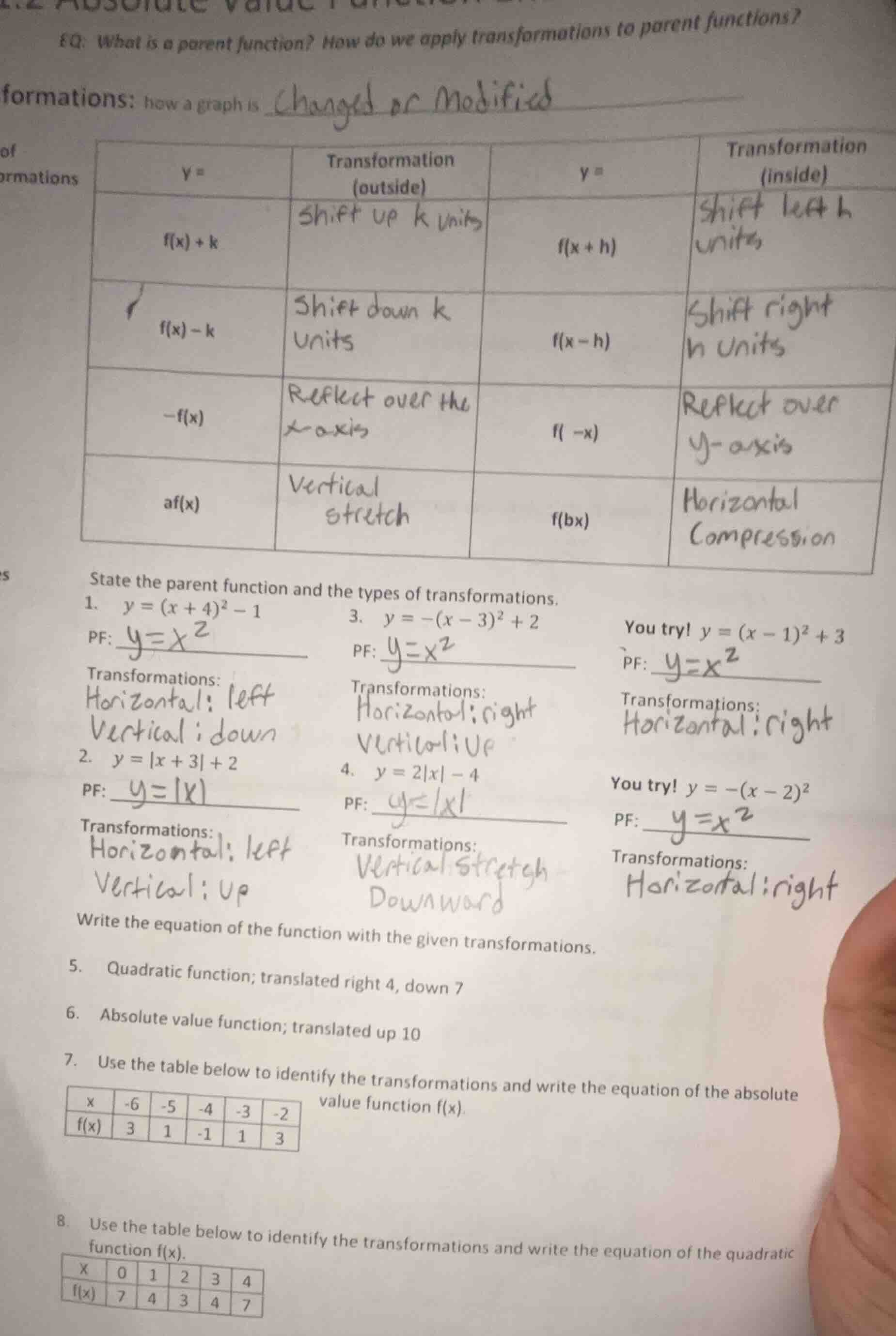
formations: how a graph is
| y = | transformation (outside) | y = | transformation (inside) |
|---|---|---|---|
| f(x) - k | shift down k units | f(x - h) | shift right h units |
| -f(x) | reflect over the x - axis | f(-x) | reflect over the y - axis |
| af(x) | vertical stretch | f(bx) | horizontal compression |
state the parent function and the types of transformations.
- $y=(x + 4)^2-1$
pf:
transformations:
- $y=-(x - 3)^2+2$
pf:
transformations:
you try! $y=(x - 1)^2+3$
pf:
transformations:
- $y=|x + 3|+2$
pf:
transformations:
- $y = 2|x|-4$
pf:
transformations:
you try! $y=-(x - 2)^2$
pf:
transformations:
write the equation of the function with the given transformations.
- quadratic function; translated right 4, down 7
- absolute value function; translated up 10
- use the table below to identify the transformations and write the equation of the absolute value function $f(x)$.
| x | -6 | -5 | -4 | -3 | -2 |
| f(x) | 3 | 1 | -1 | 1 | 3 |
- use the table below to identify the transformations and write the equation of the quadratic function $f(x)$.
| x | 0 | 1 | 2 | 3 | 4 |
| f(x) | 7 | 4 | 3 | 4 | 7 |
Let's solve these problems one by one. We'll start with the "State the parent function and the types of transformations" section, then move to "Write the equation of the function with the given transformations", and finally the table - based problems.
1. \(y=(x + 4)^{2}-1\)
Step 1: Identify the parent function
The parent function for a quadratic function (since it's a square of a linear term) is \(y = x^{2}\).
Step 2: Analyze the transformations
- For the horizontal transformation: In the form \(f(x+h)\), here \(h = 4\) (because \(x+4=x-(- 4)\)). So, it's a horizontal shift. Since \(h>0\), the graph shifts left by 4 units.
- For the vertical transformation: In the form \(f(x)+k\), here \(k=-1\). So, it's a vertical shift. Since \(k < 0\), the graph shifts down by 1 unit.
2. \(y=\vert x + 3\vert+2\)
Step 1: Identify the parent function
The parent function for an absolute - value function is \(y=\vert x\vert\).
Step 2: Analyze the transformations
- For the horizontal transformation: In the form \(f(x + h)\), here \(h = 3\) (because \(x + 3=x-(-3)\)). So, it's a horizontal shift. Since \(h>0\), the graph shifts left by 3 units.
- For the vertical transformation: In the form \(f(x)+k\), here \(k = 2\). So, it's a vertical shift. Since \(k>0\), the graph shifts up by 2 units.
3. \(y=-(x - 3)^{2}+2\)
Step 1: Identify the parent function
The parent function is \(y=x^{2}\) (quadratic function).
Step 2: Analyze the transformations
- For the horizontal transformation: In the form \(f(x - h)\), here \(h = 3\). So, it's a horizontal shift. Since \(h>0\), the graph shifts right by 3 units.
- For the vertical transformation: In the form \(f(x)+k\), here \(k = 2\). So, it's a vertical shift. Since \(k>0\), the graph shifts up by 2 units.
- For the reflection: The negative sign in front of the function \(-f(x)\) indicates a reflection over the \(x\) - axis.
4. \(y = 2\vert x\vert-4\)
Step 1: Identify the parent function
The parent function is \(y=\vert x\vert\) (absolute - value function).
Step 2: Analyze the transformations
- For the vertical stretch/compression: In the form \(af(x)\), here \(a = 2>1\). So, it's a vertical stretch by a factor of 2.
- For the vertical transformation: In the form \(f(x)+k\), here \(k=-4\). So, it's a vertical shift. Since \(k < 0\), the graph shifts down by 4 units.
"You try!" problems
1. \(y=(x - 1)^{2}+3\)
- Parent function: \(y=x^{2}\) (quadratic function).
- Transformations:
- Horizontal: In the form \(f(x - h)\), \(h = 1\). So, shift right by 1 unit.
- Vertical: In the form \(f(x)+k\), \(k = 3\). So, shift up by 3 units.
2. \(y=-(x - 2)^{2}\)
- Parent function: \(y=x^{2}\) (quadratic function).
- Transformations:
- Horizontal: In the form \(f(x - h)\), \(h = 2\). So, shift right by 2 units.
- Reflection: The negative sign in front of the function \(-f(x)\) indicates a reflection over the \(x\) - axis.
- Vertical: In the form \(f(x)+k\), \(k = 0\) (no vertical shift other than the reflection and horizontal shift).
Write the equation of the function with the given transformations
5. Quadratic function; translated right 4, down 7
The parent function of a quadratic function is \(y=x^{2}\).
- A horizontal translation right by 4 units: Replace \(x\) with \(x - 4\), so we get \(y=(x - 4)^{2}\).
- A vertical translation down by 7 units: Subtract 7 from the function, so \(y=(x - 4)^{2}-7\).
6. Absolute value function; translated up 10
The parent function of an absolute - value function is \(y=…

Snap & solve any problem in the app
Get step-by-step solutions on Sovi AI
Photo-based solutions with guided steps
Explore more problems and detailed explanations
Let's solve these problems one by one. We'll start with the "State the parent function and the types of transformations" section, then move to "Write the equation of the function with the given transformations", and finally the table - based problems.
1. \(y=(x + 4)^{2}-1\)
Step 1: Identify the parent function
The parent function for a quadratic function (since it's a square of a linear term) is \(y = x^{2}\).
Step 2: Analyze the transformations
- For the horizontal transformation: In the form \(f(x+h)\), here \(h = 4\) (because \(x+4=x-(- 4)\)). So, it's a horizontal shift. Since \(h>0\), the graph shifts left by 4 units.
- For the vertical transformation: In the form \(f(x)+k\), here \(k=-1\). So, it's a vertical shift. Since \(k < 0\), the graph shifts down by 1 unit.
2. \(y=\vert x + 3\vert+2\)
Step 1: Identify the parent function
The parent function for an absolute - value function is \(y=\vert x\vert\).
Step 2: Analyze the transformations
- For the horizontal transformation: In the form \(f(x + h)\), here \(h = 3\) (because \(x + 3=x-(-3)\)). So, it's a horizontal shift. Since \(h>0\), the graph shifts left by 3 units.
- For the vertical transformation: In the form \(f(x)+k\), here \(k = 2\). So, it's a vertical shift. Since \(k>0\), the graph shifts up by 2 units.
3. \(y=-(x - 3)^{2}+2\)
Step 1: Identify the parent function
The parent function is \(y=x^{2}\) (quadratic function).
Step 2: Analyze the transformations
- For the horizontal transformation: In the form \(f(x - h)\), here \(h = 3\). So, it's a horizontal shift. Since \(h>0\), the graph shifts right by 3 units.
- For the vertical transformation: In the form \(f(x)+k\), here \(k = 2\). So, it's a vertical shift. Since \(k>0\), the graph shifts up by 2 units.
- For the reflection: The negative sign in front of the function \(-f(x)\) indicates a reflection over the \(x\) - axis.
4. \(y = 2\vert x\vert-4\)
Step 1: Identify the parent function
The parent function is \(y=\vert x\vert\) (absolute - value function).
Step 2: Analyze the transformations
- For the vertical stretch/compression: In the form \(af(x)\), here \(a = 2>1\). So, it's a vertical stretch by a factor of 2.
- For the vertical transformation: In the form \(f(x)+k\), here \(k=-4\). So, it's a vertical shift. Since \(k < 0\), the graph shifts down by 4 units.
"You try!" problems
1. \(y=(x - 1)^{2}+3\)
- Parent function: \(y=x^{2}\) (quadratic function).
- Transformations:
- Horizontal: In the form \(f(x - h)\), \(h = 1\). So, shift right by 1 unit.
- Vertical: In the form \(f(x)+k\), \(k = 3\). So, shift up by 3 units.
2. \(y=-(x - 2)^{2}\)
- Parent function: \(y=x^{2}\) (quadratic function).
- Transformations:
- Horizontal: In the form \(f(x - h)\), \(h = 2\). So, shift right by 2 units.
- Reflection: The negative sign in front of the function \(-f(x)\) indicates a reflection over the \(x\) - axis.
- Vertical: In the form \(f(x)+k\), \(k = 0\) (no vertical shift other than the reflection and horizontal shift).
Write the equation of the function with the given transformations
5. Quadratic function; translated right 4, down 7
The parent function of a quadratic function is \(y=x^{2}\).
- A horizontal translation right by 4 units: Replace \(x\) with \(x - 4\), so we get \(y=(x - 4)^{2}\).
- A vertical translation down by 7 units: Subtract 7 from the function, so \(y=(x - 4)^{2}-7\).
6. Absolute value function; translated up 10
The parent function of an absolute - value function is \(y=\vert x\vert\).
- A vertical translation up by 10 units: Add 10 to the function, so \(y=\vert x\vert+10\).
Table - based problems
7. Absolute value function \(f(x)\) with table:
| \(x\) | \(-6\) | \(-5\) | \(-4\) | \(-3\) | \(-2\) |
|---|
The parent function of an absolute - value function is \(y = \vert x\vert\). Let's find the vertex of the absolute - value function. The vertex of \(y=\vert x\vert\) is at \((0,0)\). For our table, the vertex (the minimum or maximum point) is at \(x=-4\), \(f(x)=-1\).
- Horizontal shift: The vertex of \(y = \vert x\vert\) is at \(x = 0\), and here it's at \(x=-4\). So, the graph is shifted left by 4 units. So, we replace \(x\) with \(x + 4\) in the parent function.
- Vertical shift: The vertex of \(y=\vert x\vert\) is at \(y = 0\), and here it's at \(y=-1\). So, the graph is shifted down by 1 unit. So, we subtract 1 from the function.
The equation of the absolute - value function is \(f(x)=\vert x + 4\vert-1\). We can check:
- When \(x=-6\): \(f(-6)=\vert-6 + 4\vert-1=\vert-2\vert-1=2 - 1 = 1\)? Wait, no, our table says \(f(-6) = 3\). Wait, maybe we made a mistake. Let's re - evaluate.
The symmetry of the absolute - value function: For \(y=\vert x - h\vert+k\), the graph is symmetric about \(x = h\). Looking at the table, the values of \(f(x)\) are symmetric about \(x=-4\) (since \(f(-6)=f(-2) = 3\) and \(f(-5)=f(-3)=1\)). So, the vertex is at \((-4,-1)\).
The general form of the absolute - value function is \(y=a\vert x - h\vert+k\). Since it's an absolute - value function, \(a = 1\) (because the slope of the lines on either side of the vertex is \(\pm1\)). So, \(h=-4\) and \(k=-1\). So, \(y=\vert x+4\vert-1\). When \(x=-6\): \(\vert-6 + 4\vert-1=\vert-2\vert-1 = 1\), but the table says \(f(-6)=3\). So, \(a = 2\)? Let's check: \(y = 2\vert x+4\vert-1\). When \(x=-6\): \(2\vert-6 + 4\vert-1=2\times2-1 = 3\) (matches). When \(x=-5\): \(2\vert-5 + 4\vert-1=2\times1-1 = 1\) (matches). When \(x=-4\): \(2\vert-4 + 4\vert-1=0 - 1=-1\) (matches). When \(x=-3\): \(2\vert-3 + 4\vert-1=2\times1-1 = 1\) (matches). When \(x=-2\): \(2\vert-2 + 4\vert-1=2\times2-1 = 3\) (matches). So, the correct equation is \(f(x)=2\vert x + 4\vert-1\).
8. Quadratic function \(f(x)\) with table:
| \(x\) | \(0\) | \(1\) | \(2\) | \(3\) | \(4\) |
|---|
The parent function of a quadratic function is \(y=x^{2}\), which is symmetric about \(x = 0\). The given table is symmetric about \(x = 2\) (since \(f(0)=f(4) = 7\) and \(f(1)=f(3)=4\)).
- Horizontal shift: The vertex of \(y=x^{2}\) is at \(x = 0\), and here the vertex (minimum point) is at \(x = 2\), \(f(x)=3\). So, the graph is shifted right by 2 units. So, we replace \(x\) with \(x - 2\) in the parent function.
- Vertical shift: The vertex of \(y=x^{2}\) is at \(y = 0\), and here it's at \(y = 3\). So, the graph is shifted up by 3 units.
- Check the vertical stretch/compression: Let's assume the equation is \(y=a(x - 2)^{2}+3\). When \(x = 0\), \(y=a(0 - 2)^{2}+3=4a+3\). From the table, \(y = 7\) when \(x = 0\). So, \(4a+3=7\), \(4a=4\), \(a = 1\).
So, the equation of the quadratic function is \(f(x)=(x - 2)^{2}+3=x^{2}-4x + 4 + 3=x^{2}-4x+7\). We can check:
- When \(x = 1\): \(f(1)=(1 - 2)^{2}+3=(-1)^{2}+3=1 + 3 = 4\) (matches the table).
- When \(x = 2\): \(f(2)=(2 - 2)^{2}+3=0 + 3 = 3\) (matches the table).
- When \(x = 3\): \(f(3)=(3 - 2)^{2}+3=1 + 3 = 4\) (matches the table).
- When \(x = 4\): \(f(4)=(4 - 2)^{2}+3=4 + 3 = 7\) (matches the table).
Final Answers
1. \(y=(x + 4)^{2}-1\)
- Parent function: \(y = x^{2}\)
- Transformations: Horizontal shift left 4 units, vertical shift down 1 unit.
2. \(y=\vert x + 3\vert+2\)
- Parent function: \(y=\vert x\vert\)
- Transformations: Horizontal shift left 3 units, vertical shift up 2 units.
3. \(y=-(x - 3)^{2}+2\)
- Parent function: \(y=x^{2}\)
- Transformations: Horizontal shift right 3 units, vertical shift up 2 units, reflection over \(x\) - axis.
4. \(y = 2\vert x\vert-4\)
- Parent function: \(y=\vert x\vert\)
- Transformations: Vertical stretch by factor 2, vertical shift down 4 units.
"You try!" 1. \(y=(x - 1)^{2}+3\)
- Parent function: \(y=x^{2}\)
- Transformations: Horizontal shift right 1 unit, vertical shift up 3 units.
"You try!" 2. \(y=-(x - 2)^{2}\)
- Parent function: \(y=x^{2}\)
- Transformations: Horizontal shift right 2 units, reflection over \(x\) - axis.
5. Quadratic function; translated right 4, down 7
- Equation: \(y=(x - 4)^{2}-7=x^{2}-8x + 16-7=x^{2}-8x + 9\)
6. Absolute value function; translated up 10
- Equation: \(y=\vert x\vert+10\)
7. Absolute value function from table
- Equation: \(f(x)=2\vert x + 4\vert-1\)
8. Quadratic function from table
- Equation: \(f(x)=(x - 2)^{2}+3=x^{2}-4x + 7\)