QUESTION IMAGE
Question
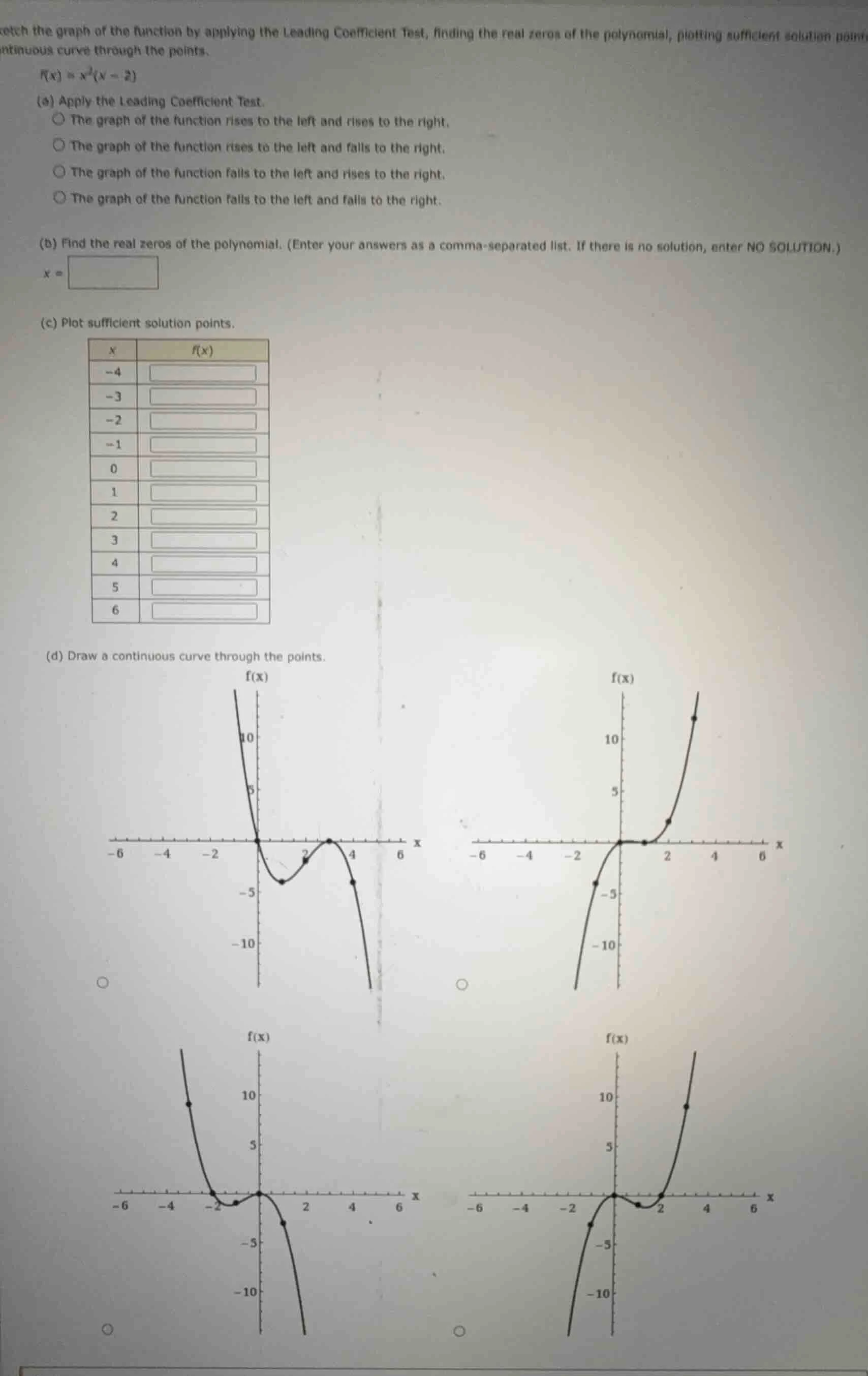
etch the graph of the function by applying the leading coefficient test, finding the real zeros of the polynomial, plotting sufficient solution points continuous curve through the points.\\( f(x) = x^2(x - 2) \\)\
(a) apply the leading coefficient test.\
\\( \bigcirc \\) the graph of the function rises to the left and rises to the right.\
\\( \bigcirc \\) the graph of the function rises to the left and falls to the right.\
\\( \bigcirc \\) the graph of the function falls to the left and rises to the right.\
\\( \bigcirc \\) the graph of the function falls to the left and falls to the right.\
\
(b) find the real zeros of the polynomial. (enter your answers as a comma - separated list. if there is no solution, enter no solution.)\
\\( x = \\)\
\
(c) plot sufficient solution points.\
| \\( x \\) | \\( f(x) \\) | \ |
| --- | --- | \ |
| \\( - 4 \\) | \ | |
| \\( - 3 \\) | \ | |
| \\( - 2 \\) | \ | |
| \\( - 1 \\) | \ | |
| \\( 0 \\) | \ | |
| \\( 1 \\) | \ | |
| \\( 2 \\) | \ | |
| \\( 3 \\) | \ | |
| \\( 4 \\) | \ | |
| \\( 5 \\) | \ | |
| \\( 6 \\) | \ |
\
(d) draw a continuous curve through the points.
Part (a)
Step1: Expand the function
First, expand \( f(x)=x^{2}(x - 2) \) to \( f(x)=x^{3}-2x^{2} \). The leading term is \( x^{3} \), with leading coefficient \( 1 \) (positive) and degree \( 3 \) (odd).
Step2: Apply Leading Coefficient Test
For a polynomial \( a_nx^n+\dots+a_0 \), if \( n \) is odd:
- If \( a_n>0 \), the graph falls to the left (\( x
ightarrow-\infty \)) and rises to the right (\( x
ightarrow\infty \)).
- If \( a_n<0 \), the graph rises to the left and falls to the right.
Here, \( n = 3 \) (odd), \( a_n=1>0 \), so the graph falls to the left and rises to the right.
Step1: Set \( f(x)=0 \)
To find real zeros, solve \( x^{2}(x - 2)=0 \).
Step2: Solve the equation
Using the zero - product property: if \( ab = 0 \), then \( a = 0 \) or \( b = 0 \).
For \( x^{2}(x - 2)=0 \), we have \( x^{2}=0 \) or \( x - 2=0 \).
- From \( x^{2}=0 \), we get \( x = 0 \) (with multiplicity 2).
- From \( x - 2=0 \), we get \( x = 2 \).
Step1: Substitute \( x \) values into \( f(x)=x^{2}(x - 2) \)
- For \( x=-4 \): \( f(-4)=(-4)^{2}\times(-4 - 2)=16\times(-6)=-96 \)
- For \( x=-3 \): \( f(-3)=(-3)^{2}\times(-3 - 2)=9\times(-5)=-45 \)
- For \( x=-2 \): \( f(-2)=(-2)^{2}\times(-2 - 2)=4\times(-4)=-16 \)
- For \( x=-1 \): \( f(-1)=(-1)^{2}\times(-1 - 2)=1\times(-3)=-3 \)
- For \( x = 0 \): \( f(0)=0^{2}\times(0 - 2)=0 \)
- For \( x = 1 \): \( f(1)=1^{2}\times(1 - 2)=1\times(-1)=-1 \)
- For \( x = 2 \): \( f(2)=2^{2}\times(2 - 2)=4\times0 = 0 \)
- For \( x = 3 \): \( f(3)=3^{2}\times(3 - 2)=9\times1 = 9 \)
- For \( x = 4 \): \( f(4)=4^{2}\times(4 - 2)=16\times2 = 32 \)
- For \( x = 5 \): \( f(5)=5^{2}\times(5 - 2)=25\times3 = 75 \)
- For \( x = 6 \): \( f(6)=6^{2}\times(6 - 2)=36\times4 = 144 \)
The table of values is:
| \( x \) | \( f(x) \) |
|---|---|
| \( - 3 \) | \( -45 \) |
| \( - 2 \) | \( -16 \) |
| \( - 1 \) | \( -3 \) |
| \( 0 \) | \( 0 \) |
| \( 1 \) | \( -1 \) |
| \( 2 \) | \( 0 \) |
| \( 3 \) | \( 9 \) |
| \( 4 \) | \( 32 \) |
| \( 5 \) | \( 75 \) |
| \( 6 \) | \( 144 \) |

Snap & solve any problem in the app
Get step-by-step solutions on Sovi AI
Photo-based solutions with guided steps
Explore more problems and detailed explanations
The graph of the function falls to the left and rises to the right.