QUESTION IMAGE
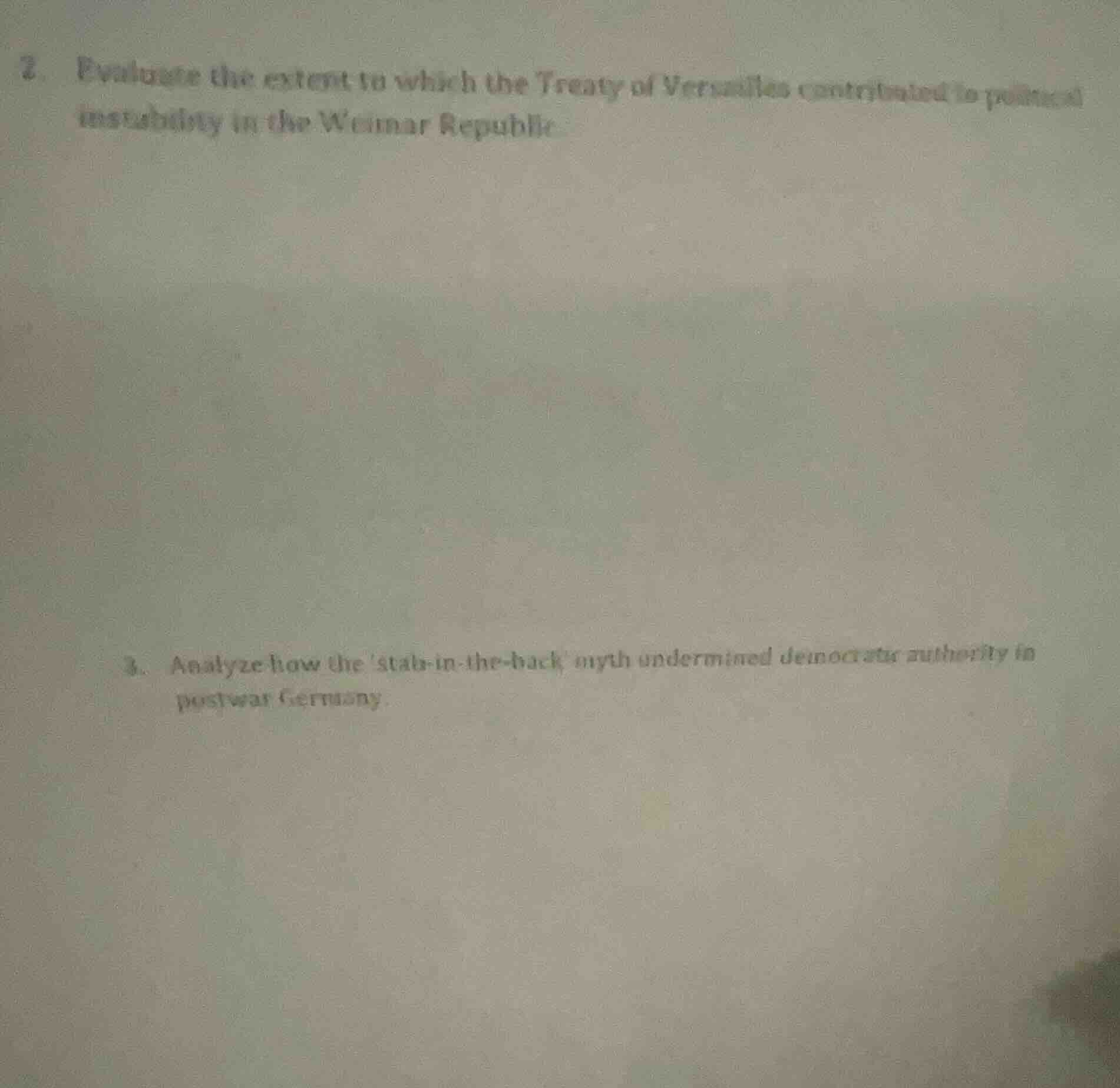
Question
- evaluate the extent to which the treaty of versailles contributed to political instability in the weimar republic
- analyze how the stab - in - the - back myth undermined democratic authority in postwar germany.
Response
Question 2:
Brief Explanations
- Treaty of Versailles Provisions: The treaty imposed heavy reparations, territorial losses, and military restrictions on Germany. These led to economic turmoil (e.g., hyperinflation) and national humiliation, weakening the Weimar Republic's legitimacy.
- Political Polarization: The harsh terms fueled extremism (e.g., Nazi and Communist movements) as they capitalized on public discontent with the treaty and the republic’s inability to resist it.
- Stab - in - the - Back Myth Link: The treaty’s "War Guilt Clause" (Article 231) was a basis for the myth, which blamed the republic’s leaders (the "November Criminals") for Germany’s defeat, undermining trust in democratic governance.
- Extent of Contribution: While the treaty was a major factor, other elements like economic crises (1923, 1929) and institutional weaknesses of the republic also played roles. But the treaty’s punitive nature was a foundational cause of instability.
Brief Explanations
- Myth Origin: The "stab - in - the - back" myth claimed Germany’s defeat in WWI was due to internal betrayal (Jews, socialists, republic leaders) rather than military failure. It gained traction after the Treaty of Versailles’ "War Guilt Clause".
- Undermining Democratic Authority:
- Legitimacy of Republic: The myth blamed the Weimar Republic’s leaders (who signed the treaty) for "betraying" Germany, eroding public trust in democratic governance.
- Political Polarization: It empowered right - wing groups (e.g., Nazis) who used the myth to attack democracy, promoting authoritarian alternatives.
- Social Division: The myth deepened societal rifts, as it targeted minority groups (like Jews) and political opponents, creating an environment hostile to democratic norms.
- Erosion of Rule of Law: It justified violence against supposed "traitors", weakening the republic’s ability to enforce laws and maintain order.

Snap & solve any problem in the app
Get step-by-step solutions on Sovi AI
Photo-based solutions with guided steps
Explore more problems and detailed explanations
The Treaty of Versailles significantly contributed to the Weimar Republic’s political instability. Its harsh terms (reparations, territorial losses, military limits) caused economic crisis, national resentment, and fueled extremism. The "War Guilt Clause" enabled the "stab - in - the - back" myth, undermining the republic’s legitimacy. While other factors (economic crashes, institutional flaws) mattered, the treaty was a core catalyst for instability.