QUESTION IMAGE
Question
evaluate the function graphically.
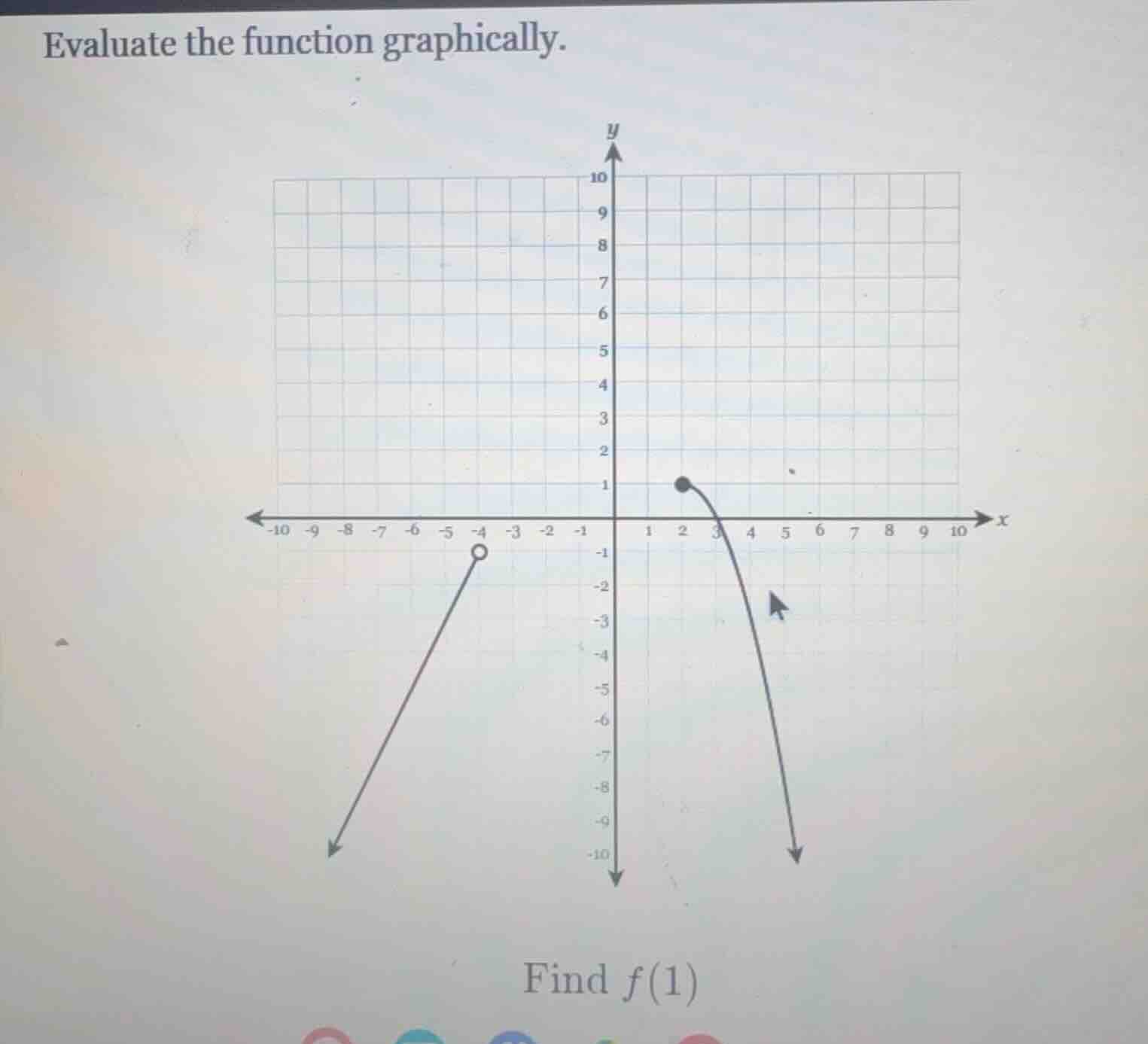
find ( f(1) )
Step1: Understand the graph
To find \( f(1) \), we look at the \( x \)-value of 1 on the graph and determine the corresponding \( y \)-value.
Step2: Locate \( x = 1 \)
On the graph, we check the points around \( x = 1 \). The graph has a point at \( x = 2 \) with \( y = 1 \), but we need \( x = 1 \). Wait, actually, we need to see the behavior. Wait, maybe I misread. Wait, the graph: let's check the domain. Wait, the left part has an open circle at \( x = -4 \), and the right part starts at \( x = 2 \) (closed circle) and goes down. Wait, maybe there's a mistake. Wait, no, maybe the function's domain: the right curve starts at \( x = 2 \) (closed dot at \( (2,1) \)) and goes to the right. Wait, but we need \( f(1) \). Wait, maybe the left part? Wait, no, the left part is a line with an open circle at \( x = -4 \), going to the left. Wait, maybe the function is defined at \( x = 1 \) by the right part? No, the right part starts at \( x = 2 \). Wait, maybe I made a mistake. Wait, no, let's re-examine. Wait, the graph: the right curve has a closed dot at \( (2,1) \), so at \( x = 2 \), \( y = 1 \). But we need \( x = 1 \). Wait, maybe the function is not defined at \( x = 1 \)? No, that can't be. Wait, maybe the left line: wait, the left line has an open circle at \( x = -4 \), and it's a line going down to the left. Wait, no, the left line is going up to the open circle at \( x = -4 \), \( y = -1 \)? Wait, no, the open circle is at \( (-4, -1) \)? Wait, no, the coordinates: the open circle is at \( x = -4 \), \( y = -1 \)? Wait, no, the grid: each square is 1 unit. So the open circle is at \( (-4, -1) \)? Wait, no, the \( y \)-axis: the open circle is at \( x = -4 \), \( y = -1 \)? Wait, no, the left line: from the open circle at \( (-4, -1) \), it goes down to the left? No, it goes up to the left? Wait, no, the arrow is pointing down to the left. Wait, maybe I'm misinterpreting. Wait, the right curve: starts at \( (2,1) \) (closed dot) and goes down, crossing the \( x \)-axis at \( x = 3 \). So at \( x = 2 \), \( y = 1 \). But we need \( x = 1 \). Wait, maybe the function is not defined at \( x = 1 \)? But the problem says "Find \( f(1) \)". Wait, maybe the left line: wait, no, the left line is for \( x < -4 \)? No, the open circle is at \( x = -4 \), so the left line is defined for \( x < -4 \), and the right curve is defined for \( x \geq 2 \)? But then \( x = 1 \) is not in either domain? That can't be. Wait, maybe the graph is misdrawn, or I'm misreading. Wait, no, maybe the closed dot is at \( (2,1) \), so the function at \( x = 2 \) is 1, but at \( x = 1 \), maybe it's the same as \( x = 2 \)? No, that doesn't make sense. Wait, maybe the left line: wait, no, the left line is a line with an open circle at \( (-4, -1) \), and it's a line going to the left, so for \( x < -4 \), the function is that line. The right curve is for \( x \geq 2 \), with \( f(2) = 1 \). But \( x = 1 \) is between \( -4 \) and \( 2 \), so maybe the function is not defined there? But the problem asks for \( f(1) \), so maybe there's a mistake. Wait, no, maybe I misread the closed dot. Wait, the closed dot is at \( (2,1) \), so \( f(2) = 1 \). But \( x = 1 \): is there a point? Wait, maybe the graph has a horizontal line? No, the right curve starts at \( (2,1) \). Wait, maybe the function is defined as \( f(x) = 1 \) for \( x = 1 \)? No, that doesn't make sense. Wait, maybe the closed dot is at \( (2,1) \), so the function at \( x = 2 \) is 1, and for \( x < 2 \), maybe it's undefined? But the problem says "Find \( f(1) \)", so maybe the answer is that…

Snap & solve any problem in the app
Get step-by-step solutions on Sovi AI
Photo-based solutions with guided steps
Explore more problems and detailed explanations
\( \boxed{1} \)