QUESTION IMAGE
Question
example3
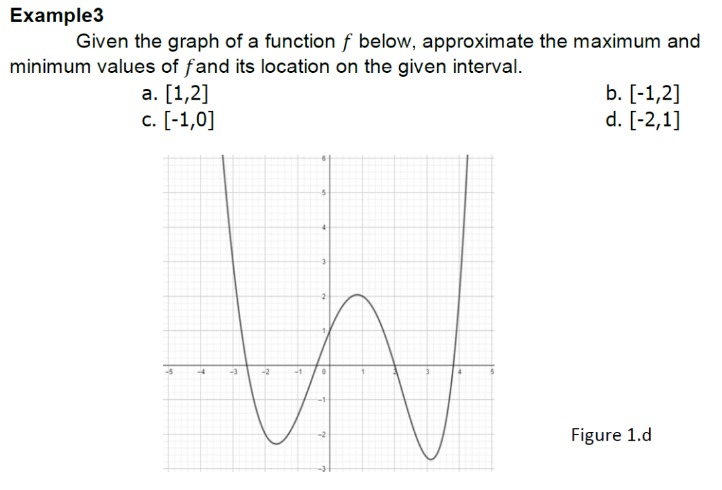
given the graph of a function ( f ) below, approximate the maximum and minimum values of ( f ) and its location on the given interval.
\ta. (1,2) \t\t\t\t\tb. (-1,2)
\tc. (-1,0) \t\t\t\t\td. (-2,1)
To solve for the maximum and minimum values of \( f \) on each interval, we analyze the graph:
Part a: Interval \([1, 2]\)
- Step 1: Analyze the graph on \([1, 2]\)
The function is decreasing on \([1, 2]\) (from \( x = 1 \) to \( x = 2 \)).
- Step 2: Find maximum and minimum
- Maximum: At \( x = 1 \), the value is \( 2 \) (from the peak near \( x = 1 \)).
- Minimum: At \( x = 2 \), the value is \( 0 \) (crosses the x - axis at \( x = 2 \)).
Part b: Interval \([-1, 2]\)
- Step 1: Identify critical points
The graph has a minimum at \( x=-1 \) (value \( - 2 \)) and a peak at \( x = 1 \) (value \( 2 \)), and ends at \( x = 2 \) (value \( 0 \)).
- Step 2: Compare values
- Maximum: At \( x = 1 \), \( f(1)=2 \) (highest point in \([-1, 2]\)).
- Minimum: At \( x=-1 \), \( f(-1)=-2 \) (lowest point in \([-1, 2]\)).
Part c: Interval \([-1, 0]\)
- Step 1: Analyze the graph on \([-1, 0]\)
The function is increasing on \([-1, 0]\) (from \( x=-1 \) to \( x = 0 \)).
- Step 2: Find maximum and minimum
- Maximum: At \( x = 0 \), the value is \( 1 \) (y - intercept).
- Minimum: At \( x=-1 \), the value is \( - 2 \) (lowest point in \([-1, 0]\)).
Part d: Interval \([-2, 1]\)
- Step 1: Identify critical points
The graph has a minimum at \( x=-2 \) (value \( - 2 \)) and a peak at \( x = 1 \) (value \( 2 \)).
- Step 2: Compare values
- Maximum: At \( x = 1 \), \( f(1)=2 \) (highest point in \([-2, 1]\)).
- Minimum: At \( x=-2 \), \( f(-2)=-2 \) (lowest point in \([-2, 1]\)).
Final Answers:
- a. \([1, 2]\):
Maximum: \( 2 \) at \( x = 1 \); Minimum: \( 0 \) at \( x = 2 \).
- b. \([-1, 2]\):
Maximum: \( 2 \) at \( x = 1 \); Minimum: \( - 2 \) at \( x=-1 \).
- c. \([-1, 0]\):
Maximum: \( 1 \) at \( x = 0 \); Minimum: \( - 2 \) at \( x=-1 \).
- d. \([-2, 1]\):
Maximum: \( 2 \) at \( x = 1 \); Minimum: \( - 2 \) at \( x=-2 \).

Snap & solve any problem in the app
Get step-by-step solutions on Sovi AI
Photo-based solutions with guided steps
Explore more problems and detailed explanations
To solve for the maximum and minimum values of \( f \) on each interval, we analyze the graph:
Part a: Interval \([1, 2]\)
- Step 1: Analyze the graph on \([1, 2]\)
The function is decreasing on \([1, 2]\) (from \( x = 1 \) to \( x = 2 \)).
- Step 2: Find maximum and minimum
- Maximum: At \( x = 1 \), the value is \( 2 \) (from the peak near \( x = 1 \)).
- Minimum: At \( x = 2 \), the value is \( 0 \) (crosses the x - axis at \( x = 2 \)).
Part b: Interval \([-1, 2]\)
- Step 1: Identify critical points
The graph has a minimum at \( x=-1 \) (value \( - 2 \)) and a peak at \( x = 1 \) (value \( 2 \)), and ends at \( x = 2 \) (value \( 0 \)).
- Step 2: Compare values
- Maximum: At \( x = 1 \), \( f(1)=2 \) (highest point in \([-1, 2]\)).
- Minimum: At \( x=-1 \), \( f(-1)=-2 \) (lowest point in \([-1, 2]\)).
Part c: Interval \([-1, 0]\)
- Step 1: Analyze the graph on \([-1, 0]\)
The function is increasing on \([-1, 0]\) (from \( x=-1 \) to \( x = 0 \)).
- Step 2: Find maximum and minimum
- Maximum: At \( x = 0 \), the value is \( 1 \) (y - intercept).
- Minimum: At \( x=-1 \), the value is \( - 2 \) (lowest point in \([-1, 0]\)).
Part d: Interval \([-2, 1]\)
- Step 1: Identify critical points
The graph has a minimum at \( x=-2 \) (value \( - 2 \)) and a peak at \( x = 1 \) (value \( 2 \)).
- Step 2: Compare values
- Maximum: At \( x = 1 \), \( f(1)=2 \) (highest point in \([-2, 1]\)).
- Minimum: At \( x=-2 \), \( f(-2)=-2 \) (lowest point in \([-2, 1]\)).
Final Answers:
- a. \([1, 2]\):
Maximum: \( 2 \) at \( x = 1 \); Minimum: \( 0 \) at \( x = 2 \).
- b. \([-1, 2]\):
Maximum: \( 2 \) at \( x = 1 \); Minimum: \( - 2 \) at \( x=-1 \).
- c. \([-1, 0]\):
Maximum: \( 1 \) at \( x = 0 \); Minimum: \( - 2 \) at \( x=-1 \).
- d. \([-2, 1]\):
Maximum: \( 2 \) at \( x = 1 \); Minimum: \( - 2 \) at \( x=-2 \).