QUESTION IMAGE
Question
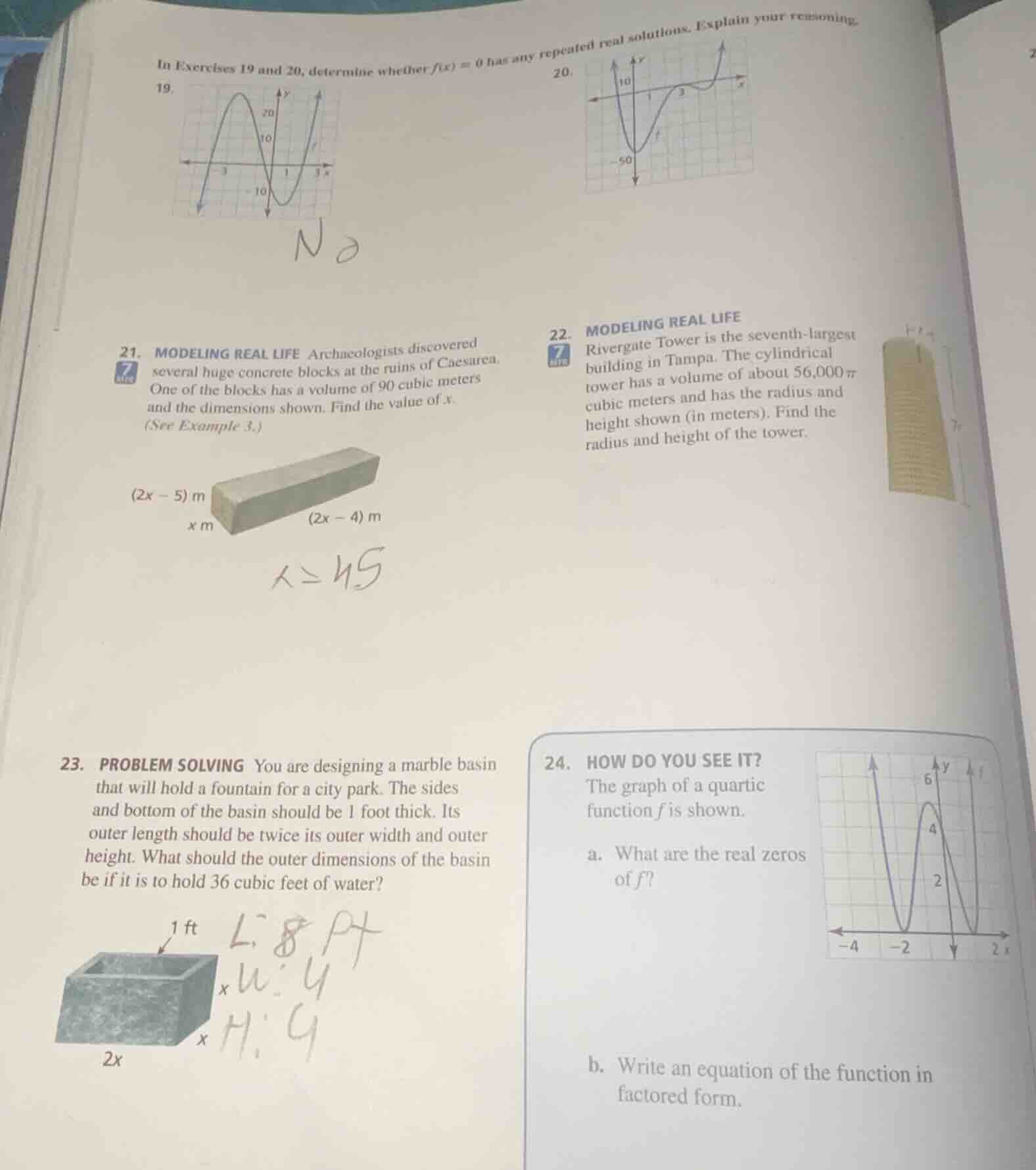
in exercises 19 and 20, determine whether ( f(x) = 0 ) has any repeated real solutions. explain your reasoning.
- graph of a function
- graph of a function
- modeling real life archaeologists discovered several huge concrete blocks at the ruins of caesarea. one of the blocks has a volume of 90 cubic meters and the dimensions shown. find the value of ( x ). (see example 3.)
diagram of a rectangular block with dimensions ( (2x - 5) ) m, ( x ) m, ( (2x - 4) ) m
- modeling real life rivergate tower is the seventh - largest building in tampa. the cylindrical tower has a volume of about ( 56,000pi ) cubic meters and has the radius and height shown (in meters). find the radius and height of the tower.
diagram of a cylinder
- problem solving you are designing a marble basin that will hold a fountain for a city park. the sides and bottom of the basin should be 1 foot thick. its outer length should be twice its outer width and outer height. what should the outer dimensions of the basin be if it is to hold 36 cubic feet of water?
diagram of a rectangular basin with 1 ft thickness, outer length ( 2x ), outer width ( x ), outer height ( x )
- how do you see it? the graph of a quartic function ( f ) is shown.
a. what are the real zeros of ( f )?
graph of a quartic function
b. write an equation of the function in factored form.
Exercise 19
Step1: Identify root behavior
A repeated real solution means the graph touches (does not cross) the x-axis at that point, i.e., a tangent intersection. The graph crosses the x-axis at all its x-intercepts, so no repeated roots.
Step1: Identify root behavior
A repeated real solution occurs where the graph touches the x-axis (tangent, does not cross). The graph touches the x-axis at $x=3$, so this is a repeated root.
Step1: Set up volume equation
Volume of a rectangular prism is $V = l \times w \times h$. Substitute $V=90$, $l=x$, $w=(2x-4)$, $h=(2x-5)$.
$$x(2x-4)(2x-5) = 90$$
Step2: Simplify the equation
First expand $(2x-4)(2x-5) = 4x^2 - 18x + 20$, then multiply by $x$:
$$4x^3 - 18x^2 + 20x - 90 = 0$$
Factor by grouping:
$$2x^2(2x-9) + 10(2x-9) = 0$$
$$(2x^2 + 10)(2x - 9) = 0$$
Step3: Solve for x
$2x^2 + 10 = 0$ has no real solutions. Solve $2x-9=0$:
$$x = \frac{9}{2} = 4.5$$

Snap & solve any problem in the app
Get step-by-step solutions on Sovi AI
Photo-based solutions with guided steps
Explore more problems and detailed explanations
No, $f(x)=0$ has no repeated real solutions because the graph crosses the x-axis at all intercepts, with no points where it touches and turns around.
---