QUESTION IMAGE
Question
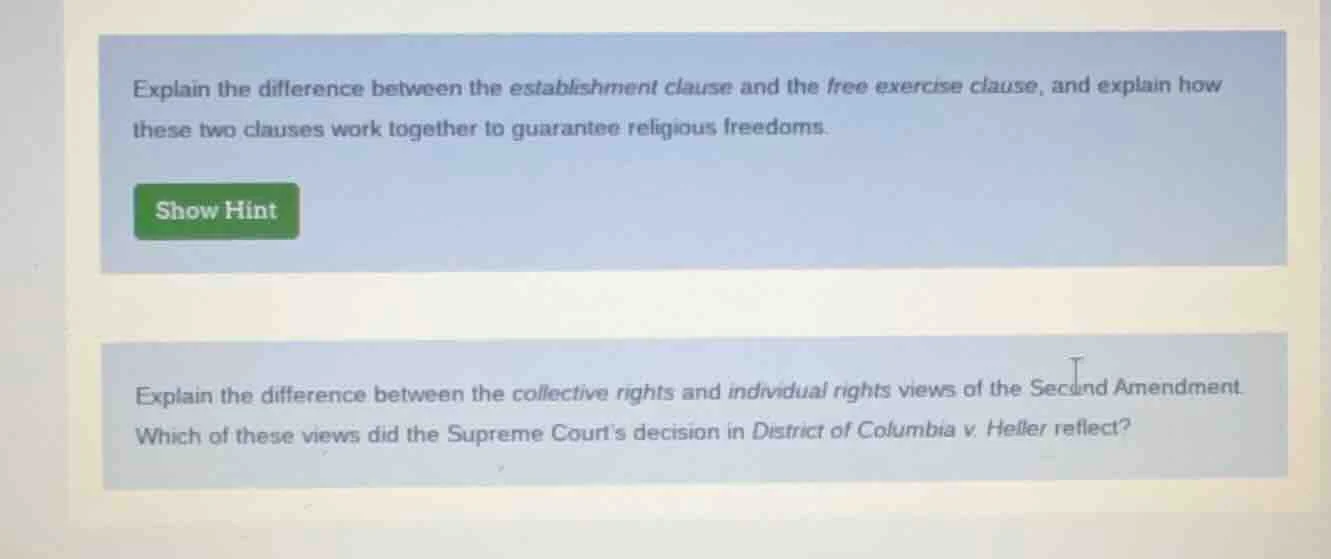
explain the difference between the establishment clause and the free exercise clause, and explain how these two clauses work together to guarantee religious freedoms.
show hint
explain the difference between the collective rights and individual rights views of the second amendment. which of these views did the supreme courts decision in district of columbia v. heller reflect?
Brief Explanations
For the First Question:
- Establishment Clause: Part of the First Amendment, it prohibits the U.S. government from creating or endorsing an official national religion, and bars excessive entanglement between government and religion. It acts as a "wall of separation" between state and religious institutions.
- Free Exercise Clause: Also from the First Amendment, it protects individuals' right to practice their chosen religion (or no religion) without government interference, as long as the practice does not violate general, neutral laws.
- Joint Function: Together, they safeguard religious freedom by preventing the government from favoring one religion over others (establishment clause) while ensuring people can follow their faith freely (free exercise clause), creating a framework for religious pluralism and individual autonomy in religious practice.
For the Second Question:
- Collective Rights View: Argues the Second Amendment protects the right of state militias (like the National Guard) to bear arms, not individual citizens. It frames the amendment as a check on federal overreach to preserve state military power.
- Individual Rights View: Contends the amendment guarantees individual citizens the right to own and possess firearms for lawful purposes, such as self-defense in the home, independent of militia membership.
- District of Columbia v. Heller (2008): The Supreme Court’s decision explicitly reflected the individual rights view. It struck down a D.C. handgun ban, ruling that the Second Amendment protects an individual's right to keep a functional firearm in the home for self-defense.

Snap & solve any problem in the app
Get step-by-step solutions on Sovi AI
Photo-based solutions with guided steps
Explore more problems and detailed explanations
First Question Answer:
- The Establishment Clause forbids government from establishing or endorsing a national religion and limits state-religion entanglement.
- The Free Exercise Clause protects individuals' right to practice their religion (or no religion) without government interference (barring violations of neutral laws).
- Together, they ensure religious pluralism: the state cannot favor a religion, and individuals can freely practice their faith, creating a balanced framework for religious freedom.
Second Question Answer:
- Collective Rights View: Frames the Second Amendment as protecting state militias' right to bear arms, not individuals.
- Individual Rights View: Holds the amendment guarantees individual citizens the right to own firearms for lawful uses like home self-defense.
- District of Columbia v. Heller reflected the individual rights view, as the Supreme Court ruled the Second Amendment protects an individual's right to keep a functional handgun in the home for self-defense.