QUESTION IMAGE
Question
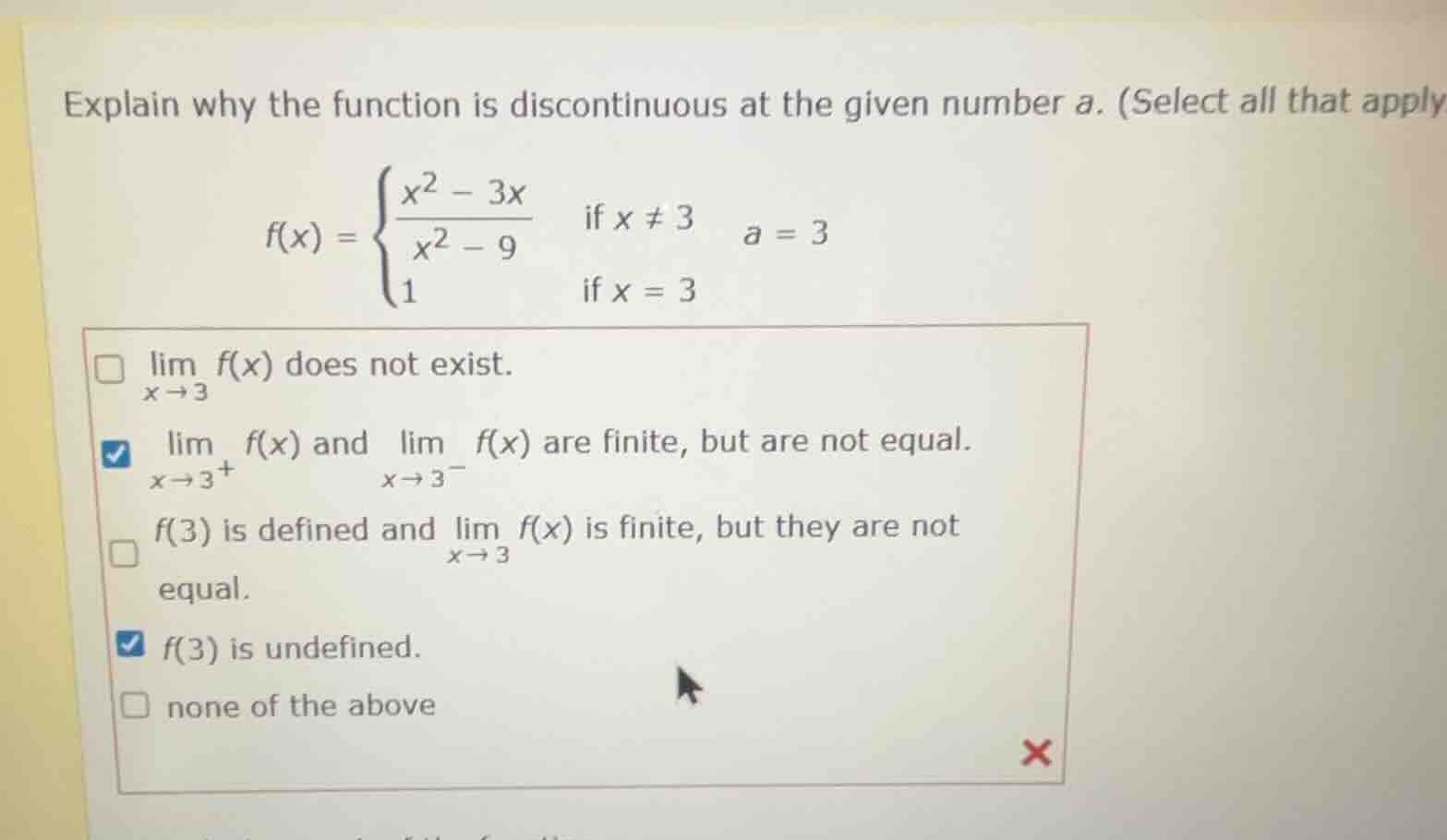
explain why the function is discontinuous at the given number a. (select all that apply)
$f(x) = \
$ $a = 3$
- $\lim\limits_{x \to 3} f(x)$ does not exist.
- $\lim\limits_{x \to 3^+} f(x)$ and $\lim\limits_{x \to 3^-} f(x)$ are finite, but are not equal.
- $f(3)$ is defined and $\lim\limits_{x \to 3} f(x)$ is finite, but they are not equal.
- $f(3)$ is undefined.
- none of the above
Step1: Analyze the function at \( x = 3 \)
First, check the definition of \( f(3) \). From the piecewise function, when \( x = 3 \), \( f(3)=1 \), so \( f(3) \) is defined. So the option " \( f(3) \) is undefined" is incorrect.
Step2: Simplify the function for \( x
eq3 \)
For \( x
eq3 \), we have \( f(x)=\frac{x^{2}-3x}{x^{2}-9} \). Factor the numerator and denominator:
- Numerator: \( x^{2}-3x=x(x - 3) \)
- Denominator: \( x^{2}-9=(x - 3)(x + 3) \)
So, \( f(x)=\frac{x(x - 3)}{(x - 3)(x + 3)}=\frac{x}{x + 3} \) (for \( x
eq3 \))
Step3: Find the limit as \( x
ightarrow3 \)
Now, find \( \lim_{x
ightarrow3}f(x) \). Since for \( x
eq3 \), \( f(x)=\frac{x}{x + 3} \), we can substitute \( x = 3 \) into this simplified function:
\( \lim_{x
ightarrow3}f(x)=\lim_{x
ightarrow3}\frac{x}{x + 3}=\frac{3}{3+3}=\frac{3}{6}=\frac{1}{2} \)
The left - hand limit \( \lim_{x
ightarrow3^{-}}f(x) \) and the right - hand limit \( \lim_{x
ightarrow3^{+}}f(x) \) are both equal to \( \frac{1}{2} \) (because the function \( \frac{x}{x + 3} \) is continuous at \( x = 3 \) except for the removable discontinuity at \( x = 3 \) in the original function). So the option " \( \lim_{x
ightarrow3^{+}}f(x) \) and \( \lim_{x
ightarrow3^{-}}f(x) \) are finite, but are not equal" is incorrect.
Step4: Compare \( \lim_{x
ightarrow3}f(x) \) and \( f(3) \)
We know that \( \lim_{x
ightarrow3}f(x)=\frac{1}{2} \) and \( f(3) = 1 \). Since \( \lim_{x
ightarrow3}f(x)
eq f(3) \), the condition for continuity ( \( \lim_{x
ightarrow a}f(x)=f(a) \)) is not met. So the correct option is " \( f(3) \) is defined and \( \lim_{x
ightarrow3}f(x) \) is finite, but they are not equal".

Snap & solve any problem in the app
Get step-by-step solutions on Sovi AI
Photo-based solutions with guided steps
Explore more problems and detailed explanations
The correct option is: \( f(3) \) is defined and \( \lim_{x
ightarrow3}f(x) \) is finite, but they are not equal.