QUESTION IMAGE
Question
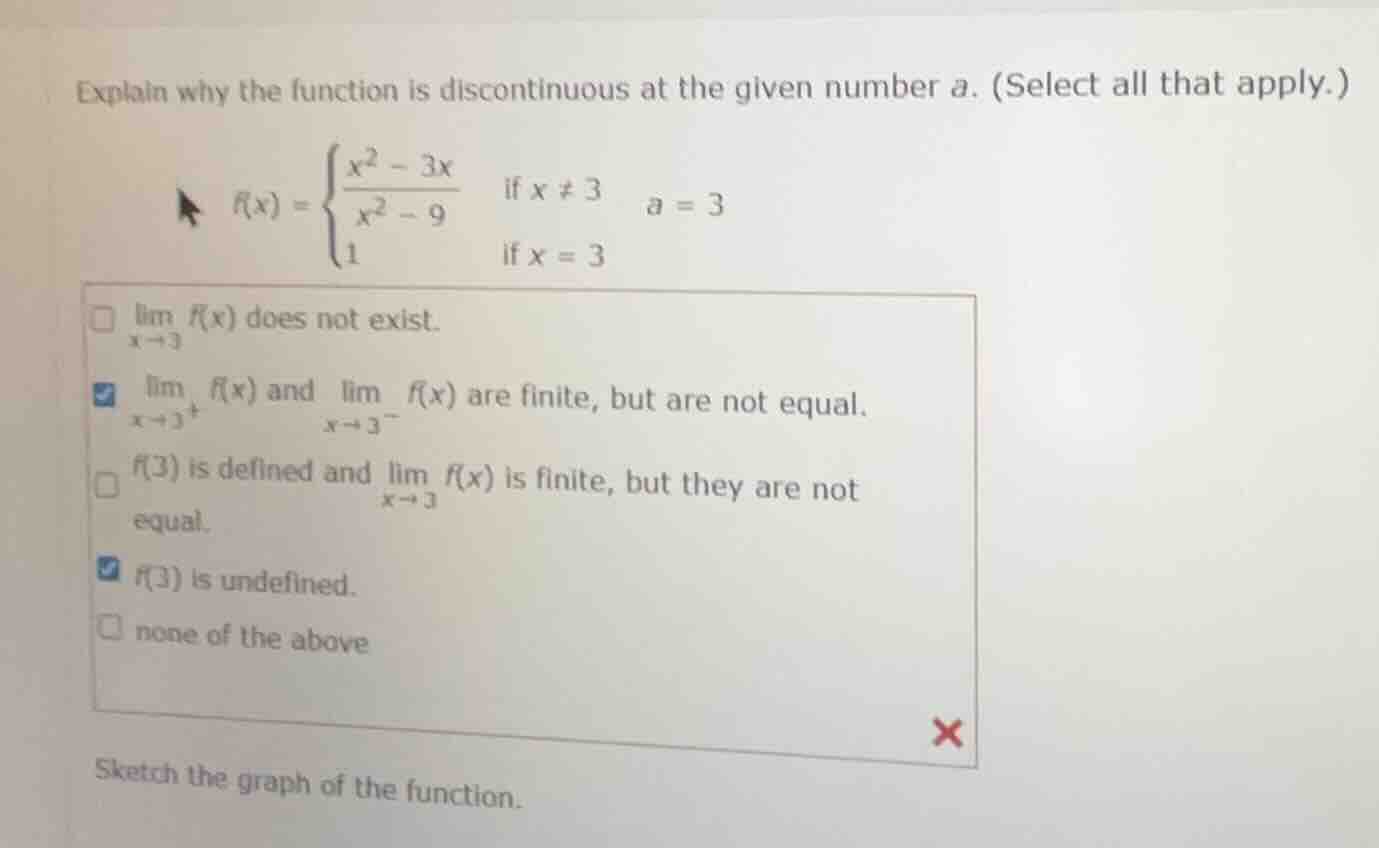
explain why the function is discontinuous at the given number a. (select all that apply.)
$f(x) = \
\quad a = 3$
- $\lim\limits_{x\to 3} f(x)$ does not exist.
- $\lim\limits_{x\to 3^+} f(x)$ and $\lim\limits_{x\to 3^-} f(x)$ are finite, but are not equal.
- $f(3)$ is defined and $\lim\limits_{x\to 3} f(x)$ is finite, but they are not equal.
- $f(3)$ is undefined.
- none of the above
sketch the graph of the function.
Step1: Simplify the function for \( x
eq 3 \)
Factor the numerator and denominator: \( \frac{x^2 - 3x}{x^2 - 9}=\frac{x(x - 3)}{(x - 3)(x + 3)} \). Cancel \( x - 3 \) (since \( x
eq 3 \), \( x - 3
eq 0 \)) to get \( \frac{x}{x + 3} \).
Step2: Find the limit as \( x \to 3 \)
Compute \( \lim_{x \to 3} \frac{x}{x + 3} \). Substitute \( x = 3 \): \( \frac{3}{3 + 3}=\frac{3}{6}=\frac{1}{2} \). So \( \lim_{x \to 3} f(x)=\frac{1}{2} \), and left/right limits are equal (since the function is rational except at \( x = 3 \), left and right limits exist and are equal to \( \frac{1}{2} \)).
Step3: Check \( f(3) \)
Given \( f(3)=1 \). Now compare \( \lim_{x \to 3} f(x)=\frac{1}{2} \) and \( f(3)=1 \). They are not equal. Also, \( f(3) \) is defined (so "f(3) is undefined" is wrong), and left/right limits are equal (so "limits not equal" is wrong), and the limit exists (so "limit does not exist" is wrong). The correct reason is "f(3) is defined and \( \lim_{x \to 3} f(x) \) is finite, but they are not equal".

Snap & solve any problem in the app
Get step-by-step solutions on Sovi AI
Photo-based solutions with guided steps
Explore more problems and detailed explanations
The correct option is:
\( f(3) \) is defined and \( \lim_{x \to 3} f(x) \) is finite, but they are not equal.