QUESTION IMAGE
Question
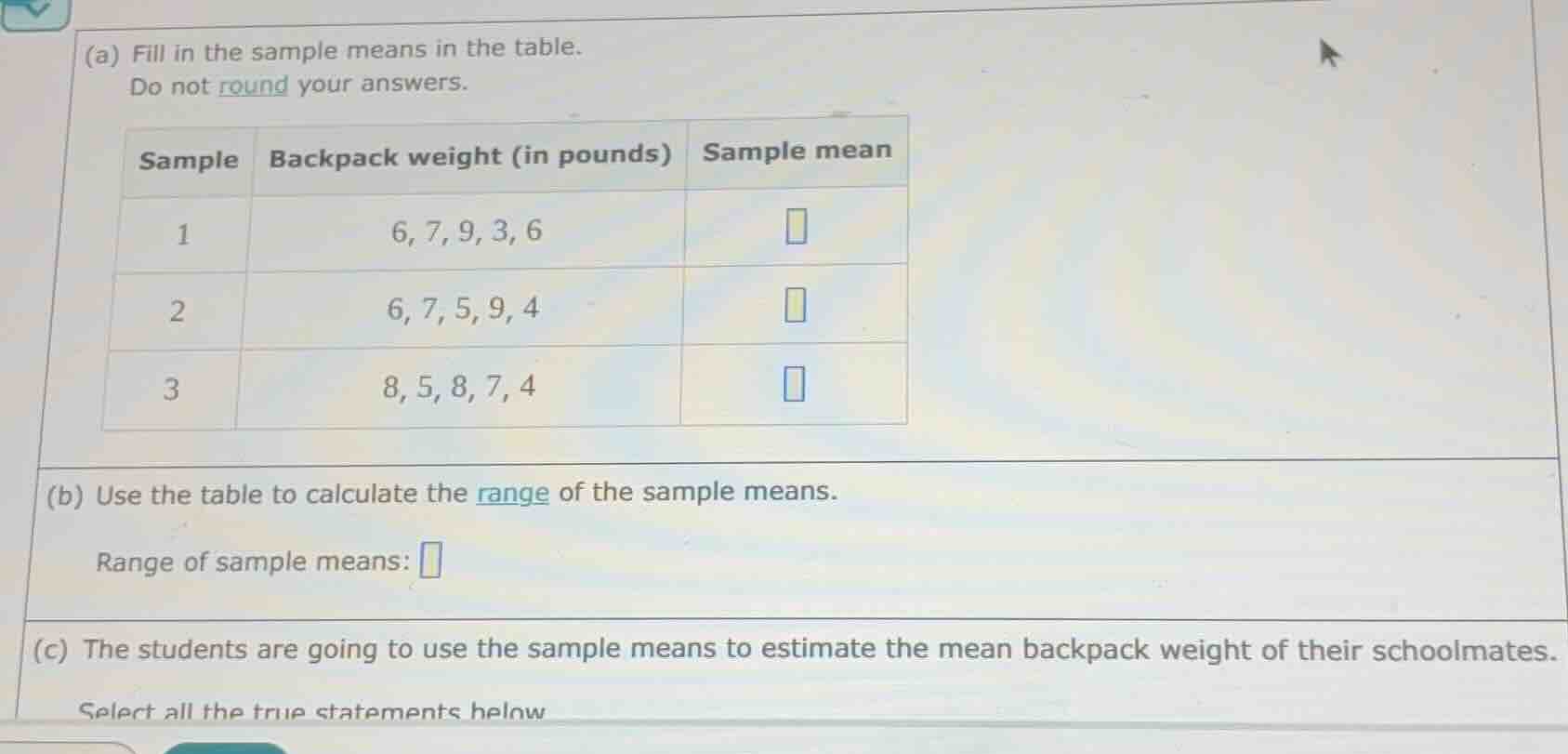
(a) fill in the sample means in the table. do not round your answers. sample backpack weight (in pounds) sample mean 1 6, 7, 9, 3, 6 2 6, 7, 5, 9, 4 3 8, 5, 8, 7, 4 (b) use the table to calculate the range of the sample means. range of sample means: (c) the students are going to use the sample means to estimate the mean backpack weight of their schoolmates. select all the true statements below
Part (a)
Step 1: Calculate sample mean for Sample 1
The formula for the sample mean $\bar{x}$ is $\bar{x}=\frac{\sum_{i = 1}^{n}x_{i}}{n}$, where $x_{i}$ are the data points and $n$ is the number of data points. For Sample 1, the data points are 6, 7, 9, 3, 6. The sum is $6 + 7+9 + 3+6=31$. There are $n = 5$ data points. So the sample mean is $\frac{31}{5}=6.2$.
Step 2: Calculate sample mean for Sample 2
For Sample 2, the data points are 6, 7, 5, 9, 4. The sum is $6 + 7+5 + 9+4=31$. With $n = 5$, the sample mean is $\frac{31}{5}=6.2$. Wait, no, $6 + 7=13$, $13+5 = 18$, $18+9=27$, $27 + 4=31$? Wait, no, 6+7+5+9+4: 6+7=13, 13+5=18, 18+9=27, 27+4=31? Wait, no, 6+7=13, 13+5=18, 18+9=27, 27+4=31? Wait, no, 6+7+5+9+4 = 31? Wait, 6+7=13, 13+5=18, 18+9=27, 27+4=31. Then $\frac{31}{5}=6.2$? Wait, no, 6+7+5+9+4: 6+7=13, 13+5=18, 18+9=27, 27+4=31. So mean is 31/5 = 6.2? Wait, no, maybe I made a mistake. Wait 6+7+5+9+4: 6+7=13, 13+5=18, 18+9=27, 27+4=31. Yes. Then Sample 2 mean is 31/5 = 6.2? Wait, no, wait Sample 3: 8,5,8,7,4. Sum is 8+5+8+7+4=32. Then mean is 32/5 = 6.4. Wait, let's recalculate Sample 1: 6+7+9+3+6. 6+7=13, 13+9=22, 22+3=25, 25+6=31. So 31/5 = 6.2. Sample 2: 6+7+5+9+4. 6+7=13, 13+5=18, 18+9=27, 27+4=31. 31/5=6.2. Sample 3: 8+5+8+7+4. 8+5=13, 13+8=21, 21+7=28, 28+4=32. 32/5 = 6.4.
Wait, maybe I miscalculated Sample 2. Let's check again: 6,7,5,9,4. 6+7=13, 13+5=18, 18+9=27, 27+4=31. Yes, sum is 31. So mean is 31/5 = 6.2. Sample 3: 8+5+8+7+4. 8+5=13, 13+8=21, 21+7=28, 28+4=32. So mean is 32/5 = 6.4.
So:
Sample 1: sum = 6+7+9+3+6 = 31, mean = 31/5 = 6.2
Sample 2: sum = 6+7+5+9+4 = 31, mean = 31/5 = 6.2
Sample 3: sum = 8+5+8+7+4 = 32, mean = 32/5 = 6.4
Part (b)
Step 1: Identify the maximum and minimum sample means
From part (a), the sample means are 6.2, 6.2, and 6.4. The maximum value is 6.4 and the minimum value is 6.2.
Step 2: Calculate the range
The range is calculated as $Range = \text{Maximum value}-\text{Minimum value}$. So $Range = 6.4 - 6.2 = 0.2$.
Part (a) Answers:
Sample 1 mean: $\boldsymbol{6.2}$
Sample 2 mean: $\boldsymbol{6.2}$
Sample 3 mean: $\boldsymbol{6.4}$
Part (b) Answer:
Range of sample means: $\boldsymbol{0.2}$
(Note: For part (c), since the options are not provided, we can't answer it. If you provide the options, we can help you with that part too.)

Snap & solve any problem in the app
Get step-by-step solutions on Sovi AI
Photo-based solutions with guided steps
Explore more problems and detailed explanations
Step 1: Identify the maximum and minimum sample means
From part (a), the sample means are 6.2, 6.2, and 6.4. The maximum value is 6.4 and the minimum value is 6.2.
Step 2: Calculate the range
The range is calculated as $Range = \text{Maximum value}-\text{Minimum value}$. So $Range = 6.4 - 6.2 = 0.2$.
Part (a) Answers:
Sample 1 mean: $\boldsymbol{6.2}$
Sample 2 mean: $\boldsymbol{6.2}$
Sample 3 mean: $\boldsymbol{6.4}$
Part (b) Answer:
Range of sample means: $\boldsymbol{0.2}$
(Note: For part (c), since the options are not provided, we can't answer it. If you provide the options, we can help you with that part too.)