QUESTION IMAGE
Question
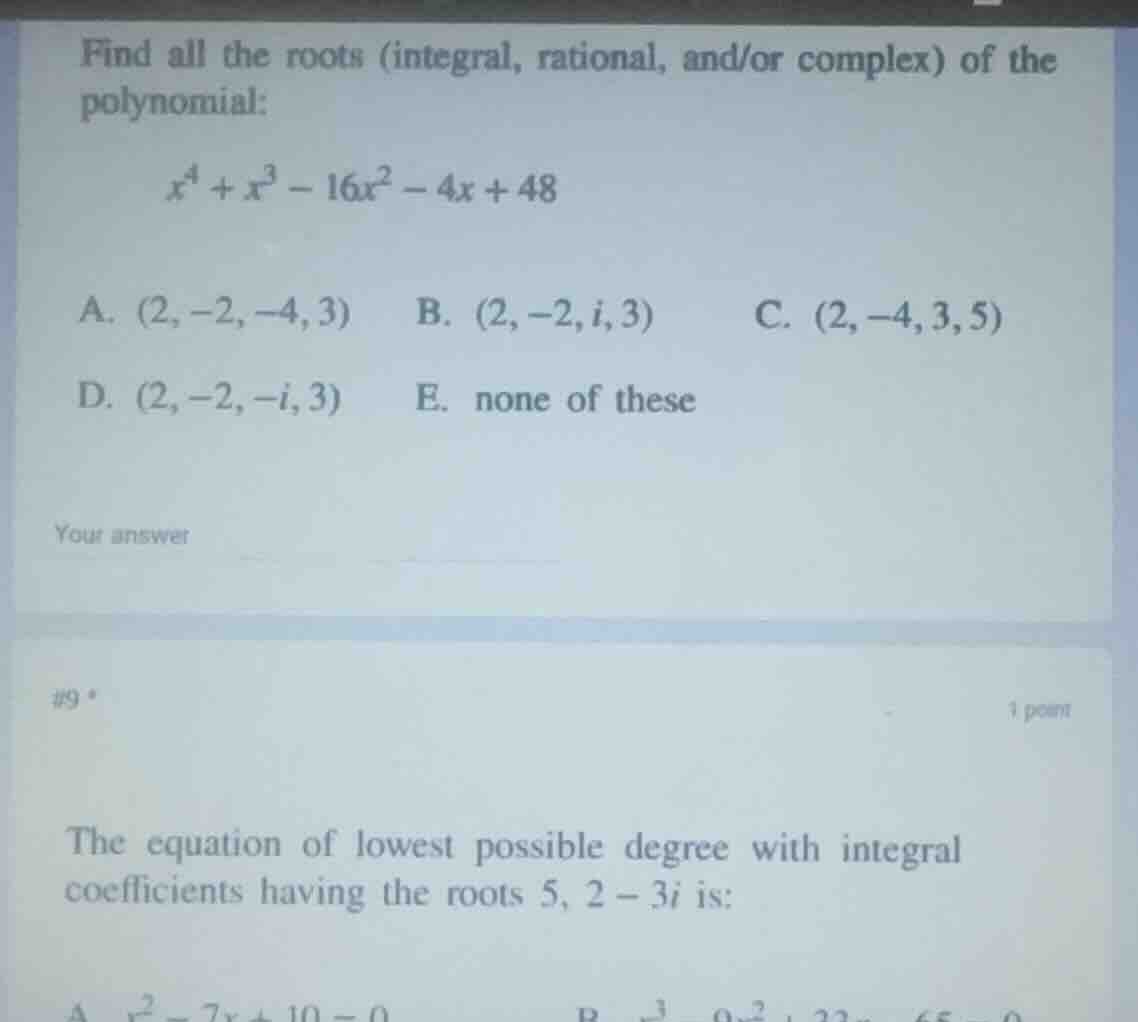
find all the roots (integral, rational, and/or complex) of the polynomial:
\\( x^4 + x^3 - 16x^2 - 4x + 48 \\)
a. \\( (2, -2, -4, 3) \\) b. \\( (2, -2, i, 3) \\) c. \\( (2, -4, 3, 5) \\)
d. \\( (2, -2, -i, 3) \\) e. none of these
your answer
#9 *
the equation of lowest possible degree with integral coefficients having the roots 5, \\( 2 - 3i \\) is:
First Question: Find all roots of $x^4 + x^3 - 16x^2 - 4x + 48$
Step1: Test integral root x=2
Substitute $x=2$ into polynomial:
$2^4 + 2^3 - 16(2)^2 - 4(2) + 48 = 16 + 8 - 64 - 8 + 48 = 0$
Step2: Factor out $(x-2)$
Use polynomial division or synthetic division:
$x^4 + x^3 - 16x^2 - 4x + 48 = (x-2)(x^3 + 3x^2 - 10x - 24)$
Step3: Test integral root x=3
Substitute $x=3$ into cubic:
$3^3 + 3(3)^2 - 10(3) - 24 = 27 + 27 - 30 - 24 = 0$
Step4: Factor out $(x-3)$
Divide cubic by $(x-3)$:
$x^3 + 3x^2 - 10x - 24 = (x-3)(x^2 + 6x + 8)$
Step5: Factor quadratic
$x^2 + 6x + 8 = (x+2)(x+4)$
Step6: List all roots
Set each factor to 0: $x=2, 3, -2, -4$
Step1: Use conjugate root theorem
For integer coefficients, complex roots come in conjugate pairs. So $2+3i$ is also a root.
Step2: Write linear factors
Factors: $(x-5), (x-(2-3i)), (x-(2+3i))$
Step3: Multiply complex factors
$(x-2+3i)(x-2-3i) = (x-2)^2 - (3i)^2 = x^2 -4x +4 +9 = x^2 -4x +13$
Step4: Multiply by $(x-5)$
$(x-5)(x^2 -4x +13) = x^3 -4x^2 +13x -5x^2 +20x -65 = x^3 -9x^2 +33x -65$

Snap & solve any problem in the app
Get step-by-step solutions on Sovi AI
Photo-based solutions with guided steps
Explore more problems and detailed explanations
A. (2, -2, -4, 3)
---