QUESTION IMAGE
Question
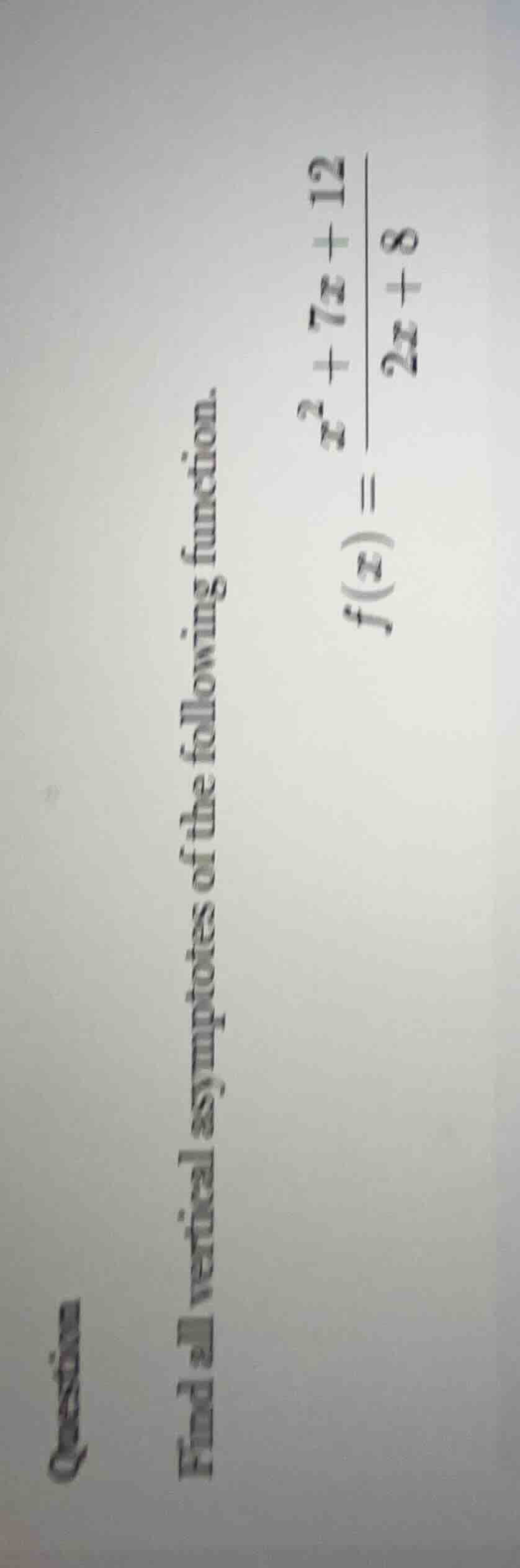
find all vertical asymptotes of the following function.
$f(x) = \dfrac{x^2 + 7x + 12}{2x + 8}$
Step1: Factor numerator and denominator
First, factor the numerator \(x^2 + 7x + 12\) and the denominator \(2x + 8\).
The numerator: \(x^2 + 7x + 12=(x + 3)(x + 4)\) (by finding two numbers that multiply to 12 and add to 7).
The denominator: \(2x + 8 = 2(x + 4)\) (factoring out the greatest common factor, which is 2).
So the function becomes \(f(x)=\frac{(x + 3)(x + 4)}{2(x + 4)}\).
Step2: Cancel common factors (if any)
We can cancel the common factor \((x + 4)\) from the numerator and the denominator, but we must note that \(x
eq - 4\) (since this would make the original denominator zero). After canceling, we have \(f(x)=\frac{x + 3}{2}\) for \(x
eq - 4\).
Step3: Find vertical asymptotes
Vertical asymptotes occur where the denominator of the original function is zero (and the numerator is not zero at that point, or after canceling common factors, the factor still makes the denominator zero).
The original denominator is \(2x + 8\). Set \(2x+8 = 0\). Solving for \(x\):
\(2x=-8\)
\(x=-4\).
But we need to check if the numerator is zero at \(x = - 4\). The original numerator at \(x=-4\) is \((-4)^2+7(-4)+12=16 - 28 + 12=0\). However, after canceling the common factor \((x + 4)\), the simplified function has no vertical asymptote at \(x=-4\) (it has a hole there instead). Wait, did we make a mistake? Wait, no—wait, the original function is a rational function. Let's re - examine.
Wait, the degree of the numerator is 2 (since the highest power of \(x\) in the numerator is \(x^2\)) and the degree of the denominator is 1 (highest power of \(x\) in the denominator is \(x^1\)). When the degree of the numerator is greater than the degree of the denominator, there is no vertical asymptote? Wait, no, vertical asymptotes are about the denominator being zero (and the factor not being canceled out in a way that removes the singularity). Wait, in our case, after factoring, we saw that the \((x + 4)\) factor cancels. So the original function has a removable discontinuity (a hole) at \(x=-4\), and since the denominator of the simplified function is a constant (2), there are no vertical asymptotes? Wait, that can't be right. Wait, no—wait, the original function: let's re - express.
Wait, the original function is \(f(x)=\frac{x^2 + 7x + 12}{2x + 8}\). The denominator is linear (\(2x + 8\)) and the numerator is quadratic (\(x^2+7x + 12\)). When we factor, we have a common factor. So the only point where the denominator is zero is \(x=-4\), but since the numerator is also zero there, it's a hole, not a vertical asymptote. So there are no vertical asymptotes? Wait, no, maybe I messed up the factoring. Wait, \(x^2+7x + 12\): factors of 12 that add to 7 are 3 and 4, so \((x + 3)(x + 4)\) is correct. Denominator: \(2x + 8=2(x + 4)\), correct. So when we cancel \((x + 4)\), we get \(\frac{x + 3}{2}\) with a hole at \(x=-4\). So the denominator of the simplified function is 2, which is never zero. So there are no vertical asymptotes.

Snap & solve any problem in the app
Get step-by-step solutions on Sovi AI
Photo-based solutions with guided steps
Explore more problems and detailed explanations
There are no vertical asymptotes.