QUESTION IMAGE
Question
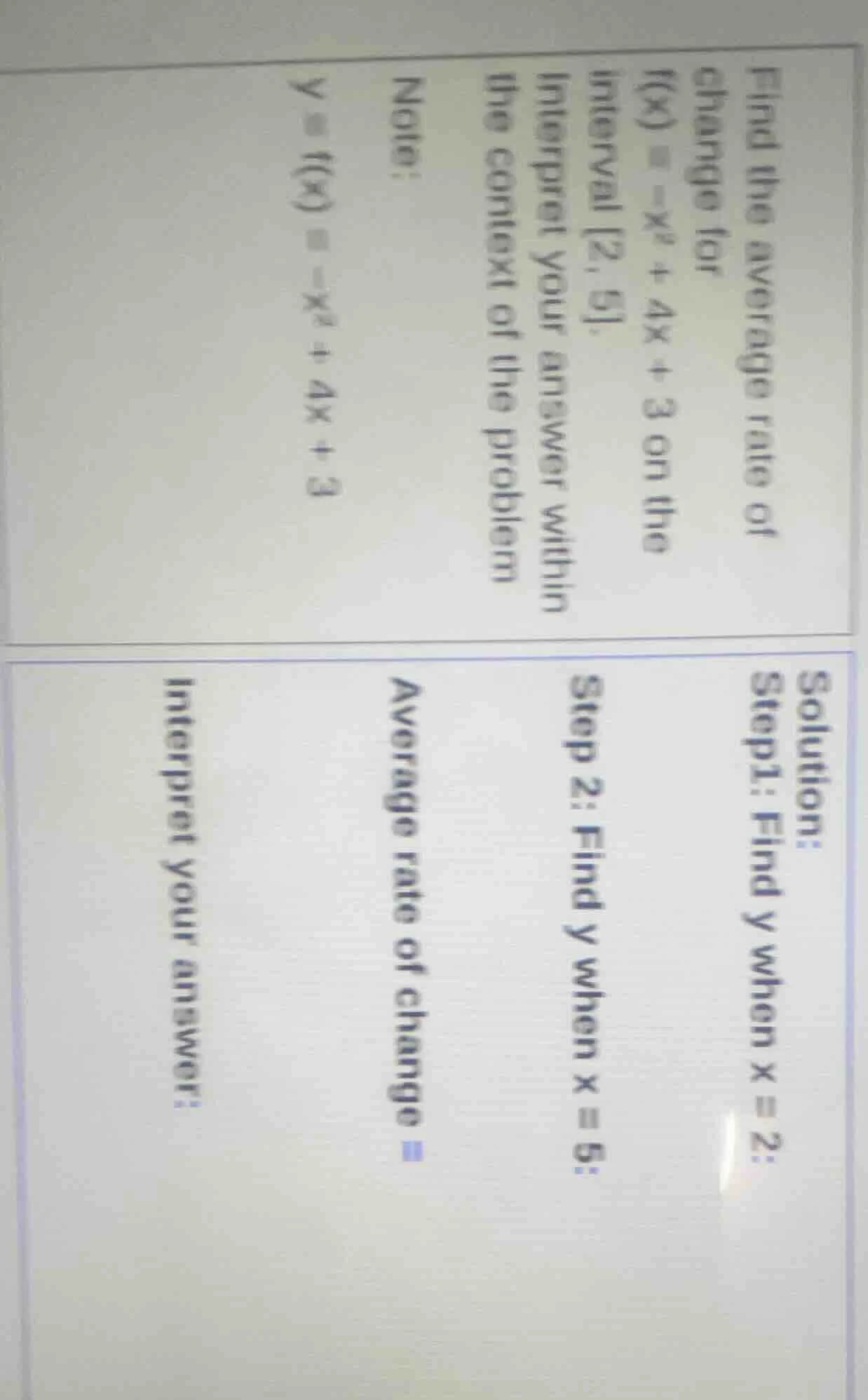
find the average rate of change for $f(x) = -x^2 + 4x + 3$ on the interval $2, 5$.
interpret your answer within the context of the problem
note:
$y = f(x) = -x^2 + 4x + 3$
solution:
step1: find y when x = 2:
step 2: find y when x = 5:
average rate of change =
interpret your answer:
Step1: Calculate f(2)
Substitute $x=2$ into $f(x)$:
$$f(2) = -(2)^2 + 4(2) + 3 = -4 + 8 + 3 = 7$$
Step2: Calculate f(5)
Substitute $x=5$ into $f(x)$:
$$f(5) = -(5)^2 + 4(5) + 3 = -25 + 20 + 3 = -2$$
Step3: Apply average rate formula
Use $\frac{f(b)-f(a)}{b-a}$ for $[a,b]=[2,5]$:
$$\text{Average rate of change} = \frac{f(5)-f(2)}{5-2} = \frac{-2 - 7}{3} = \frac{-9}{3} = -3$$
Step4: Interpret the result
The average rate of change means, on the interval $[2,5]$, the function $f(x)$ decreases by an average of 3 units for every 1 unit increase in $x$.

Snap & solve any problem in the app
Get step-by-step solutions on Sovi AI
Photo-based solutions with guided steps
Explore more problems and detailed explanations
The average rate of change is $-3$. On the interval $[2, 5]$, the value of the function $f(x)$ decreases by an average of 3 for each 1-unit increase in $x$.