QUESTION IMAGE
Question
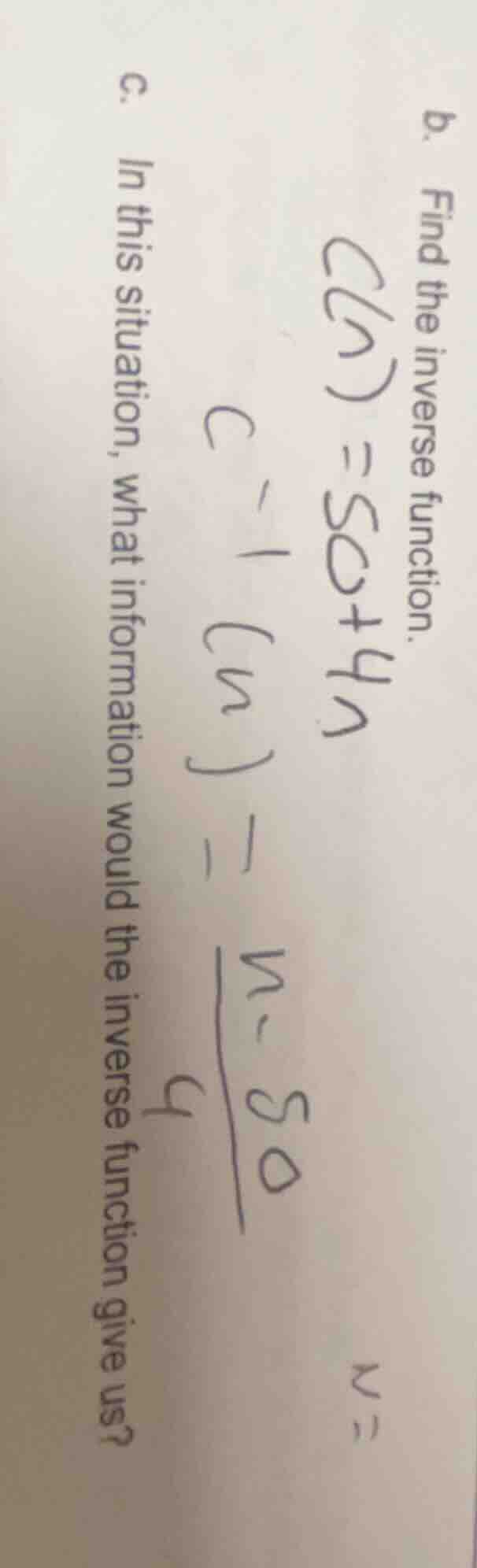
b. find the inverse function.
c(n) = 50 + 4n
c^{-1}(n) = \frac{n - 50}{4}
c. in this situation, what information would the inverse function give us?
Part b: Find the inverse function of \( C(n) = 50 + 4n \)
Step 1: Replace \( C(n) \) with \( y \)
We start by writing the function as \( y = 50 + 4n \). This is a standard step to make it easier to solve for \( n \) in terms of \( y \), which will give us the inverse function.
\( y = 50 + 4n \)
Step 2: Solve for \( n \) in terms of \( y \)
First, subtract 50 from both sides of the equation to isolate the term with \( n \).
\( y - 50 = 4n \)
Then, divide both sides by 4 to solve for \( n \).
\( n=\frac{y - 50}{4} \)
Step 3: Replace \( n \) with \( C^{-1}(y) \) and \( y \) with \( n \)
The inverse function is usually written in terms of the original input variable (which was \( n \) for the original function, but we use \( n \) as the input for the inverse function here). So we replace \( y \) with \( n \) and \( n \) with \( C^{-1}(n) \).
\( C^{-1}(n)=\frac{n - 50}{4} \)
The original function \( C(n)=50 + 4n \) likely represents a cost function, where \( n \) could be the number of items (or some quantity) and \( C(n) \) is the total cost. The inverse function \( C^{-1}(n)=\frac{n - 50}{4} \) reverses the relationship. If we know the total cost (now the input to the inverse function, \( n \) in \( C^{-1}(n) \)), the inverse function will give us the number of items (or the quantity) that would result in that total cost. For example, if we know the total cost is a certain value, we can plug it into the inverse function to find out how many units (or whatever \( n \) represents) were involved to get that cost.

Snap & solve any problem in the app
Get step-by-step solutions on Sovi AI
Photo-based solutions with guided steps
Explore more problems and detailed explanations
The inverse function is \( \boldsymbol{C^{-1}(n)=\frac{n - 50}{4}} \)