QUESTION IMAGE
Question
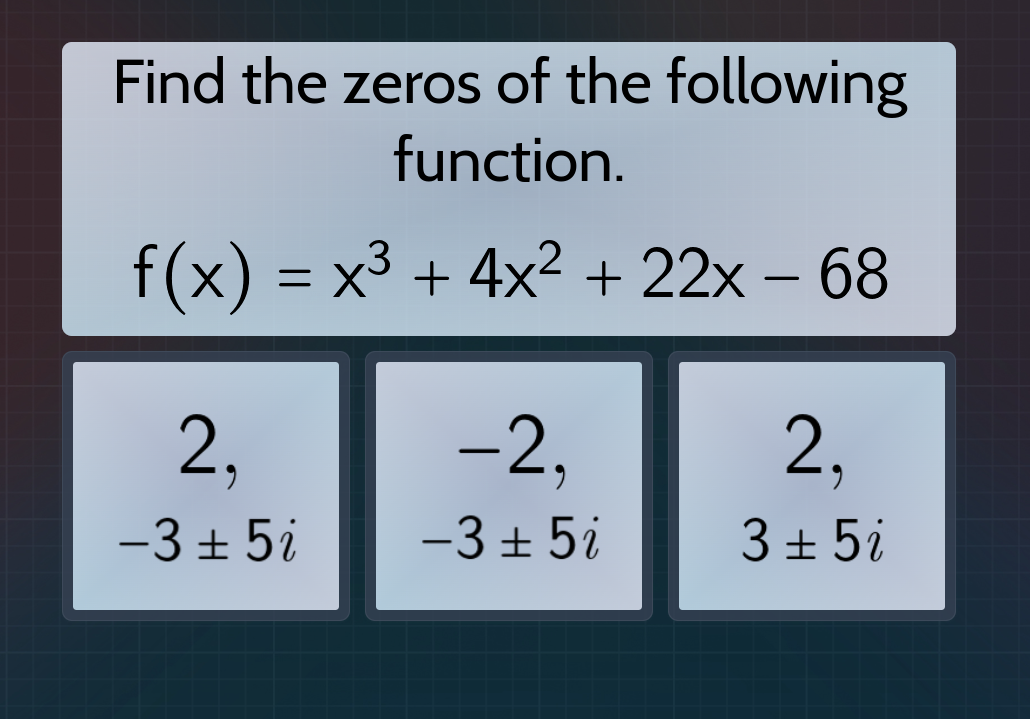
find the zeros of the following function.
$f(x) = x^3 + 4x^2 + 22x - 68$
2,
$-3 \pm 5i$
$-2,$
$-3 \pm 5i$
2,
$3 \pm 5i$
Step1: Test possible rational zeros
Using Rational Root Theorem, possible rational zeros are factors of 68 over factors of 1, so ±1, ±2, ±4, ±17, ±34, ±68. Test \(x = 2\): \(f(2)=2^3 + 4(2)^2+22(2)-68 = 8 + 16 + 44 - 68 = 0\). So \(x - 2\) is a factor.
Step2: Perform polynomial division or use synthetic division
Divide \(f(x)\) by \(x - 2\) using synthetic division:
\[
\]
So \(f(x)=(x - 2)(x^2 + 6x + 34)\).
Step3: Solve the quadratic equation
Solve \(x^2 + 6x + 34 = 0\) using quadratic formula \(x=\frac{-b\pm\sqrt{b^2 - 4ac}}{2a}\), where \(a = 1\), \(b = 6\), \(c = 34\).
Discriminant: \(b^2 - 4ac = 36 - 136 = -100\).
So \(x=\frac{-6\pm\sqrt{-100}}{2}=\frac{-6\pm10i}{2}=-3\pm5i\).

Snap & solve any problem in the app
Get step-by-step solutions on Sovi AI
Photo-based solutions with guided steps
Explore more problems and detailed explanations
2, \(-3 \pm 5i\) (corresponding to the first option: 2, \(-3 \pm 5i\))