QUESTION IMAGE
Question
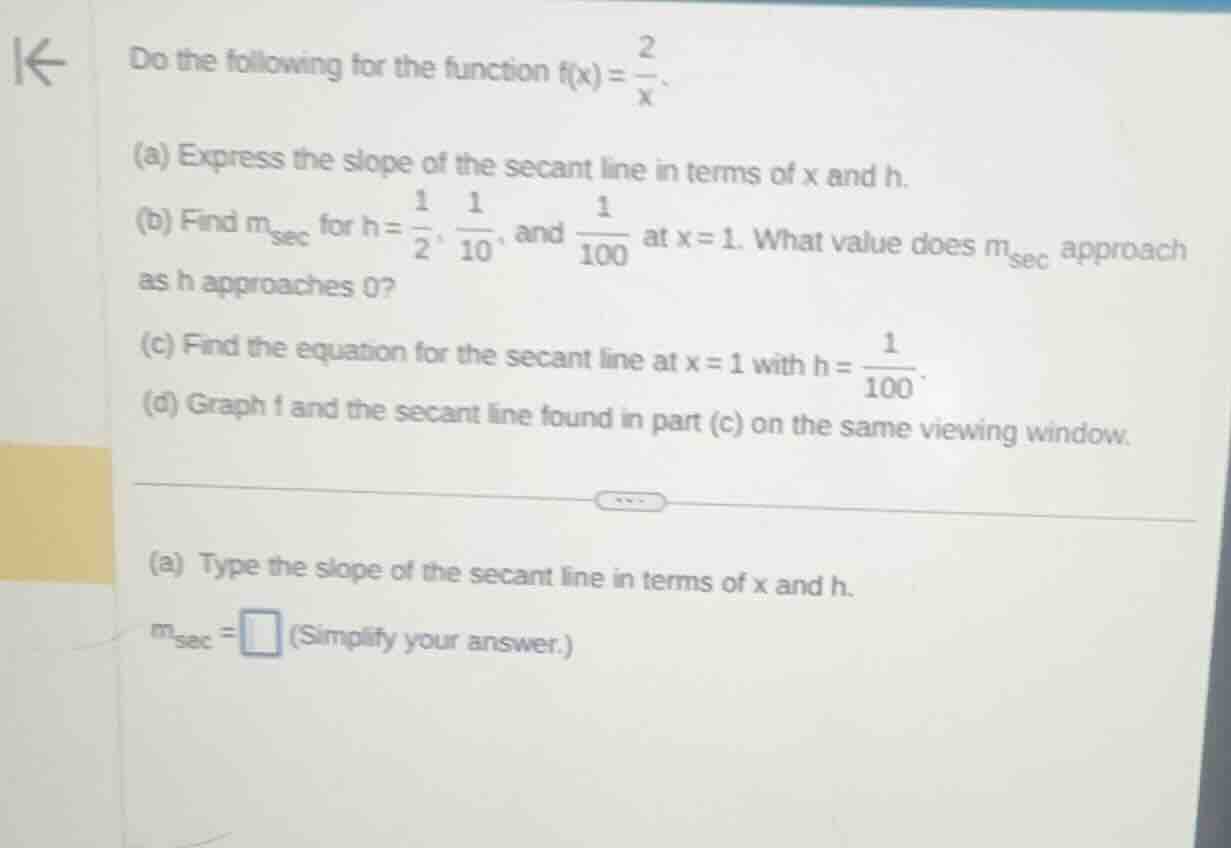
do the following for the function $f(x)=\frac{2}{x}$.
(a) express the slope of the secant line in terms of $x$ and $h$.
(b) find $m_{\text{sec}}$ for $h = \frac{1}{2}$, $\frac{1}{10}$, and $\frac{1}{100}$ at $x = 1$. what value does $m_{\text{sec}}$ approach as $h$ approaches 0?
(c) find the equation for the secant line at $x = 1$ with $h = \frac{1}{100}$.
(d) graph $f$ and the secant line found in part (c) on the same viewing window.
(a) type the slope of the secant line in terms of $x$ and $h$.
$m_{\text{sec}} = \square$ (simplify your answer.)
Step1: Recall secant slope formula
$m_{\text{sec}} = \frac{f(x+h) - f(x)}{h}$
Step2: Substitute $f(x)=\frac{2}{x}$
$m_{\text{sec}} = \frac{\frac{2}{x+h} - \frac{2}{x}}{h}$
Step3: Combine numerator fractions
$\frac{2x - 2(x+h)}{x(x+h)} = \frac{2x - 2x - 2h}{x(x+h)} = \frac{-2h}{x(x+h)}$
Step4: Divide by h and simplify
$m_{\text{sec}} = \frac{\frac{-2h}{x(x+h)}}{h} = \frac{-2}{x(x+h)}$
(Part b):
Step1: Substitute $x=1$ into slope formula
$m_{\text{sec}} = \frac{-2}{1(1+h)} = \frac{-2}{1+h}$
Step2: Calculate for $h=\frac{1}{2}$
$m_{\text{sec}} = \frac{-2}{1+\frac{1}{2}} = \frac{-2}{\frac{3}{2}} = -\frac{4}{3} \approx -1.333$
Step3: Calculate for $h=\frac{1}{10}$
$m_{\text{sec}} = \frac{-2}{1+\frac{1}{10}} = \frac{-2}{\frac{11}{10}} = -\frac{20}{11} \approx -1.818$
Step4: Calculate for $h=\frac{1}{100}$
$m_{\text{sec}} = \frac{-2}{1+\frac{1}{100}} = \frac{-2}{\frac{101}{100}} = -\frac{200}{101} \approx -1.980$
Step5: Find limit as $h\to0$
$\lim_{h\to0} \frac{-2}{1+h} = -2$
(Part c):
Step1: Find $f(1)$
$f(1) = \frac{2}{1} = 2$
Step2: Use point-slope form $y-y_1=m(x-x_1)$
$y - 2 = -\frac{200}{101}(x - 1)$
Step3: Rearrange to slope-intercept form
$y = -\frac{200}{101}x + \frac{200}{101} + 2 = -\frac{200}{101}x + \frac{402}{101}$
(Part d):
- For $f(x)=\frac{2}{x}$: Plot hyperbola with branches in first and third quadrants, vertical asymptote $x=0$, horizontal asymptote $y=0$, passing through $(1,2)$.
- For the secant line $y = -\frac{200}{101}x + \frac{402}{101}$: Plot a line with slope $\approx-1.98$ and y-intercept $\approx3.98$, passing through $(1,2)$ and $(1.01, \frac{2}{1.01}\approx1.9802)$.
- Use a viewing window centered near $x=1$, e.g., $x\in[0.5,1.5]$, $y\in[1,3]$ to clearly see the intersection at $(1,2)$ and the close proximity of the line and curve near this point.

Snap & solve any problem in the app
Get step-by-step solutions on Sovi AI
Photo-based solutions with guided steps
Explore more problems and detailed explanations
$\frac{-2}{x(x+h)}$
---