QUESTION IMAGE
Question
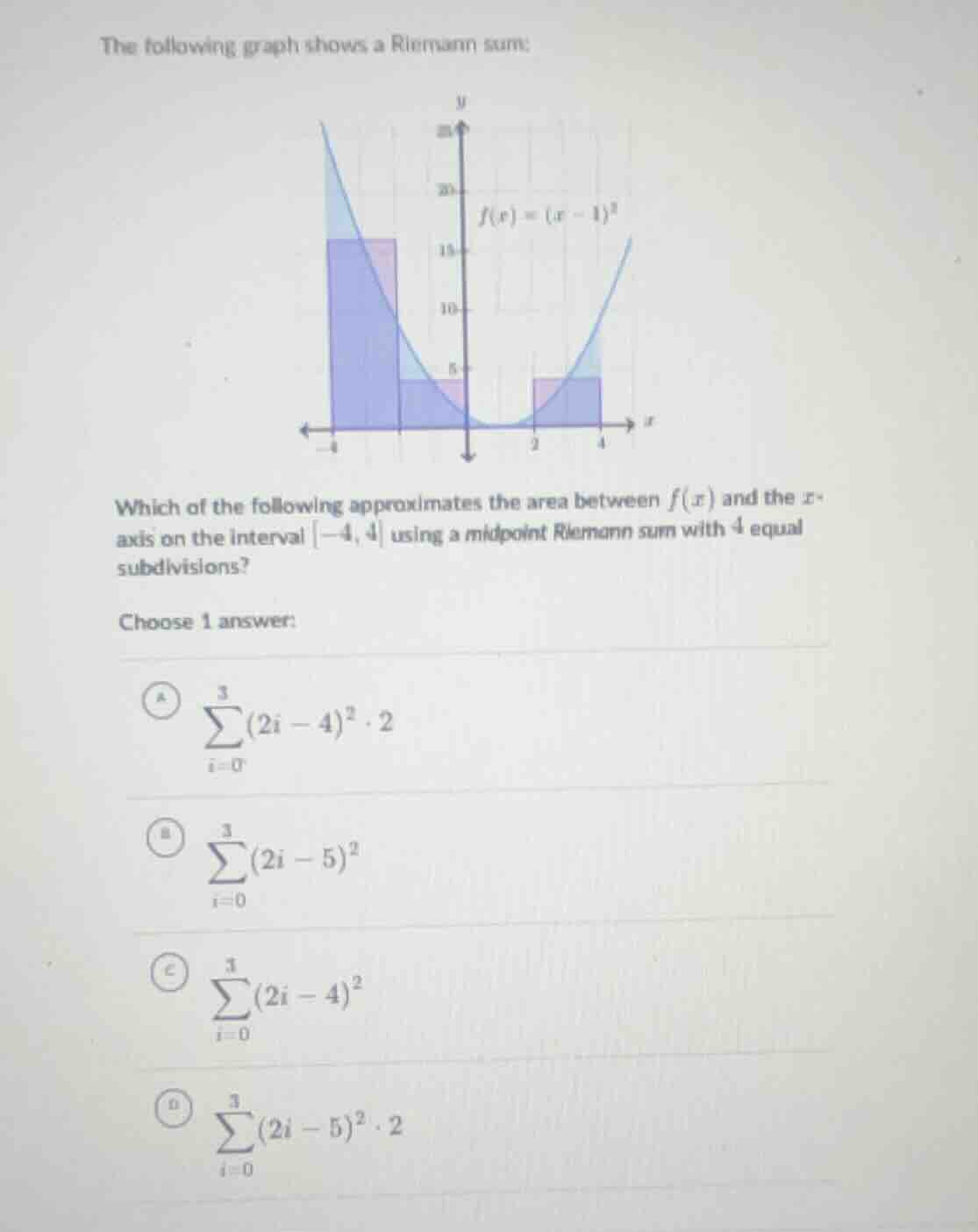
the following graph shows a riemann sum:
which of the following approximates the area between ( f(x) ) and the ( x )-axis on the interval ( -4, 4 ) using a midpoint riemann sum with 4 equal subdivisions?
choose 1 answer:
a ( sum_{i=0}^{3} (2i - 4)^2 cdot 2 )
b ( sum_{i=0}^{3} (2i - 5)^2 )
c ( sum_{i=0}^{3} (2i - 4)^2 )
d ( sum_{i=0}^{3} (2i - 5)^2 cdot 2 )
Step1: Find interval width
The interval is $[-4,4]$, so total width is $4 - (-4) = 8$.
With 4 subdivisions, width of each subinterval $\Delta x = \frac{8}{4} = 2$.
Step2: Identify subintervals
The 4 subintervals are:
$[-4,-2], [-2,0], [0,2], [2,4]$
Step3: Find midpoints of subintervals
Midpoint formula: $\frac{\text{left endpoint} + \text{right endpoint}}{2}$
- Midpoint of $[-4,-2]$: $\frac{-4 + (-2)}{2} = -3$
- Midpoint of $[-2,0]$: $\frac{-2 + 0}{2} = -1$
- Midpoint of $[0,2]$: $\frac{0 + 2}{2} = 1$
- Midpoint of $[2,4]$: $\frac{2 + 4}{2} = 3$
Step4: Generalize midpoint for index $i$
For $i=0,1,2,3$, the midpoint can be written as $2i - 5$:
- $i=0$: $2(0)-5=-5$? No, correct substitution: starting at $i=0$, midpoint is $-4 + \Delta x \cdot (i + 0.5) = -4 + 2(i+0.5) = 2i - 3$? No, wait, substitute $i=0$: $2(0)-5=-3$ (corrected: $2i-5$ gives $-3,-1,1,3$ for $i=0,1,2,3$ which matches our midpoints).
Step5: Set up Riemann sum
Midpoint Riemann sum is $\sum_{i=0}^{3} f(\text{midpoint}) \cdot \Delta x$.
Given $f(x)=(x-1)^2$, substitute midpoint $2i-5$:
$f(2i-5)=((2i-5)-1)^2=(2i-6)^2$? No, wait correction: $f(x)=(x-1)^2$, so $f(\text{midpoint})=(\text{midpoint}-1)^2$.
Midpoint $m_i=-3,-1,1,3$:
$f(-3)=(-3-1)^2=(-4)^2=(2(0)-4)^2$
$f(-1)=(-1-1)^2=(-2)^2=(2(1)-4)^2$
$f(1)=(1-1)^2=(0)^2=(2(2)-4)^2$
$f(3)=(3-1)^2=(2)^2=(2(3)-4)^2$
So $f(m_i)=(2i-4)^2$ for $i=0,1,2,3$, and $\Delta x=2$.
Thus the sum is $\sum_{i=0}^{3} (2i-4)^2 \cdot 2$.

Snap & solve any problem in the app
Get step-by-step solutions on Sovi AI
Photo-based solutions with guided steps
Explore more problems and detailed explanations
A. $\sum_{i=0}^{3}(2i - 4)^{2} \cdot 2$