QUESTION IMAGE
Question
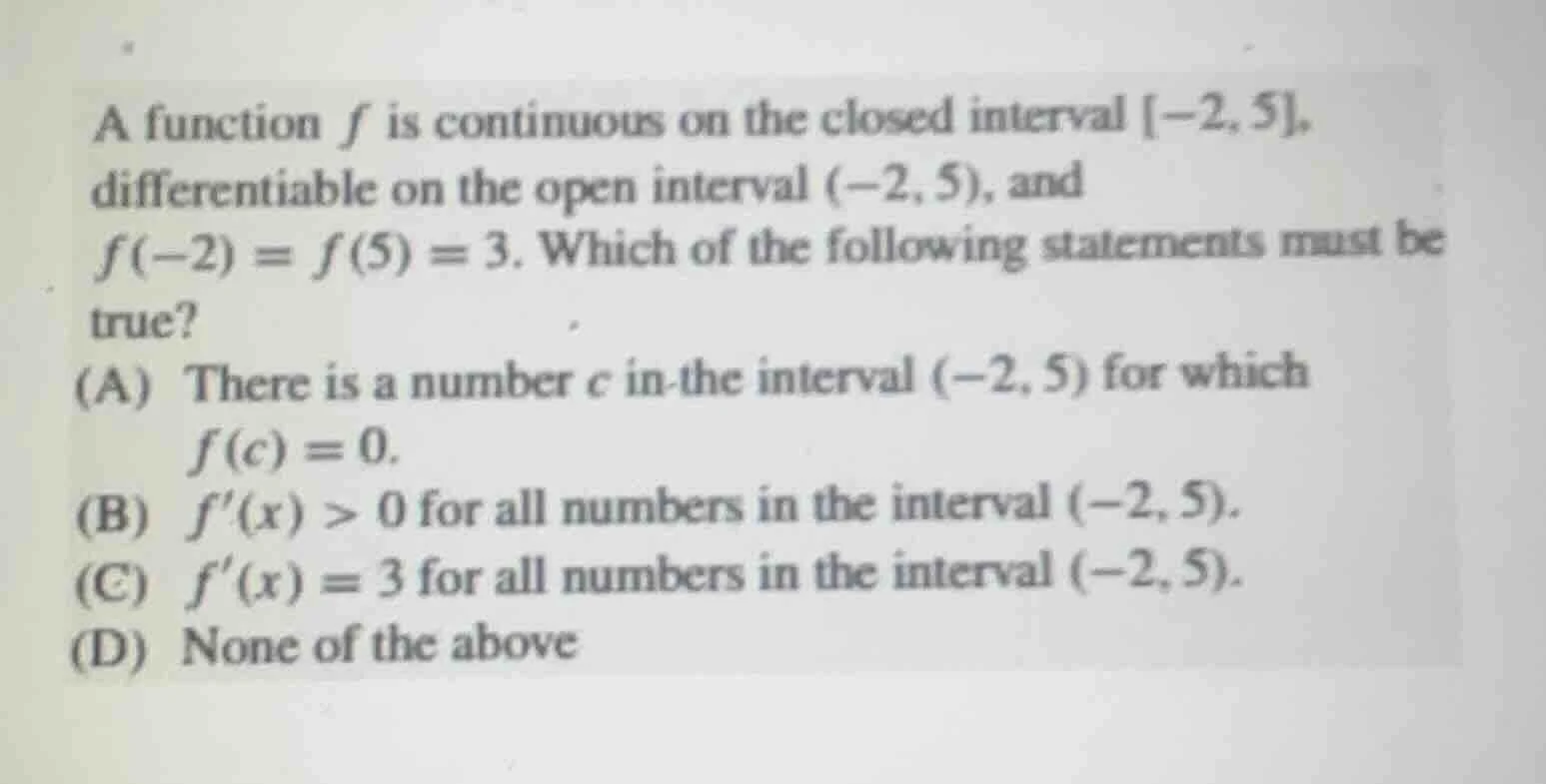
a function $f$ is continuous on the closed interval $-2, 5$, differentiable on the open interval $(-2, 5)$, and $f(-2) = f(5) = 3$. which of the following statements must be true?
(a) there is a number $c$ in the interval $(-2, 5)$ for which $f(c) = 0$.
(b) $f(x) > 0$ for all numbers in the interval $(-2, 5)$.
(c) $f(x) = 3$ for all numbers in the interval $(-2, 5)$.
(d) none of the above
Step1: Analyze Rolle's Theorem conditions
The function $f(x)$ is continuous on $[-2,5]$, differentiable on $(-2,5)$, and $f(-2)=f(5)=3$. Rolle's Theorem guarantees there exists a $c\in(-2,5)$ where $f'(c)=0$, but it does not guarantee $f(c)=0$.
Step2: Evaluate Option A
There is no requirement for $f(x)$ to cross 0. For example, $f(x)=3$ (a constant function) satisfies the given conditions but never equals 0. So A is not necessarily true.
Step3: Evaluate Option B
$f'(x)>0$ would mean the function is strictly increasing, but $f(-2)=f(5)$, so the function cannot be strictly increasing over the interval. B is false.
Step4: Evaluate Option C
$f'(x)=3$ would mean the function is linear with slope 3, but $f(-2)=f(5)$ implies a slope of $\frac{3-3}{5-(-2)}=0$, not 3. C is false.
Step5: Evaluate Option D
Since A, B, C are not necessarily true, D is the correct choice.

Snap & solve any problem in the app
Get step-by-step solutions on Sovi AI
Photo-based solutions with guided steps
Explore more problems and detailed explanations
D. None of the above