QUESTION IMAGE
Question
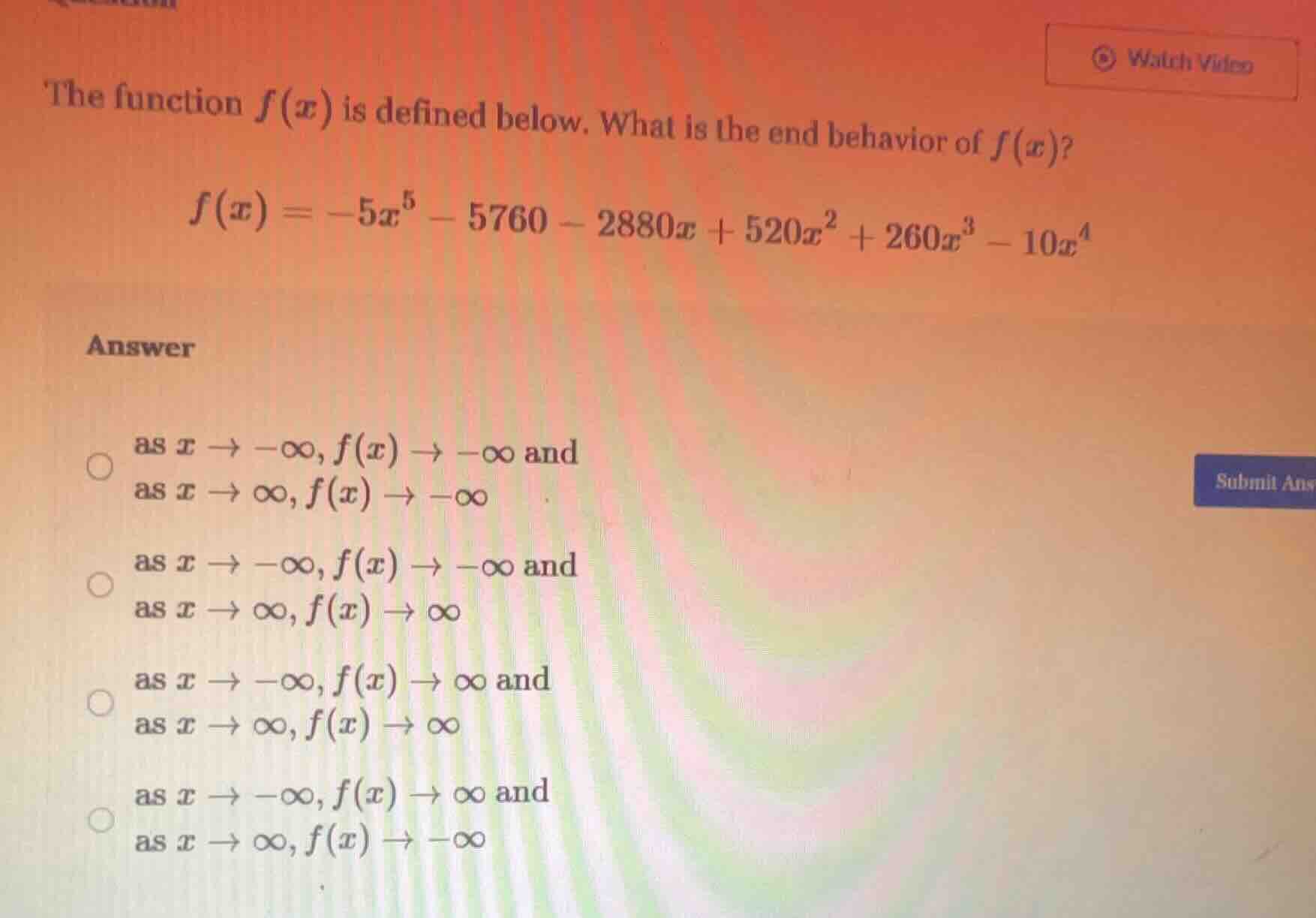
the function $f(x)$ is defined below. what is the end behavior of $f(x)$?
$f(x) = -5x^5 - 5760 - 2880x + 520x^2 + 260x^3 - 10x^4$
answer
\\(\circ\\) as $x \to -\infty, f(x) \to -\infty$ and as $x \to \infty, f(x) \to -\infty$
\\(\circ\\) as $x \to -\infty, f(x) \to -\infty$ and as $x \to \infty, f(x) \to \infty$
\\(\circ\\) as $x \to -\infty, f(x) \to \infty$ and as $x \to \infty, f(x) \to \infty$
\\(\circ\\) as $x \to -\infty, f(x) \to \infty$ and as $x \to \infty, f(x) \to -\infty$
Step1: Identify the leading term
The leading term of a polynomial is the term with the highest degree. For the polynomial \( f(x) = -5x^5 - 5760 - 2880x + 520x^2 + 260x^3 - 10x^4 \), we look at the exponents of \( x \) in each term. The degrees are: for \( -5x^5 \) it's 5, for \( -10x^4 \) it's 4, for \( 260x^3 \) it's 3, for \( 520x^2 \) it's 2, for \( -2880x \) it's 1, and for the constant term \( -5760 \) it's 0. So the leading term is \( -5x^5 \), with leading coefficient \( -5 \) and degree \( 5 \) (which is odd).
Step2: Analyze end behavior based on leading term
For a polynomial, the end behavior is determined by the leading term. The rules for end behavior are:
- If the degree is odd:
- If the leading coefficient is positive: as \( x \to \infty \), \( f(x) \to \infty \); as \( x \to -\infty \), \( f(x) \to -\infty \).
- If the leading coefficient is negative: as \( x \to \infty \), \( f(x) \to -\infty \); as \( x \to -\infty \), \( f(x) \to \infty \).
Here, the degree (5) is odd and the leading coefficient (\( -5 \)) is negative. So:
- As \( x \to \infty \), \( f(x) \to -\infty \) (because for large positive \( x \), \( -5x^5 \) will be a large negative number, and the other terms become negligible compared to the leading term).
- As \( x \to -\infty \), \( f(x) \to \infty \) (because for large negative \( x \), \( x^5 \) is negative (since 5 is odd), so \( -5x^5 = -5\times(\text{negative}) = \text{positive} \), and again the other terms are negligible, so \( f(x) \) goes to \( \infty \)).

Snap & solve any problem in the app
Get step-by-step solutions on Sovi AI
Photo-based solutions with guided steps
Explore more problems and detailed explanations
as \( x \to -\infty \), \( f(x) \to \infty \) and as \( x \to \infty \), \( f(x) \to -\infty \) (the last option among the choices, which is the one with "as \( x \to -\infty, f(x) \to \infty \) and as \( x \to \infty, f(x) \to -\infty \)")