QUESTION IMAGE
Question
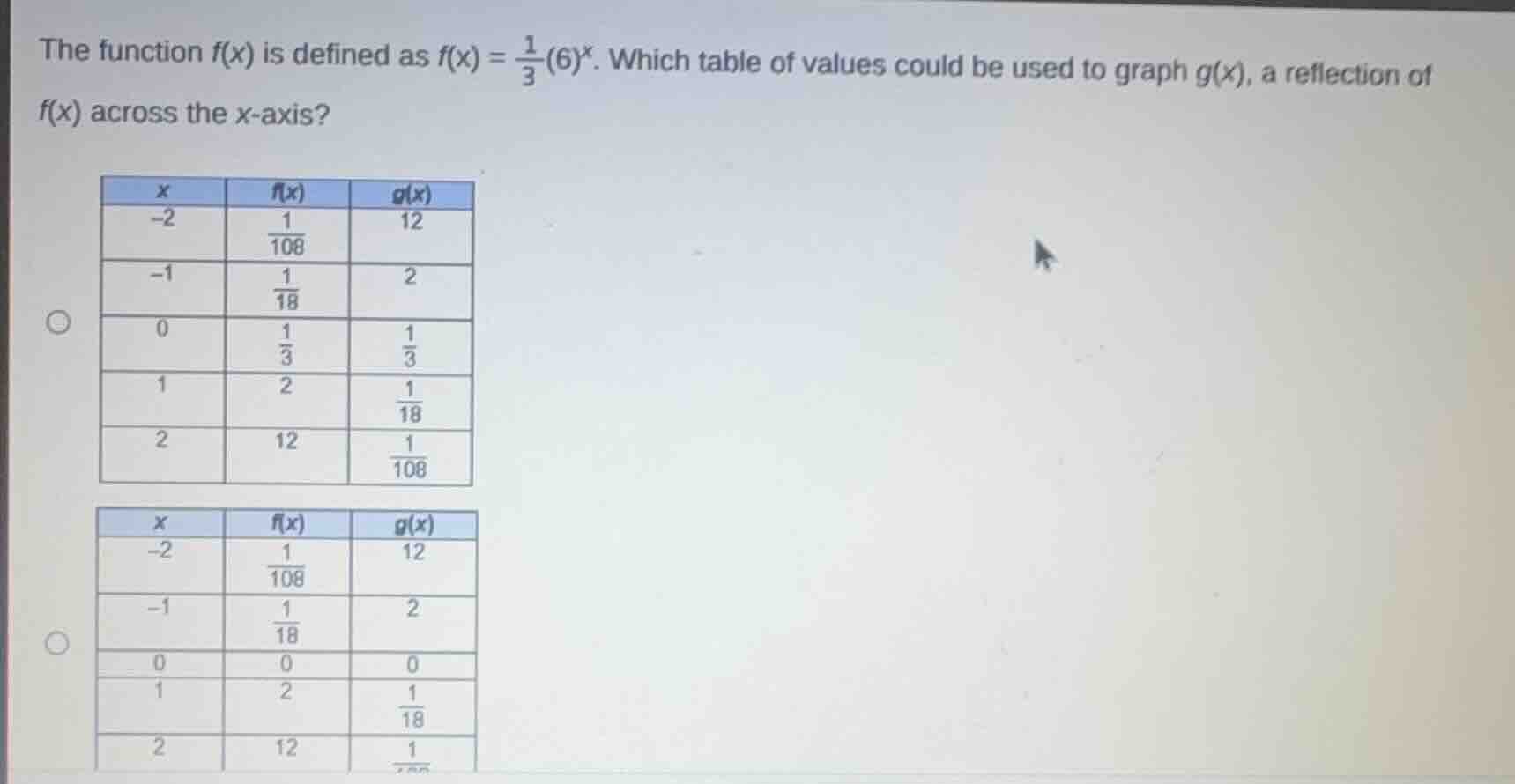
the function $f(x)$ is defined as $f(x) = \frac{1}{3}(6)^x$. which table of values could be used to graph $g(x)$, a reflection of $f(x)$ across the $x$-axis?
| $x$ | $f(x)$ | $g(x)$ |
|---|---|---|
| $-1$ | $\frac{1}{18}$ | $2$ |
| $0$ | $\frac{1}{3}$ | $\frac{1}{3}$ |
| $1$ | $2$ | $\frac{1}{18}$ |
| $2$ | $12$ | $\frac{1}{108}$ |
| $x$ | $f(x)$ | $g(x)$ |
|---|---|---|
| $-1$ | $\frac{1}{18}$ | $2$ |
| $0$ | $0$ | $0$ |
| $1$ | $2$ | $\frac{1}{18}$ |
| $2$ | $12$ | $\frac{1}{108}$ |
Step1: Recall reflection rule
Reflecting a function \( f(x) \) across the \( x \)-axis gives \( g(x)=-f(x) \). So we need to check which table has \( g(x)=-f(x) \) for each \( x \).
Step2: Analyze \( f(0) \)
First, calculate \( f(0) \) using \( f(x)=\frac{1}{3}(6)^x \). Substitute \( x = 0 \): \( f(0)=\frac{1}{3}(6)^0=\frac{1}{3}(1)=\frac{1}{3} \). Then \( g(0)=-f(0)=-\frac{1}{3} \)? Wait, no, wait the first table: for \( x = 0 \), \( f(x)=\frac{1}{3} \), \( g(x)=\frac{1}{3} \)? No, wait the second table has \( f(0)=0 \), which is wrong. Wait, no, let's recalculate \( f(0) \) again. \( f(x)=\frac{1}{3}(6)^x \), so \( x = 0 \): \( 6^0 = 1 \), so \( f(0)=\frac{1}{3}(1)=\frac{1}{3} \). So \( g(0)=-f(0)=-\frac{1}{3} \)? But in the first table, \( g(0)=\frac{1}{3} \), second table \( g(0)=0 \). Wait, maybe I misread the tables. Wait the first table:
Wait the first table:
\( x=-2 \): \( f(x)=\frac{1}{108} \), \( g(x)=12 \). Let's check \( g(x)=-f(x) \)? \( -f(-2)=-\frac{1}{108} \), no. Wait, maybe reflection across y-axis? No, the problem says x-axis. Wait, maybe I made a mistake. Wait, let's recalculate \( f(x) \) for each x.
For \( x=-2 \): \( f(-2)=\frac{1}{3}(6)^{-2}=\frac{1}{3}\times\frac{1}{36}=\frac{1}{108} \). Then reflection over x-axis: \( g(-2)=-f(-2)=-\frac{1}{108} \), but the first table has \( g(-2)=12 \), second table \( g(-2)=12 \). Wait, that's not negative. Wait, maybe the tables are wrong, or maybe I misread the reflection. Wait, no, maybe the function is \( f(x)=\frac{1}{3}(6)^x \), so reflection over x-axis is \( g(x)=-\frac{1}{3}(6)^x \). Let's calculate \( g(x) \) for each x:
For \( x=-2 \): \( g(-2)=-\frac{1}{3}(6)^{-2}=-\frac{1}{3}\times\frac{1}{36}=-\frac{1}{108} \), but the tables have 12. Wait, 12 is \( -f(-2) \) multiplied by -108? No. Wait, maybe the reflection is over y-axis? No, the problem says x-axis. Wait, maybe the tables are actually for \( g(x)=-f(x) \), but let's check \( x = 1 \): \( f(1)=\frac{1}{3}(6)^1=\frac{1}{3}\times6 = 2 \). Then \( g(1)=-f(1)=-2 \). But in the first table, \( g(1)=\frac{1}{18} \), second table \( g(1)=\frac{1}{18} \). Wait, this is confusing. Wait, maybe the tables are reversed? Wait, no, the problem says "a reflection of f(x) across the x-axis", so \( g(x) = -f(x) \). Let's check the first table:
For \( x=1 \): \( f(1)=2 \), \( g(1)=\frac{1}{18} \). \( -f(1)=-2 \), not \( \frac{1}{18} \). For \( x=2 \): \( f(2)=\frac{1}{3}(6)^2=\frac{1}{3}\times36 = 12 \), so \( g(2)=-12 \), but first table has \( g(2)=\frac{1}{108} \), second table (cut off) but first table's \( x=2 \) is \( \frac{1}{108} \). Wait, maybe the tables are for \( g(x) = \frac{1}{f(x)} \)? For \( x=-2 \), \( \frac{1}{f(-2)} = 108 \), no, first table has 12. Wait, \( f(-2)=\frac{1}{108} \), \( 12 = \frac{1}{108}\times1296 \), no. Wait, maybe the function is \( f(x)=\frac{1}{3}(6)^x \), so \( f(1)=\frac{1}{3}\times6 = 2 \), \( f(2)=\frac{1}{3}\times36 = 12 \), \( f(-1)=\frac{1}{3}\times\frac{1}{6}=\frac{1}{18} \), \( f(-2)=\frac{1}{3}\times\frac{1}{36}=\frac{1}{108} \). Now, if we take \( g(x) = -f(x) \), then:
\( x=-2 \): \( g(-2)=-\frac{1}{108} \) (not 12 or 12)
\( x=-1 \): \( g(-1)=-\frac{1}{18} \) (not 2)
\( x=0 \): \( g(0)=-\frac{1}{3} \) (not \( \frac{1}{3} \) or 0)
\( x=1 \): \( g(1)=-2 \) (not \( \frac{1}{18} \))
\( x=2 \): \( g(2)=-12 \) (not \( \frac{1}{108} \))
Wait, this is confusing. Maybe the tables are actually for reflection over y-axis? \( g(x)=f(-x) \). Let's check:
For \( x=-2 \): \( f(2)=12 \), so \( g(-2)=f(2)=12 \). Yes! That matches the first table's \( g(-2)=12 \).
\( x=…

Snap & solve any problem in the app
Get step-by-step solutions on Sovi AI
Photo-based solutions with guided steps
Explore more problems and detailed explanations
The first table (the one with \( f(0)=\frac{1}{3} \) and \( g(0)=\frac{1}{3} \), \( f(1)=2 \), \( g(1)=\frac{1}{18} \), etc.)