QUESTION IMAGE
Question
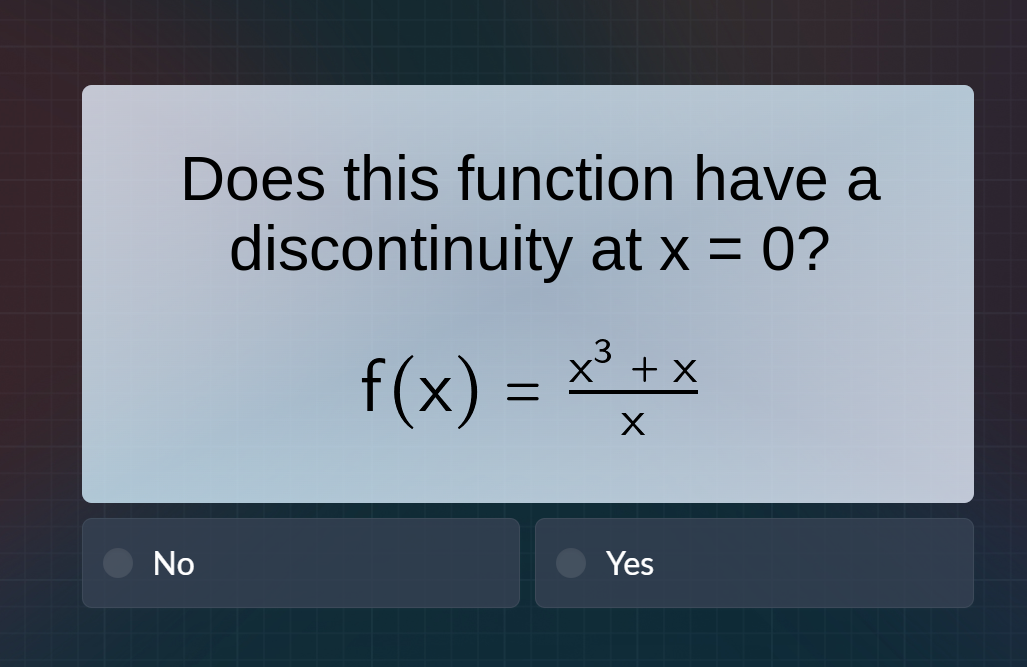
does this function have a discontinuity at x = 0?
$f(x) = \frac{x^3 + x}{x}$
no yes
Step1: Simplify the function
To analyze the discontinuity, first simplify \( f(x)=\frac{x^{3}+x}{x} \) for \( x
eq0 \) (since \( x = 0 \) makes the denominator zero, but we can simplify by factoring out \( x \) from the numerator).
Factor the numerator: \( x^{3}+x=x(x^{2} + 1) \).
So, \( f(x)=\frac{x(x^{2}+1)}{x} \), and for \( x
eq0 \), we can cancel the \( x \) terms, getting \( f(x)=x^{2}+1 \) (for \( x
eq0 \)).
Step2: Check the limit as \( x \to 0 \)
Now, find the limit of \( f(x) \) as \( x \) approaches \( 0 \). Using the simplified function \( f(x)=x^{2}+1 \) (valid for \( x
eq0 \)), we calculate \( \lim_{x\to0}f(x)=\lim_{x\to0}(x^{2}+1) \).
Substitute \( x = 0 \) into \( x^{2}+1 \): \( 0^{2}+1 = 1 \).
Step3: Check the function's behavior at \( x = 0 \)
The original function \( f(x)=\frac{x^{3}+x}{x} \) is undefined at \( x = 0 \) (since division by zero is undefined), but the limit as \( x \to 0 \) exists (it is \( 1 \)). A discontinuity occurs when the function is undefined at a point, or the limit does not exist, or the limit does not equal the function's value at that point. Here, \( f(0) \) is undefined, but the limit as \( x \to 0 \) exists. However, we also need to see if we can redefine the function at \( x = 0 \) to make it continuous. But the question is whether there is a discontinuity at \( x = 0 \). Since the function is undefined at \( x = 0 \), and the limit exists, this is a removable discontinuity (a type of discontinuity). Wait, but let's re - evaluate. Wait, the process:
Wait, the definition of continuity: A function \( y = f(x) \) is continuous at \( x = a \) if three conditions are met:
- \( f(a) \) is defined.
- \( \lim_{x\to a}f(x) \) exists.
- \( \lim_{x\to a}f(x)=f(a) \).
At \( x = 0 \):
- \( f(0) \) is undefined (because plugging \( x = 0 \) into \( \frac{x^{3}+x}{x} \) gives \( \frac{0}{0} \), which is undefined).
So, condition 1 is not met. Therefore, the function has a discontinuity at \( x = 0 \) (specifically, a removable discontinuity, but it is still a discontinuity). Wait, but earlier when we simplified, we saw that the limit exists. But the key is that the function is undefined at \( x = 0 \), so it is discontinuous there.
Wait, but let's check again. Wait, maybe I made a mistake. Wait, the function \( f(x)=\frac{x^{3}+x}{x} \) can be simplified to \( x^{2}+1 \) for all \( x
eq0 \). The limit as \( x\to0 \) is \( 1 \), but \( f(0) \) is undefined. So, the function has a discontinuity at \( x = 0 \) (because it's undefined there, even though the limit exists). So the answer should be yes.
Wait, but let's confirm with the definition of discontinuity: A point \( x = a \) is a point of discontinuity of a function \( f(x) \) if \( f(x) \) is not continuous at \( x = a \). And a function is not continuous at \( x = a \) if it fails any of the three continuity conditions. Since \( f(0) \) is undefined, it fails the first condition, so it is discontinuous at \( x = 0 \).

Snap & solve any problem in the app
Get step-by-step solutions on Sovi AI
Photo-based solutions with guided steps
Explore more problems and detailed explanations
Yes