QUESTION IMAGE
Question
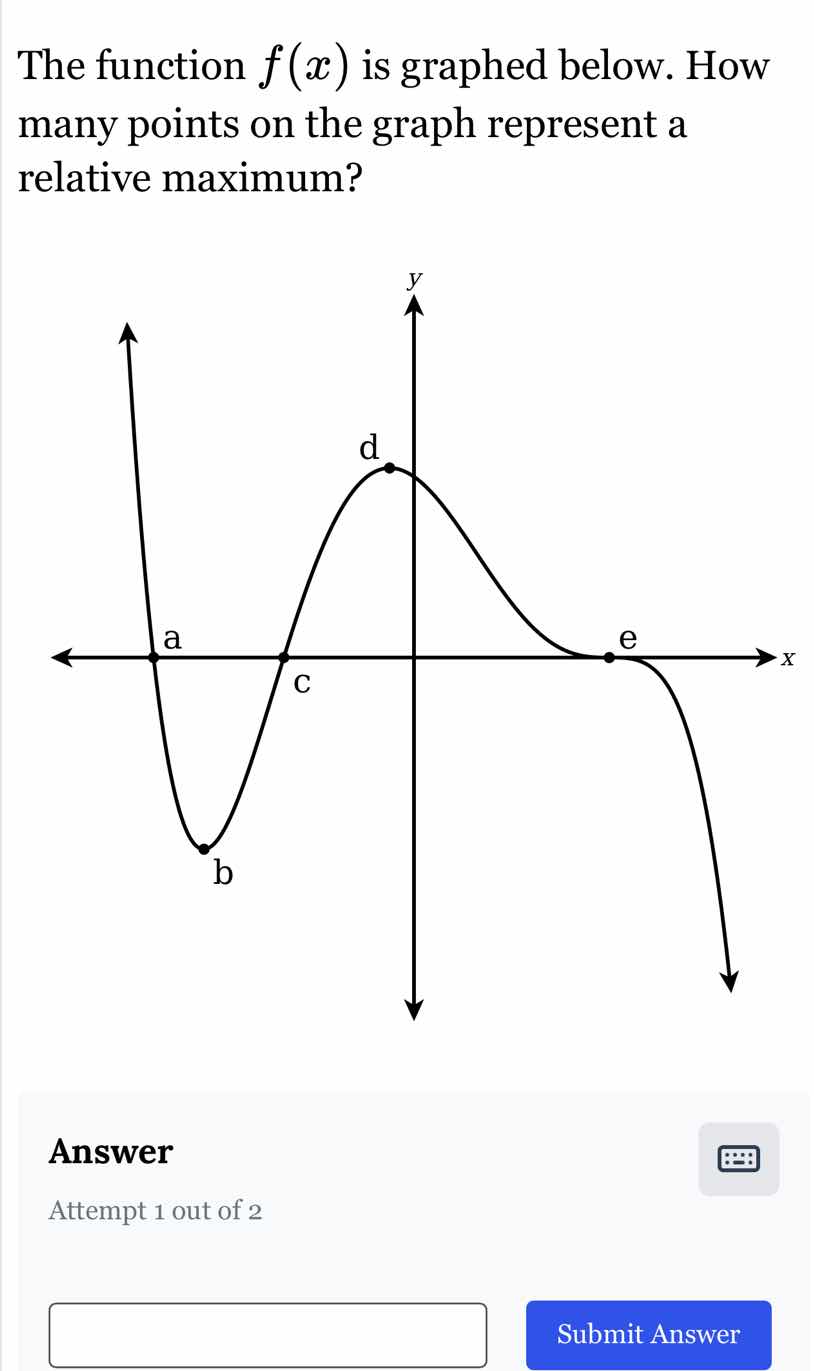
the function $f(x)$ is graphed below. how many points on the graph represent a relative maximum?
graph of a function with points labeled a, b, c, d, e
answer
attempt 1 out of 2
submit answer button
Step1: Define relative maximum
A relative maximum is a point where the function changes from increasing to decreasing, and the function value at that point is greater than the values at neighboring points.
Step2: Analyze each point
- Point \(a\): It's an \(x\)-intercept, the function is decreasing before and increasing after? No, before \(a\) the function is going up, after \(a\) it goes down to \(b\), but \(a\) is on the \(x\)-axis, not a peak.
- Point \(b\): It's a relative minimum (function changes from decreasing to increasing here).
- Point \(c\): \(x\)-intercept, function is increasing before and after? No, before \(c\) it was increasing from \(b\), after \(c\) it continues to increase to \(d\).
- Point \(d\): Here, the function changes from increasing (coming from \(c\) to \(d\)) to decreasing (after \(d\) it goes down), and \(d\) is higher than its neighbors. So \(d\) is a relative maximum.
- Point \(e\): It's a point where the function touches the \(x\)-axis and then goes down, but before \(e\) the function was decreasing to \(e\) (from \(d\) to \(e\) it's decreasing) and after \(e\) it's decreasing more. So \(e\) is not a relative maximum (it's a point where the function stops decreasing? Wait, no, the graph approaches \(e\) from above (since before \(e\) the function is above \(x\)-axis, touches \(e\) and then goes down). Wait, actually, at \(e\), the function has a horizontal tangent? But the key is relative maximum: a point where around it, the function is higher. At \(d\), the function is higher than left (from \(c\) to \(d\) increasing) and right (from \(d\) to \(e\) decreasing). At \(e\), the left side (towards \(d\)) is decreasing to \(e\), and right side is decreasing from \(e\). So \(e\) is not a relative maximum. Only \(d\) is a relative maximum? Wait, wait, maybe I made a mistake. Wait, the graph: from \(b\) to \(d\), the function is increasing (from \(b\) up to \(d\)), then from \(d\) to \(e\) it's decreasing, then from \(e\) down. So \(d\) is a relative maximum. Is there another? Wait, the left part: from the left end (going down to \(a\), then down to \(b\), then up to \(c\), then up to \(d\)). Wait, \(b\) is a minimum. \(d\) is a maximum. What about the leftmost part? The left end is going up, so as \(x\) approaches \(-\infty\), the function goes to \(+\infty\)? Wait, no, the left end arrow is going up, so the function is increasing as \(x\) approaches \(-\infty\)? Wait, the graph: leftmost point, the arrow is up, so when \(x\) is very small (negative, large magnitude), \(f(x)\) is large positive, then it comes down to \(a\), then down to \(b\), then up to \(c\), then up to \(d\), then down to \(e\), then down. Wait, so before \(a\), the function is decreasing (from \(+\infty\) to \(a\)), then from \(a\) to \(b\) it's decreasing, then from \(b\) to \(d\) it's increasing (since \(b\) to \(c\) to \(d\) is up), then \(d\) to \(e\) is down, \(e\) to right is down. So the relative maximum: a point where the function changes from increasing to decreasing. So from \(b\) to \(d\), the function is increasing (so the slope is positive), then from \(d\) to \(e\), slope is negative. So \(d\) is a relative maximum. Is there another? Wait, the leftmost part: as \(x\) approaches \(-\infty\), \(f(x)\) approaches \(+\infty\), but that's a limit, not a point. The actual points: \(d\) is the only point where the function changes from increasing to decreasing. Wait, but wait, maybe I misread the graph. Let me re-examine: the graph has a minimum at \(b\), then increases to \(d\), then decreases to \(e\), then decreases mor…

Snap & solve any problem in the app
Get step-by-step solutions on Sovi AI
Photo-based solutions with guided steps
Explore more problems and detailed explanations
1