QUESTION IMAGE
Question
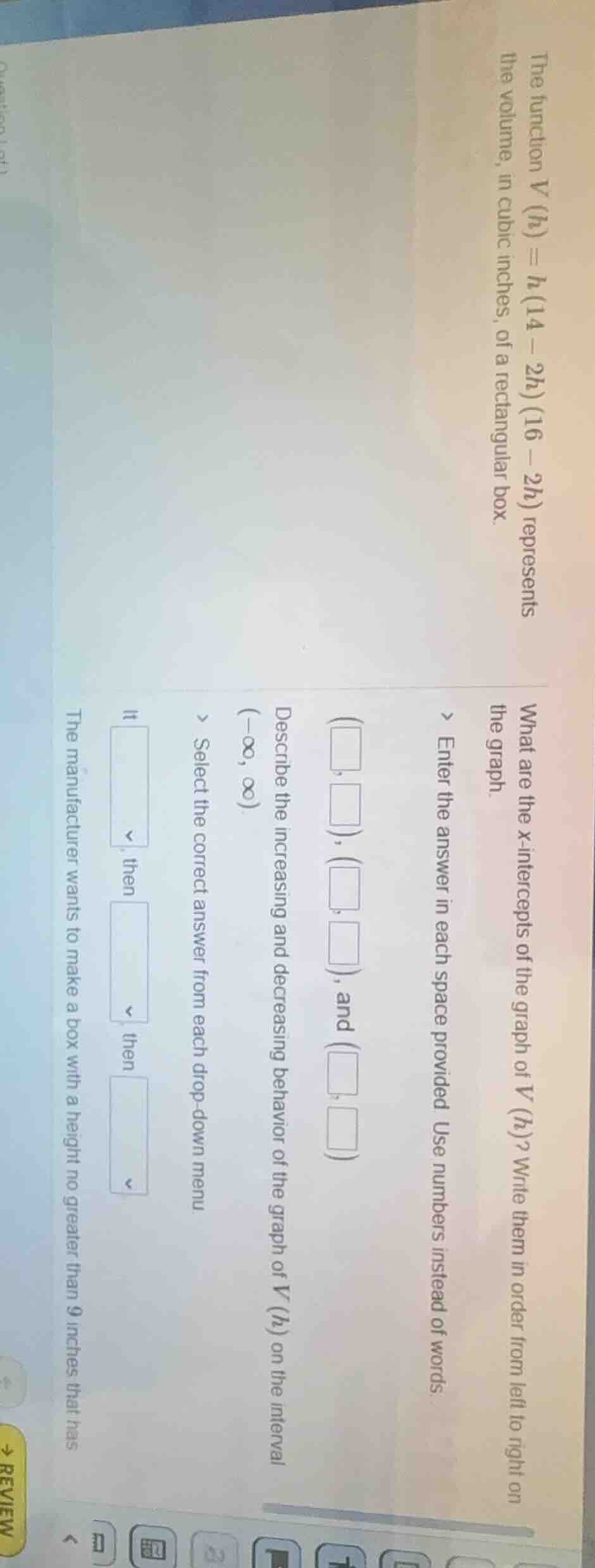
the function $v(h) = h(14 - 2h)(16 - 2h)$ represents the volume, in cubic inches, of a rectangular box.
what are the x-intercepts of the graph of $v(h)$? write them in order from left to right on the graph.
enter the answer in each space provided. use numbers instead of words.
$(\square, \square)$, $(\square, \square)$, and $(\square, \square)$
describe the increasing and decreasing behavior of the graph of $v(h)$ on the interval $(-\infty, \infty)$.
select the correct answer from each drop-down menu
it $\boldsymbol{\downarrow}$ then $\boldsymbol{\downarrow}$ then $\boldsymbol{\downarrow}$
the manufacturer wants to make a box with a height no greater than 9 inches that has
Step1: Find x-intercepts (V(h)=0)
Set $h(14-2h)(16-2h)=0$
Solve each factor:
$h=0$; $14-2h=0 \implies h=7$; $16-2h=0 \implies h=8$
Step2: Order intercepts left to right
Sort the solutions: $0, 7, 8$
Step3: Simplify volume function
Expand $V(h)=h(14-2h)(16-2h)$:
First multiply $(14-2h)(16-2h)=224-28h-32h+4h^2=4h^2-60h+224$
Then $V(h)=h(4h^2-60h+224)=4h^3-60h^2+224h$
Step4: Find critical points
Take derivative $V'(h)=12h^2-120h+224$
Set $V'(h)=0$: $12h^2-120h+224=0$
Divide by 4: $3h^2-30h+56=0$
Use quadratic formula $h=\frac{30\pm\sqrt{900-672}}{6}=\frac{30\pm\sqrt{228}}{6}=\frac{30\pm2\sqrt{57}}{6}=\frac{15\pm\sqrt{57}}{3}$
Calculate approximate values: $\frac{15+\sqrt{57}}{3}\approx7.26$, $\frac{15-\sqrt{57}}{3}\approx2.74$
Step5: Test intervals for increase/decrease
For $(-\infty,2.74)$: $V'(h)>0$ (increasing)
For $(2.74,7.26)$: $V'(h)<0$ (decreasing)
For $(7.26,\infty)$: $V'(h)>0$ (increasing)
Step6: Apply height constraint ($h\leq9$)
Since volume is positive only for $0

Snap & solve any problem in the app
Get step-by-step solutions on Sovi AI
Photo-based solutions with guided steps
Explore more problems and detailed explanations
- x-intercepts: $(0,0)$, $(7,0)$, and $(8,0)$
- Increasing/decreasing behavior:
On $(-\infty, \infty)$:
- Increasing on $(-\infty, \frac{15-\sqrt{57}}{3})$, decreasing on $(\frac{15-\sqrt{57}}{3}, \frac{15+\sqrt{57}}{3})$, increasing on $(\frac{15+\sqrt{57}}{3}, \infty)$
For valid box heights ($h>0$, volume positive):
If $0 < h < \frac{15-\sqrt{57}}{3}$ (≈2.74), then volume is increasing; if $\frac{15-\sqrt{57}}{3} < h < 7$, then volume is decreasing; if $7 < h \leq9$, then volume is negative (not a valid box)