QUESTION IMAGE
Question
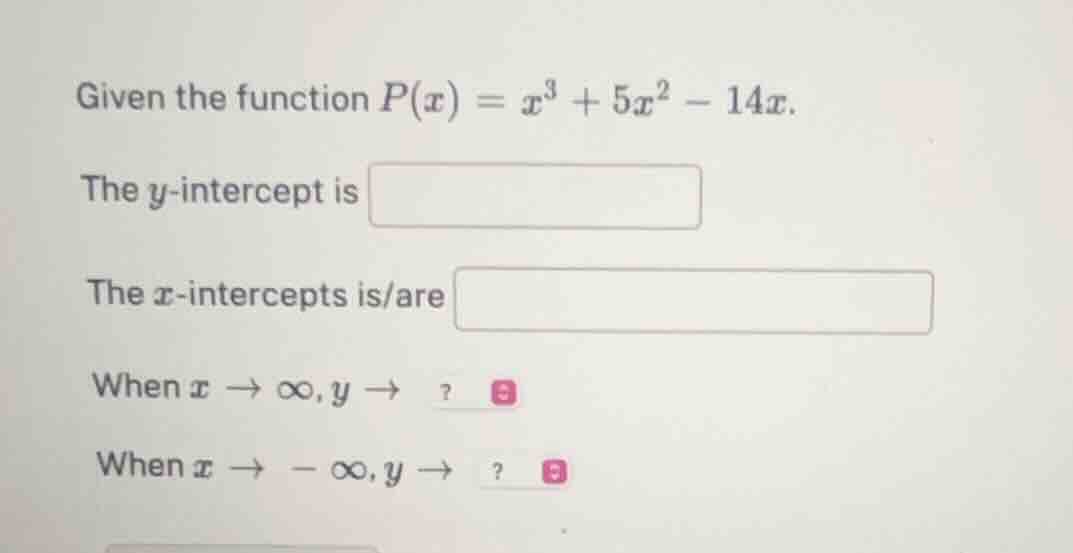
given the function $p(x) = x^3 + 5x^2 - 14x$.
the $y$-intercept is
the $x$-intercepts is/are
when $x \
ightarrow \infty, y \
ightarrow$ ?
when $x \
ightarrow -\infty, y \
ightarrow$ ?
y - intercept
Step1: Recall y - intercept definition
The y - intercept of a function \(y = P(x)\) is the value of \(y\) when \(x = 0\).
Step2: Substitute \(x = 0\) into \(P(x)\)
Substitute \(x = 0\) into \(P(x)=x^{3}+5x^{2}-14x\). We get \(P(0)=0^{3}+5\times0^{2}-14\times0 = 0\).
Step1: Recall x - intercept definition
The x - intercepts of a function \(y = P(x)\) are the values of \(x\) when \(y = 0\), i.e., we need to solve the equation \(P(x)=0\).
Step2: Solve \(x^{3}+5x^{2}-14x = 0\)
Factor out an \(x\) from the left - hand side of the equation: \(x(x^{2}+5x - 14)=0\).
Then, factor the quadratic expression \(x^{2}+5x - 14\). We need to find two numbers that multiply to \(- 14\) and add up to \(5\). The numbers are \(7\) and \(-2\). So, \(x^{2}+5x - 14=(x + 7)(x-2)\).
The factored form of the equation is \(x(x + 7)(x - 2)=0\).
Using the zero - product property (if \(ab = 0\), then either \(a = 0\) or \(b = 0\) or \(c = 0\) for \(a\times b\times c=0\)), we have \(x=0\) or \(x + 7=0\) (which gives \(x=-7\)) or \(x - 2=0\) (which gives \(x = 2\)).
Step1: Recall end - behavior of polynomial functions
For a polynomial function \(P(x)=a_{n}x^{n}+a_{n - 1}x^{n - 1}+\cdots+a_{1}x + a_{0}\), the end - behavior is determined by the leading term \(a_{n}x^{n}\) (the term with the highest power of \(x\)).
In the polynomial \(P(x)=x^{3}+5x^{2}-14x\), the leading term is \(x^{3}\) (where \(a_{n}=1\) and \(n = 3\), and \(n\) is odd).
Step2: Analyze end - behavior for \(x
ightarrow\infty\)
When \(n\) is odd and \(a_{n}>0\), as \(x
ightarrow\infty\), \(x^{n}
ightarrow\infty\). Since \(a_{n}=1>0\) and \(n = 3\) (odd), when \(x
ightarrow\infty\), \(x^{3}
ightarrow\infty\), so \(P(x)=x^{3}+5x^{2}-14x
ightarrow\infty\).
Step3: Analyze end - behavior for \(x
ightarrow-\infty\)
When \(n\) is odd and \(a_{n}>0\), as \(x
ightarrow-\infty\), \(x^{n}
ightarrow-\infty\) (because for an odd power, a negative number raised to an odd power is negative). Since \(a_{n}=1>0\) and \(n = 3\) (odd), when \(x
ightarrow-\infty\), \(x^{3}
ightarrow-\infty\), so \(P(x)=x^{3}+5x^{2}-14x
ightarrow-\infty\).

Snap & solve any problem in the app
Get step-by-step solutions on Sovi AI
Photo-based solutions with guided steps
Explore more problems and detailed explanations
The y - intercept is \(0\).