QUESTION IMAGE
Question
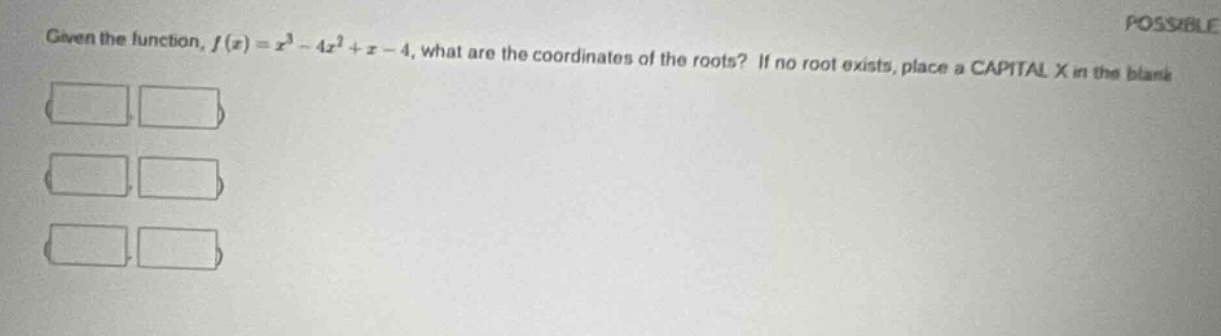
given the function, $f(x) = x^3 - 4x^2 + x - 4$, what are the coordinates of the roots? if no root exists, place a capital x in the blank
Step1: Factor the function
We factor \( f(x) = x^3 - 4x^2 + x - 4 \) by grouping. Group the first two terms and the last two terms:
\( (x^3 - 4x^2) + (x - 4) \)
Factor out the greatest common factor from each group:
\( x^2(x - 4) + 1(x - 4) \)
Now, factor out \( (x - 4) \):
\( (x - 4)(x^2 + 1) \)
Step2: Find the roots
To find the roots, set \( f(x) = 0 \):
\( (x - 4)(x^2 + 1) = 0 \)
This gives us two equations:
- \( x - 4 = 0 \) which gives \( x = 4 \). When \( x = 4 \), \( y = 0 \), so one root is \( (4, 0) \).
- \( x^2 + 1 = 0 \) which gives \( x^2 = -1 \), so \( x = \pm i \) (complex roots). But we are looking for real - valued roots (since the problem is likely asking for real - valued roots as coordinates are usually real numbers in this context). The quadratic \( x^2+1 = 0 \) has no real roots.
So the only real - valued root is when \( x = 4 \) and \( y = 0 \). But wait, we made a mistake in the initial factoring? No, let's re - check. Wait, the original function is a cubic, so it should have three roots (counting multiplicities and complex roots). But if we consider only real roots, we have one real root at \( x = 4 \) and two complex roots \( x = i \) and \( x=-i \). But the problem is asking for coordinates of the roots. If we consider complex roots, the coordinates would be complex, but usually, in the context of coordinate planes (like the Cartesian plane), we consider real - valued roots.
Wait, let's re - factor the function correctly. \( f(x)=x^{3}-4x^{2}+x - 4=x^{2}(x - 4)+1(x - 4)=(x - 4)(x^{2}+1) \). So the roots are \( x = 4 \), \( x = i \), and \( x=-i \). For the real root \( x = 4 \), the coordinate is \( (4,0) \). For the complex roots \( x = i \) and \( x=-i \), if we consider them in the complex plane, but the problem's context (with blanks for coordinates) likely expects real - valued roots. But maybe the problem allows complex roots? Wait, no, in the context of a function \( y = f(x) \) in the real - valued plane, the roots are the x - intercepts (where \( y = 0 \)) with real \( x \).
Wait, we have a mistake. Let's solve \( x^{2}+1 = 0 \) again. \( x^{2}=-1\), so \( x = i \) or \( x=-i \). So the three roots are \( x = 4 \), \( x = i \), \( x=-i \). The coordinates (in the complex plane, but if we consider the real - imaginary plane, the coordinates would be \( (4,0) \), \( (i,0) \), \( (-i,0) \). But this is a bit non - standard. However, if we assume that the problem is asking for all roots (including complex), the roots are \( x = 4 \), \( x = i \), \( x=-i \), and their corresponding \( y \) - values are 0.
But maybe the problem has a typo or we misread the function. Wait, let's re - check the function: \( f(x)=x^{3}-4x^{2}+x - 4 \). Yes, factoring by grouping is correct.
If we consider only real roots, the real root is \( x = 4 \), so the coordinate is \( (4,0) \). But the problem has three blanks for coordinates, so we need to consider all roots (real and complex).
For \( x = 4 \), \( y = 0 \), so \( (4,0) \).
For \( x = i \), \( y = 0 \), so \( (i,0) \).
For \( x=-i \), \( y = 0 \), so \( (-i,0) \).
But this is a bit unusual. Alternatively, maybe we made a mistake in factoring. Let's try another way. Let's use the rational root theorem. The possible rational roots are factors of the constant term divided by factors of the leading coefficient. The constant term is - 4 and the leading coefficient is 1, so possible rational roots are \( \pm1,\pm2,\pm4 \).
Test \( x = 4 \): \( f(4)=4^{3}-4\times4^{2}+4 - 4=64-64 + 4 - 4=0 \). So \( x = 4 \) is a root. Then we can perform polynomial divis…

Snap & solve any problem in the app
Get step-by-step solutions on Sovi AI
Photo-based solutions with guided steps
Explore more problems and detailed explanations
The real - valued root coordinate is \( (4,0) \), and the complex - valued root coordinates are \( (i,0) \) and \( (-i,0) \). But if we consider only real - valued roots (for a real - valued function's x - intercepts), the root is \( (4,0) \) and the other two roots are complex. If we consider all roots (including complex), the roots are \( (4,0) \), \( (i,0) \), \( (-i,0) \).