QUESTION IMAGE
Question
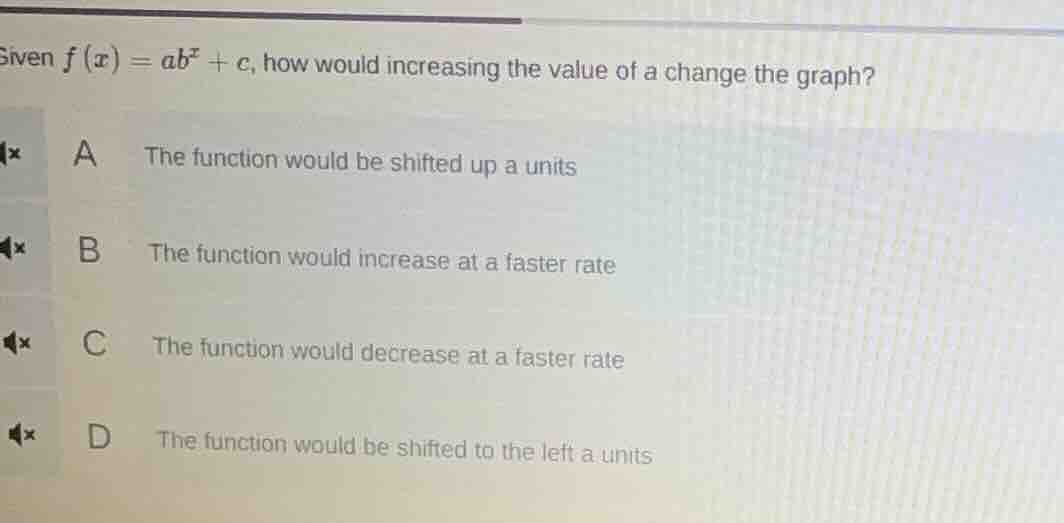
given $f(x)=ab^x + c$, how would increasing the value of $a$ change the graph?
a the function would be shifted up $a$ units
b the function would increase at a faster rate
c the function would decrease at a faster rate
d the function would be shifted to the left $a$ units
The function \( f(x) = ab^x + c \) is an exponential function. The parameter \( a \) in an exponential function \( ab^x + c \) (where \( b>1 \) for growth, \( 0 < b < 1 \) for decay) affects the vertical stretch or the rate of change. If \( a \) is increased, for a growth - oriented exponential function (when \( b>1 \)), the function values will be multiplied by a larger factor, so the function will increase at a faster rate. If \( b \) were between 0 and 1 (decay), increasing \( a \) would make the function decrease at a faster rate, but since the options B and C are about rate change, and typically in the context of exponential functions (unless specified otherwise, we consider the growth case or the general effect of \( a \) on the rate of change of the exponential part). Shifting up is related to \( c \), and shifting left/right is related to changes in the exponent (like \( b^{x - h}\) for horizontal shift), not to \( a \). So increasing \( a \) makes the function increase (or decrease) at a faster rate. Among the options, B is the correct description for the case when \( b>1 \) (the common case for exponential growth which is often the context unless stated otherwise).

Snap & solve any problem in the app
Get step-by-step solutions on Sovi AI
Photo-based solutions with guided steps
Explore more problems and detailed explanations
B. The function would increase at a faster rate