QUESTION IMAGE
Question
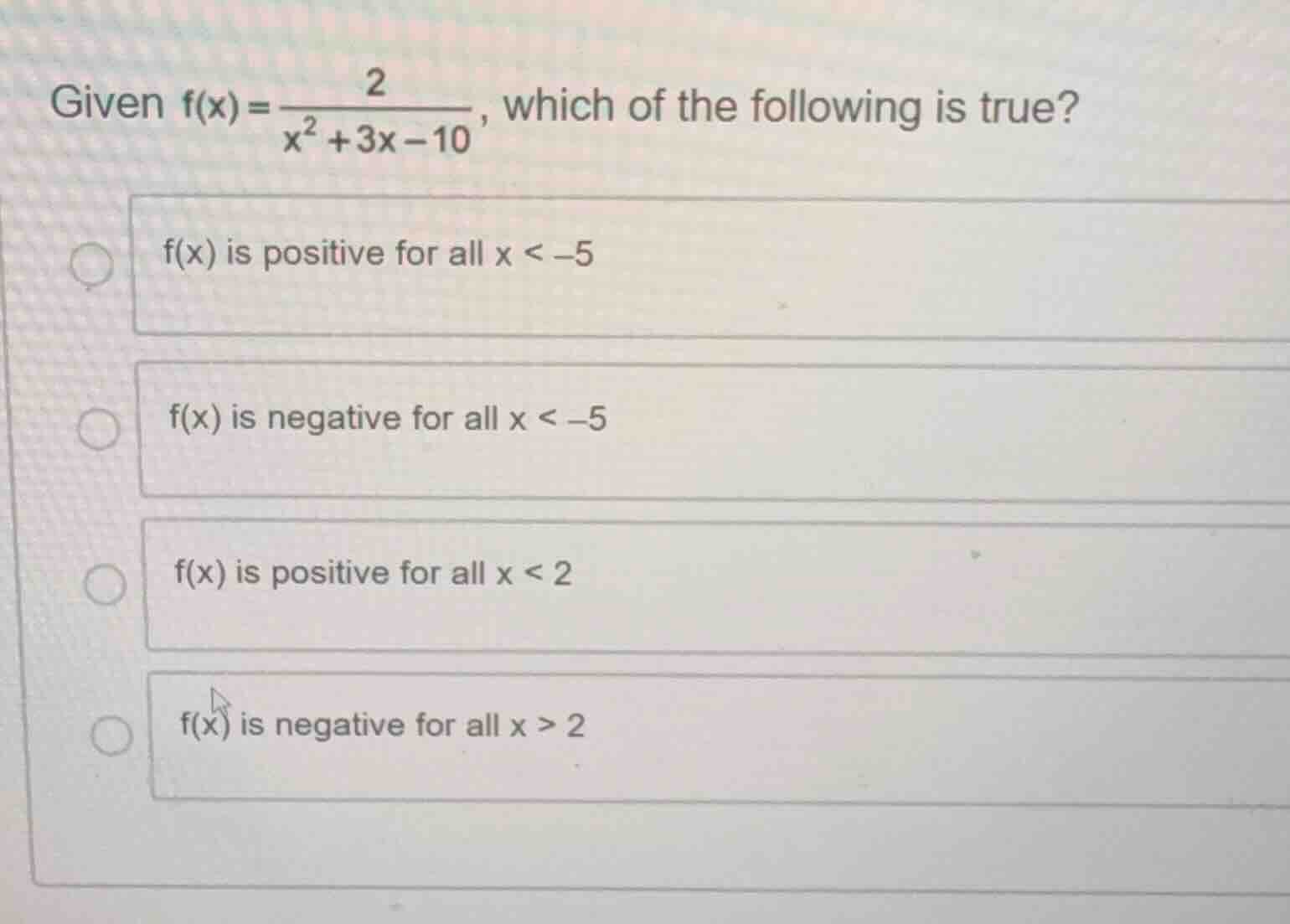
given $f(x)=\frac{2}{x^2 + 3x - 10}$, which of the following is true?
$f(x)$ is positive for all $x < -5$
$f(x)$ is negative for all $x < -5$
$f(x)$ is positive for all $x < 2$
$f(x)$ is negative for all $x > 2$
Step1: Factor the denominator
First, factor the quadratic in the denominator: \(x^2 + 3x - 10=(x + 5)(x - 2)\). So the function is \(f(x)=\frac{2}{(x + 5)(x - 2)}\).
Step2: Analyze the sign of the denominator for \(x < - 5\)
When \(x < - 5\), both \((x + 5)\) and \((x - 2)\) are negative (since \(x+5<0\) and \(x - 2<0\) when \(x < - 5\)). The product of two negative numbers is positive, so \((x + 5)(x - 2)>0\). The numerator \(2\) is positive. So a positive number divided by a positive number is positive. So \(f(x)=\frac{2}{(x + 5)(x - 2)}>0\) for \(x < - 5\).
Step3: Analyze other options
- For \(x < - 5\) we saw \(f(x)\) is positive, so the option "f(x) is negative for all \(x < - 5\)" is wrong.
- For \(x\) between \(-5\) and \(2\) (e.g., \(x = 0\)), \((x + 5)=5>0\) and \((x - 2)=- 2<0\), so \((x + 5)(x - 2)<0\), and \(f(x)=\frac{2}{(x + 5)(x - 2)}<0\). So "f(x) is positive for all \(x < 2\)" is wrong.
- For \(x>2\), both \((x + 5)\) and \((x - 2)\) are positive, so \((x + 5)(x - 2)>0\), and \(f(x)=\frac{2}{(x + 5)(x - 2)}>0\). So "f(x) is negative for all \(x>2\)" is wrong.

Snap & solve any problem in the app
Get step-by-step solutions on Sovi AI
Photo-based solutions with guided steps
Explore more problems and detailed explanations
f(x) is positive for all \(x < -5\) (the first option)