QUESTION IMAGE
Question
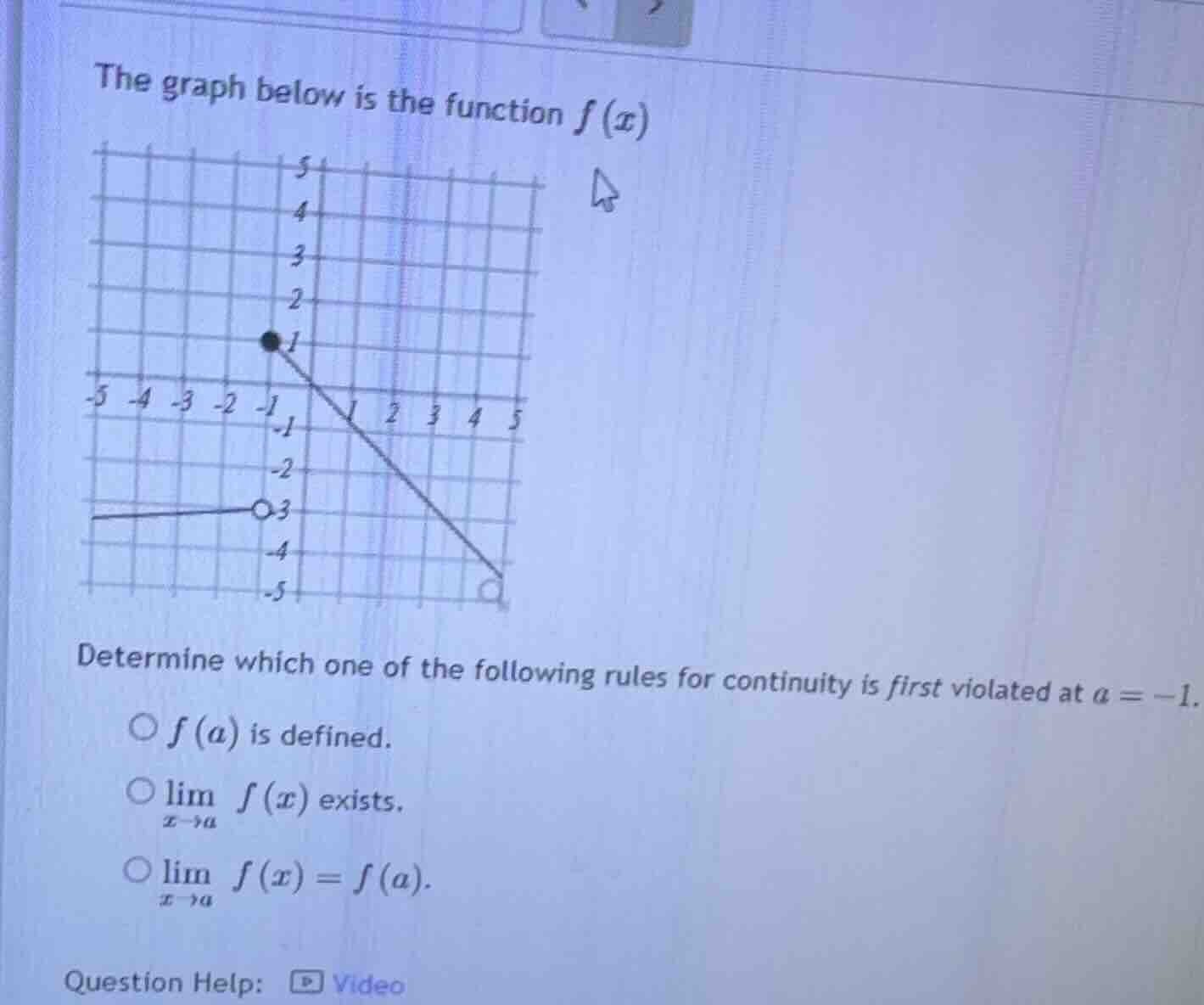
the graph below is the function $f(x)$
determine which one of the following rules for continuity is first violated at $a = -1$.
$\bigcirc$ $f(a)$ is defined.
$\bigcirc$ $\lim\limits_{x \to a} f(x)$ exists.
$\bigcirc$ $\lim\limits_{x \to a} f(x) = f(a)$.
question help: video
Step1: Recall continuity rules
A function \( f(x) \) is continuous at \( x = a \) if three conditions are met:
- \( f(a) \) is defined.
- \( \lim_{x \to a} f(x) \) exists.
- \( \lim_{x \to a} f(x) = f(a) \).
We check each condition at \( a = -1 \).
Step2: Check \( f(a) \) is defined
From the graph, at \( x = -1 \), there is a filled dot at \( y = 1 \), so \( f(-1) = 1 \). Thus, \( f(a) \) is defined.
Step3: Check \( \lim_{x \to a} f(x) \) exists
To find the limit as \( x \to -1 \), we check the left - hand limit (LHL) and right - hand limit (RHL).
- Left - hand limit: As \( x \) approaches \( -1 \) from the left, the function approaches \( - 3\) (since there is an open circle at \( (-1,-3) \) for the left - hand part of the graph).
- Right - hand limit: As \( x \) approaches \( -1 \) from the right, the function approaches \( 1\) (from the line \( y=-x \), when \( x = - 1\), \( y = 1\)).
Since LHL \(=-3\) and RHL \( = 1\), and LHL\(
eq\) RHL, \( \lim_{x\to - 1}f(x)\) does not exist.
Step4: Analyze the third condition (though not needed as we found the violation in step 3)
Since the limit does not exist, we don't need to check the third condition as the second condition for continuity is already violated.

Snap & solve any problem in the app
Get step-by-step solutions on Sovi AI
Photo-based solutions with guided steps
Explore more problems and detailed explanations
\(\lim\limits_{x\to a}f(x)\) exists.