QUESTION IMAGE
Question
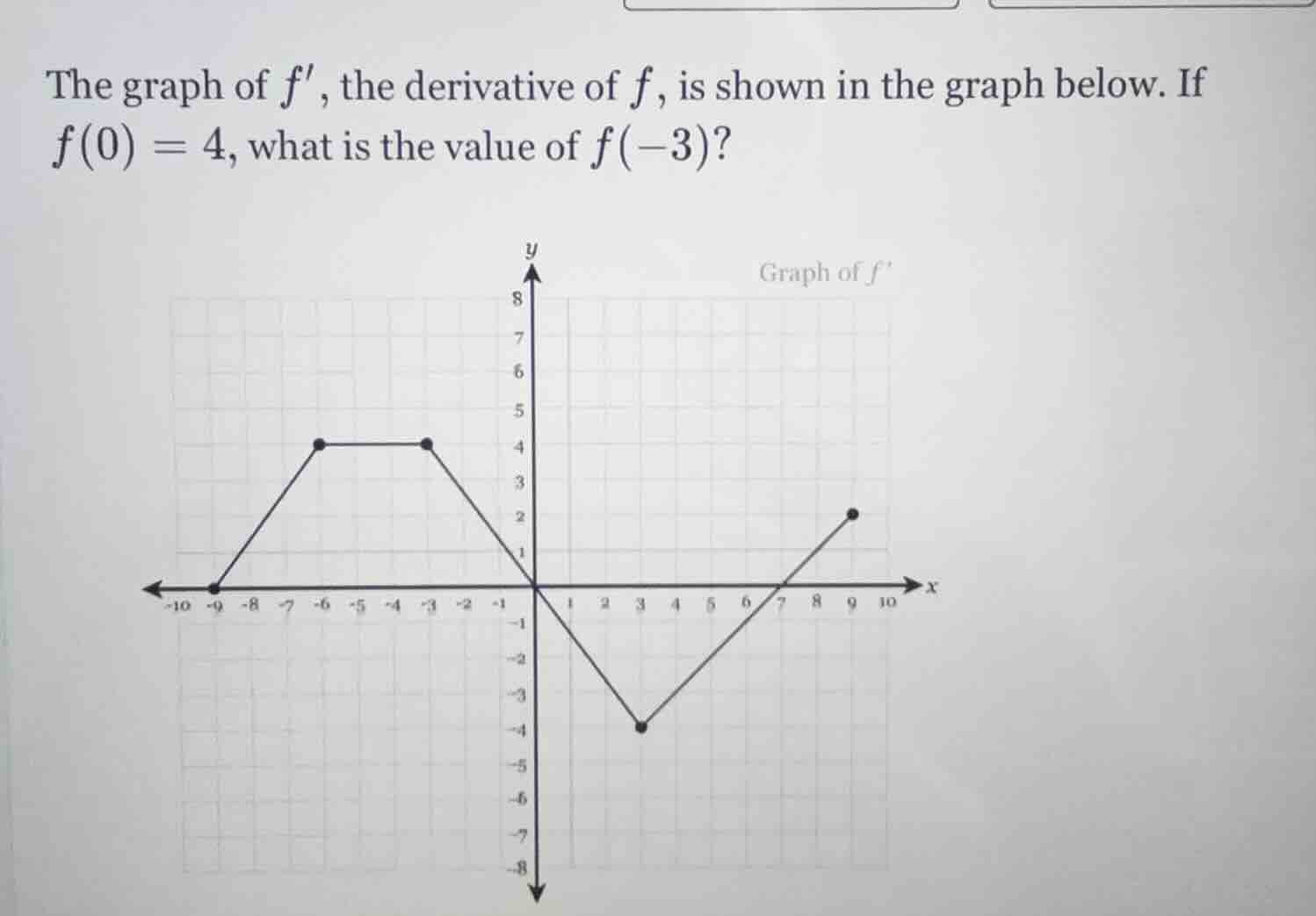
the graph of $f$, the derivative of $f$, is shown in the graph below. if $f(0) = 4$, what is the value of $f(-3)$?
Step1: Recall the Fundamental Theorem of Calculus
The Fundamental Theorem of Calculus states that \( f(b) - f(a) = \int_{a}^{b} f'(x) \, dx \). We want to find \( f(-3) \), and we know \( f(0) = 4 \). So we can rewrite the formula as \( f(-3) - f(0) = \int_{-3}^{0} f'(x) \, dx \), which implies \( f(-3) = f(0) + \int_{-3}^{0} f'(x) \, dx \). But since \( \int_{-3}^{0} f'(x) \, dx = -\int_{0}^{-3} f'(x) \, dx \), we can also think of it as \( f(-3) = f(0) - \int_{0}^{-3} f'(x) \, dx \), or more simply, we can compute the integral from \( -3 \) to \( 0 \) of \( f'(x) \) and use \( f(0) = 4 \) to find \( f(-3) \).
Step2: Analyze the graph of \( f' \) from \( x = -3 \) to \( x = 0 \)
Looking at the graph of \( f' \):
- From \( x = -3 \) to \( x = -2 \): Wait, actually, from \( x = -3 \) to \( x = 0 \), let's break down the graph. Wait, the graph of \( f' \) from \( x = -9 \) to \( x = -6 \) is a line from \( (-9, 0) \) to \( (-6, 4) \), then from \( x = -6 \) to \( x = -3 \) it's a horizontal line at \( y = 4 \), then from \( x = -3 \) to \( x = 0 \) it's a line from \( (-3, 4) \) to \( (0, 0) \). Wait, let's confirm the shape. From \( x = -3 \) to \( x = 0 \), the graph of \( f' \) is a line segment from \( (-3, 4) \) to \( (0, 0) \). So the area under \( f' \) from \( x = -3 \) to \( x = 0 \) is the area of a triangle? Wait, no, from \( x = -3 \) to \( x = 0 \), the function \( f'(x) \) is a line with slope \( \frac{0 - 4}{0 - (-3)} = -\frac{4}{3} \), but actually, the graph from \( x = -3 \) to \( x = 0 \) is a line from \( (-3, 4) \) to \( (0, 0) \). So the integral \( \int_{-3}^{0} f'(x) \, dx \) is the area between the graph of \( f' \), the \( x \)-axis, and the vertical lines \( x = -3 \) and \( x = 0 \). Since the graph is above the \( x \)-axis (from \( x = -3 \) to \( x = 0 \), \( f'(x) \) is positive), the integral is the area of the triangle with base \( 3 \) (from \( x = -3 \) to \( x = 0 \), the length is \( 0 - (-3) = 3 \)) and height \( 4 \) (at \( x = -3 \), \( f'(x) = 4 \), and at \( x = 0 \), \( f'(x) = 0 \)). Wait, the area of a triangle is \( \frac{1}{2} \times base \times height \). So base is \( 3 \) (from \( -3 \) to \( 0 \)), height is \( 4 \) (the \( y \)-value at \( x = -3 \)). So the area is \( \frac{1}{2} \times 3 \times 4 = 6 \). Wait, but let's check the intervals again. Wait, from \( x = -6 \) to \( x = -3 \), \( f'(x) = 4 \) (horizontal line). Then from \( x = -3 \) to \( x = 0 \), it's a line from \( (-3, 4) \) to \( (0, 0) \). Wait, no, the original graph: at \( x = -3 \), the point is \( (-3, 4) \), then at \( x = 0 \), it's \( (0, 0) \). So from \( x = -3 \) to \( x = 0 \), the graph is a line with slope \( (0 - 4)/(0 - (-3)) = -4/3 \), but the area under \( f'(x) \) from \( x = -3 \) to \( x = 0 \) is the integral of \( f'(x) \) from \( -3 \) to \( 0 \), which is the area of the region bounded by \( f'(x) \), the \( x \)-axis, \( x = -3 \), and \( x = 0 \). Since \( f'(x) \) is positive in this interval (from \( y = 4 \) at \( x = -3 \) to \( y = 0 \) at \( x = 0 \)), the integral is the area of the triangle with base \( 3 \) (from \( -3 \) to \( 0 \)) and height \( 4 \) (the maximum \( y \)-value in this interval). So the area is \( \frac{1}{2} \times 3 \times 4 = 6 \). Wait, but actually, from \( x = -3 \) to \( x = 0 \), the graph is a line from \( (-3, 4) \) to \( (0, 0) \), so the integral \( \int_{-3}^{0} f'(x) \, dx \) is the area of the triangle with vertices at \( (-3, 0) \), \( (0, 0) \), and \( (-3, 4) \). So that area is \( \frac{1}{2} \times \text{base} \times \text{height} = \fr…

Snap & solve any problem in the app
Get step-by-step solutions on Sovi AI
Photo-based solutions with guided steps
Explore more problems and detailed explanations
\( \boxed{-2} \)