QUESTION IMAGE
Question
graph the equation shown below by transforming the given graph of the parent function.
$y = \frac{1}{2}\sqrt{x}$
Step1: Identify the parent function
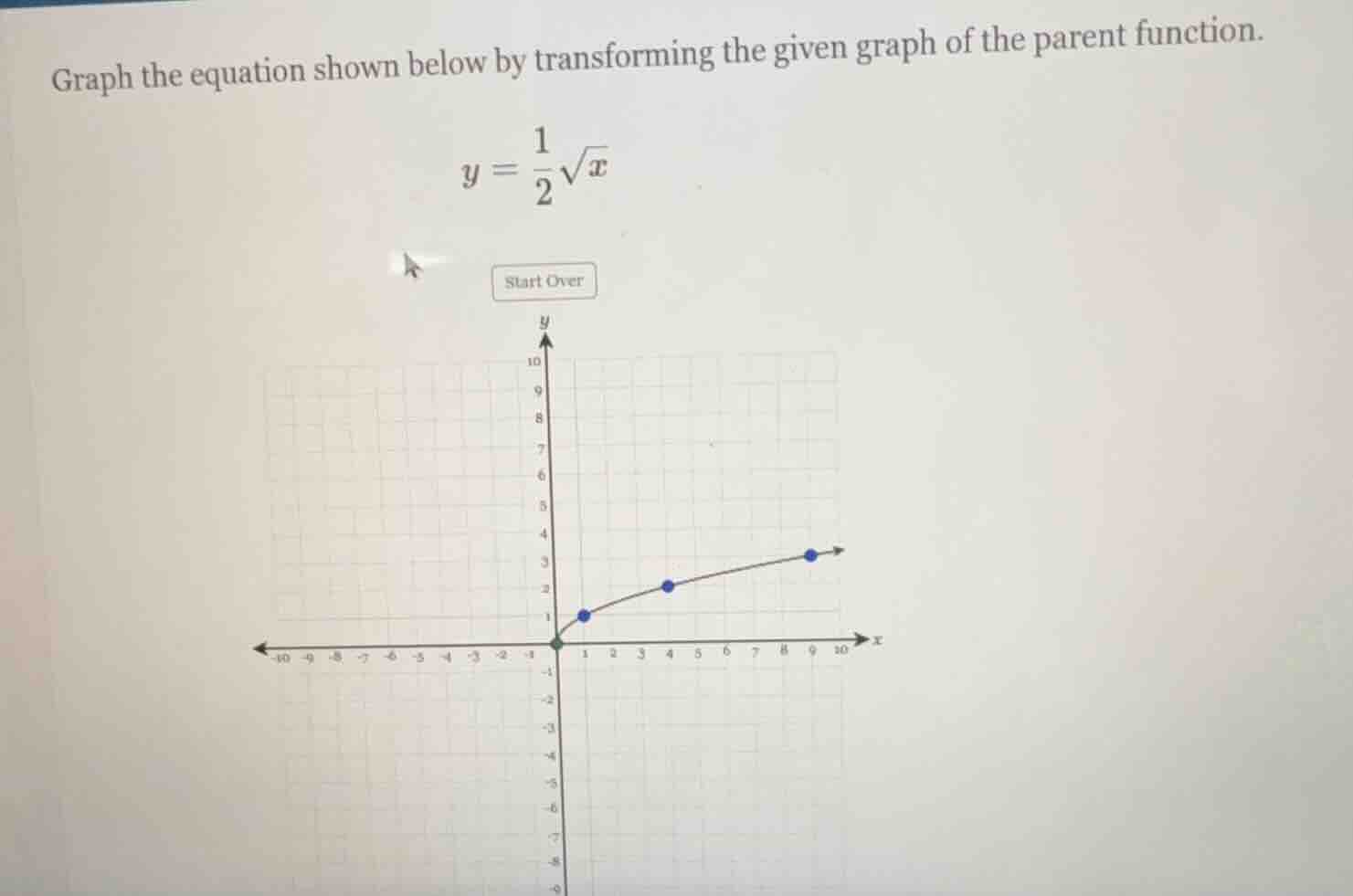
The parent function here is \( y = \sqrt{x} \). The graph of \( y=\sqrt{x} \) passes through points like \((0,0)\), \((1,1)\), \((4,2)\), \((9,3)\) (as seen in the given graph: when \( x = 1 \), \( y = 1 \); \( x = 4 \), \( y = 2 \); \( x = 9 \), \( y = 3 \)).
Step2: Analyze the transformation
The given function is \( y=\frac{1}{2}\sqrt{x} \). This is a vertical compression of the parent function \( y = \sqrt{x} \) by a factor of \( \frac{1}{2} \). For a vertical compression by a factor of \( a \) (where \( 0 < a < 1 \)), we multiply the \( y \)-coordinate of each point on the parent function by \( a \).
Step3: Transform the key points
- For the point \((0,0)\) on \( y = \sqrt{x} \): Multiply the \( y \)-coordinate by \( \frac{1}{2} \), we get \((0, 0\times\frac{1}{2})=(0,0)\).
- For the point \((1,1)\) on \( y = \sqrt{x} \): Multiply the \( y \)-coordinate by \( \frac{1}{2} \), we get \((1, 1\times\frac{1}{2})=(1, 0.5)\).
- For the point \((4,2)\) on \( y = \sqrt{x} \): Multiply the \( y \)-coordinate by \( \frac{1}{2} \), we get \((4, 2\times\frac{1}{2})=(4, 1)\).
- For the point \((9,3)\) on \( y = \sqrt{x} \): Multiply the \( y \)-coordinate by \( \frac{1}{2} \), we get \((9, 3\times\frac{1}{2})=(9, 1.5)\).
Step4: Graph the transformed function
Plot the transformed points \((0,0)\), \((1, 0.5)\), \((4, 1)\), \((9, 1.5)\) and draw a smooth curve through them. This curve will be a vertically compressed version of the parent square - root function, with the same domain (\( x\geq0 \)) and increasing nature, but "flatter" than the parent function.

Snap & solve any problem in the app
Get step-by-step solutions on Sovi AI
Photo-based solutions with guided steps
Explore more problems and detailed explanations
To graph \( y = \frac{1}{2}\sqrt{x} \), vertically compress the graph of \( y=\sqrt{x} \) by a factor of \( \frac{1}{2} \). Plot points \((0,0)\), \((1, 0.5)\), \((4, 1)\), \((9, 1.5)\) (obtained by multiplying the \( y \)-coordinates of the parent function's key points by \( \frac{1}{2} \)) and draw a smooth curve through them.