QUESTION IMAGE
Question
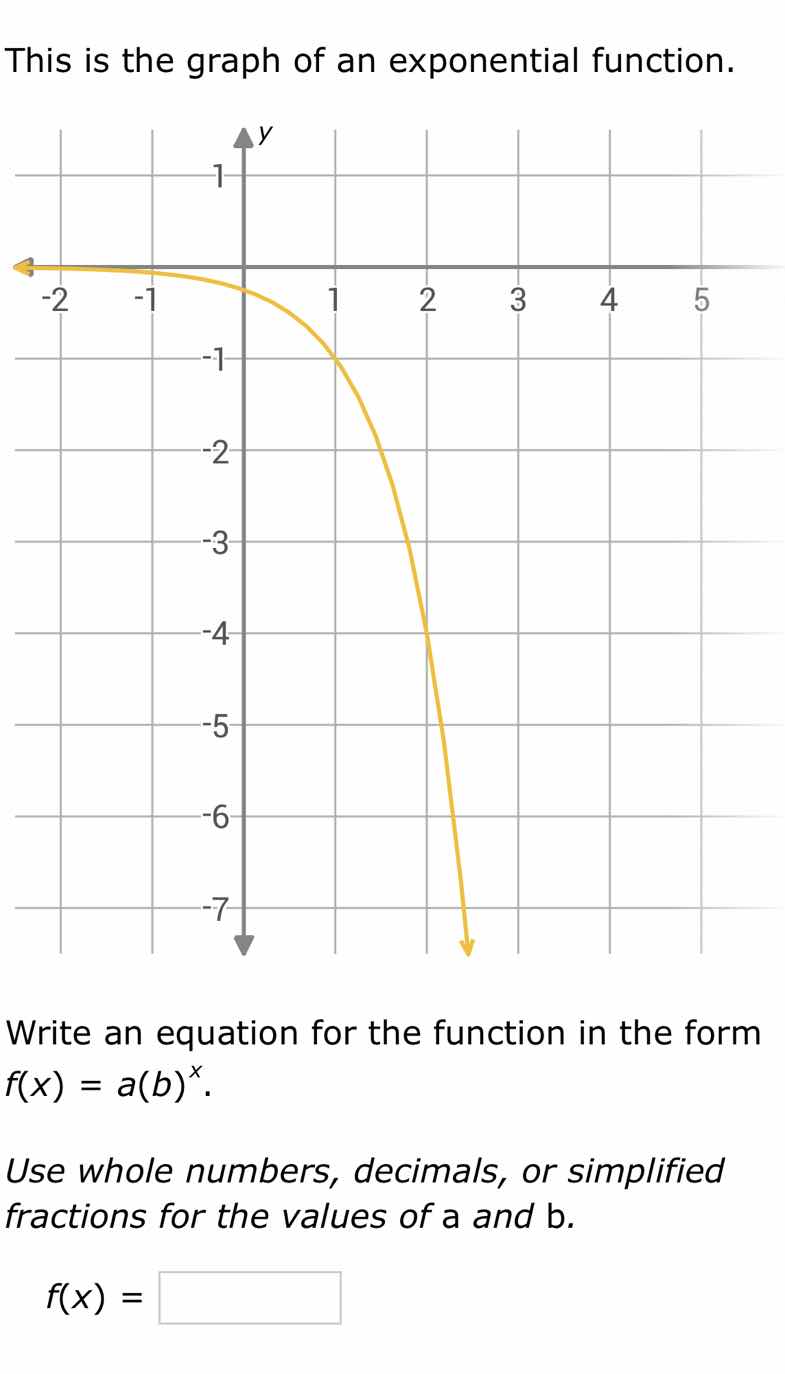
this is the graph of an exponential function.
write an equation for the function in the form ( f(x) = a(b)^x ).
use whole numbers, decimals, or simplified fractions for the values of ( a ) and ( b ).
( f(x) = )
Step1: Find the value of \( a \)
The general form of an exponential function is \( f(x)=a(b)^x \). When \( x = 0 \), we know that \( f(0)=a(b)^0=a\times1=a \). From the graph, when \( x = 0 \), the \( y \)-intercept is \( - 0.5\)? Wait, no, looking at the graph, when \( x = 0 \), the point is on the \( y \)-axis. Wait, the graph passes through \( (0, - 0.5) \)? Wait, no, let's check the points. Wait, when \( x = 0 \), the \( y \)-value: looking at the graph, the curve crosses the \( y \)-axis at \( (0, - 0.5) \)? Wait, no, maybe I made a mistake. Wait, let's take another point. Let's see, when \( x = 1 \), what is \( y \)? From the graph, when \( x = 1 \), \( y=-1 \). Wait, no, the graph at \( x = 1 \) seems to be at \( y=-1 \)? Wait, no, the grid lines: the \( y \)-axis has marks at \( 1, - 1, - 2, \dots \). Wait, when \( x = 0 \), the \( y \)-value is \( - 0.5 \)? No, maybe the \( y \)-intercept is \( - 0.5 \)? Wait, no, let's re - examine. The standard exponential function form is \( f(x)=a(b)^x \). Let's use the \( y \)-intercept. When \( x = 0 \), \( f(0)=a\times b^0=a \). From the graph, when \( x = 0 \), the function passes through \( (0, - 0.5) \)? Wait, no, maybe the \( y \)-intercept is \( - 0.5 \)? Wait, no, let's check the point \( (1, - 1) \). Wait, if \( x = 1 \), \( y=-1 \), and \( x = 0 \), \( y=-0.5 \). Then, substituting \( x = 0 \) into \( f(x)=a(b)^x \), we get \( f(0)=a\times b^0=a \). So \( a=-0.5 \)? Wait, no, maybe the \( y \)-intercept is \( - 0.5 \). Wait, another approach: let's assume that the function passes through \( (0, - 0.5) \) (the \( y \)-intercept) and \( (1, - 1) \). Wait, when \( x = 0 \), \( f(0)=a=-0.5 \)? No, wait, maybe the \( y \)-intercept is \( - 0.5 \), and when \( x = 1 \), \( f(1)=-1 \). Then, using \( f(x)=a(b)^x \), when \( x = 0 \), \( f(0)=a=-0.5 \)? No, that can't be. Wait, maybe I made a mistake. Let's look at the graph again. The graph is a decreasing exponential function. Let's use two points. Let's take \( (0, - 0.5) \) and \( (1, - 1) \). Wait, no, when \( x = 0 \), \( y=-0.5 \), so \( a=-0.5 \). Then, when \( x = 1 \), \( f(1)=-0.5\times b^1=-1 \). So \( - 0.5b=-1 \), then \( b=\frac{-1}{-0.5}=2 \). Wait, but the function is decreasing? Wait, no, if \( b > 1 \), the function is increasing, but the graph is decreasing. So maybe \( b=\frac{1}{2} \)? Wait, I think I messed up the direction. Let's start over.
The general form of an exponential function is \( f(x)=a(b)^x \). For an exponential function, if it is decreasing, \( 0 < b<1 \). Let's find two points on the graph. Let's take \( x = 0 \): from the graph, when \( x = 0 \), the \( y \)-value is \( - 0.5 \)? Wait, no, the graph crosses the \( y \)-axis at \( (0, - 0.5) \)? Wait, no, looking at the grid, the \( y \)-axis has a mark at \( - 0.5 \)? No, the grid lines are at integer values? Wait, maybe the \( y \)-intercept is \( - 0.5 \). Wait, let's take \( x = 0 \), \( f(0)=a=-0.5 \). Then, let's take \( x = 1 \), \( f(1)=-1 \). Then, substituting into \( f(x)=a(b)^x \), we have \( - 1=-0.5\times b^1 \), so \( b = \frac{-1}{-0.5}=2 \). But if \( b = 2 \), the function \( f(x)=-0.5(2)^x \) is a decreasing function? Wait, no, \( y=-0.5(2)^x \): as \( x \) increases, \( 2^x \) increases, and since there is a negative sign, \( y \) decreases, which matches the graph. Let's check another point. When \( x = 2 \), \( f(2)=-0.5\times2^2=-0.5\times4 = - 2 \). Wait, but from the graph, when \( x = 2 \), is \( y=-2 \)? The graph at \( x = 2 \) seems to be at \( y=-2 \)? Wait, no, the graph at \( x = 2 \) is much lower. Wait, maybe…

Snap & solve any problem in the app
Get step-by-step solutions on Sovi AI
Photo-based solutions with guided steps
Explore more problems and detailed explanations
\( f(x)=-\frac{1}{2}(2)^x \) (or \( f(x)=-0.5(2)^x \))