QUESTION IMAGE
Question
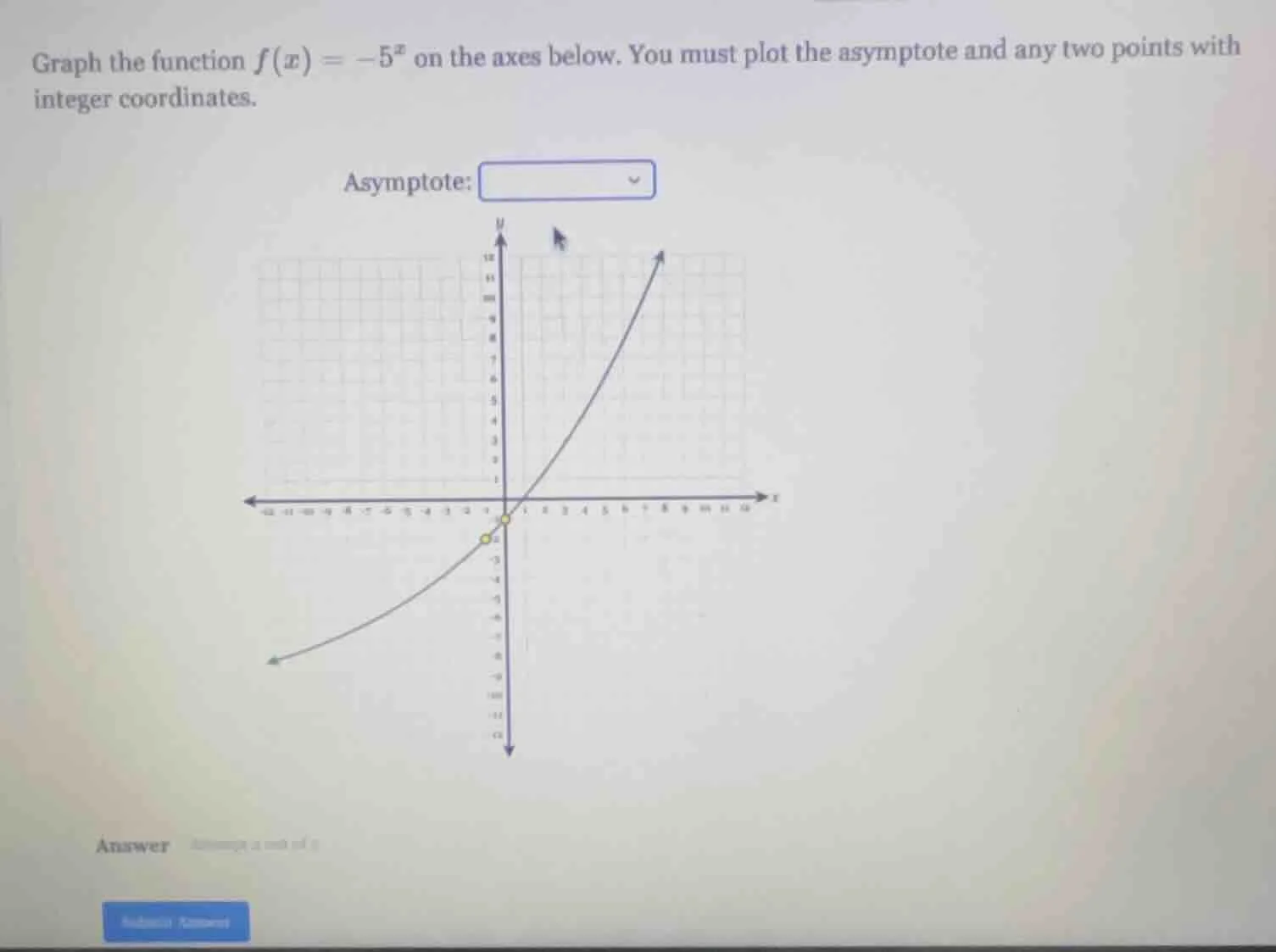
graph the function $f(x) = -5^x$ on the axes below. you must plot the asymptote and any two points with integer coordinates.
asymptote:
Step1: Recall exponential function asymptote
For an exponential function of the form \( f(x) = a \cdot b^x + c \), the horizontal asymptote is \( y = c \). In the function \( f(x)=-5^{x} \), we can rewrite it as \( f(x)=-1\cdot5^{x}+0 \). So, comparing with the general form, \( c = 0 \). But wait, let's analyze the behavior as \( x\to\pm\infty \). As \( x\to\infty \), \( 5^{x}\to\infty \), so \( - 5^{x}\to-\infty \). As \( x\to-\infty \), \( 5^{x}\to0 \), so \( -5^{x}\to0 \). So the horizontal asymptote is \( y = 0 \) (the x - axis), but wait, no—wait, the standard exponential function \( y = a^x \) has horizontal asymptote \( y = 0 \). For \( y=-a^{x} \), as \( x\to-\infty \), \( a^{x}\to0 \), so \( -a^{x}\to0 \), and as \( x\to\infty \), \( -a^{x}\to-\infty \). So the horizontal asymptote is \( y = 0 \)? Wait, no, let's check the function \( f(x)=-5^{x} \). Let's find the limit as \( x\to\pm\infty \).
Limit as \( x\to\infty \): \( \lim_{x\to\infty}-5^{x}=-\infty \)
Limit as \( x\to-\infty \): \( \lim_{x\to-\infty}-5^{x}=-\lim_{x\to-\infty}5^{x}= - 0 = 0 \)
So the horizontal asymptote is \( y = 0 \) (the x - axis).
Step2: Find two points with integer coordinates
Let's find \( f(0) \): Substitute \( x = 0 \) into \( f(x)=-5^{x} \), we get \( f(0)=-5^{0}=-1 \). So the point is \( (0, - 1) \).
Let's find \( f(1) \): Substitute \( x = 1 \) into \( f(x)=-5^{x} \), we get \( f(1)=-5^{1}=-5 \). So the point is \( (1, - 5) \). Or we can take \( x=-1 \): \( f(-1)=-5^{-1}=-\frac{1}{5} \), but that's not an integer. So better to take \( x = 0 \) and \( x = 1 \) (or \( x = 0 \) and \( x=-1 \) but \( x=-1 \) gives non - integer y? Wait, no, \( x=-1 \): \( 5^{-1}=\frac{1}{5} \), so \( f(-1)=-\frac{1}{5} \), which is not integer. So \( x = 0 \): \( (0, - 1) \), \( x = 1 \): \( (1, - 5) \), \( x = 2 \): \( (2, - 25) \), etc. Or \( x = 0 \) and \( x = 0 \) is one, \( x=-1 \) is not good. Wait, \( x = 0 \): \( y=-1 \), \( x = 1 \): \( y=-5 \), \( x = - 0 \) is same as \( x = 0 \).

Snap & solve any problem in the app
Get step-by-step solutions on Sovi AI
Photo-based solutions with guided steps
Explore more problems and detailed explanations
Asymptote: \( y = 0 \)
Two points: \( (0, - 1) \) and \( (1, - 5) \) (you can plot these points and the asymptote \( y = 0 \) on the graph)