QUESTION IMAGE
Question
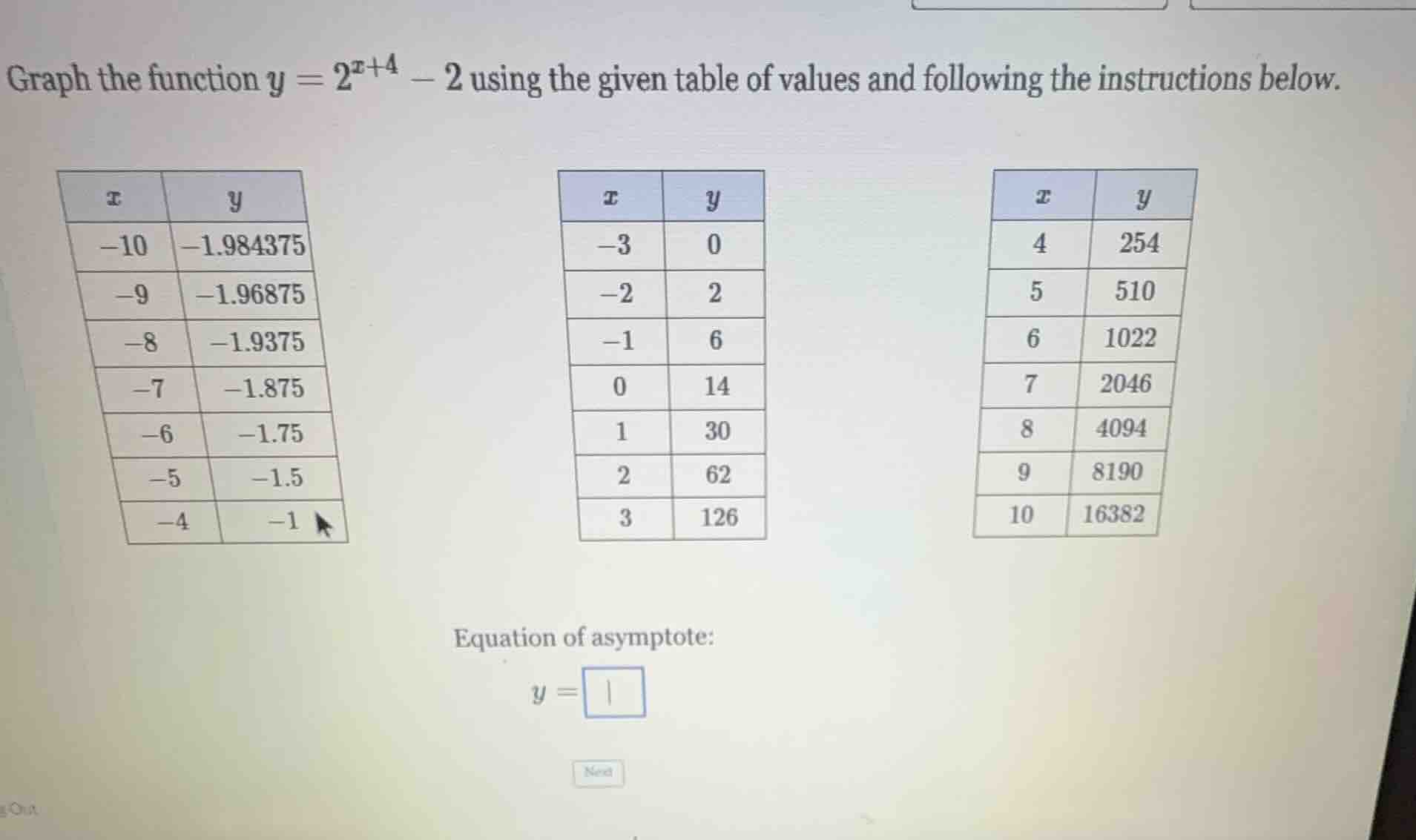
graph the function $y = 2^{x+4} - 2$ using the given table of values and following the instructions below.
| $x$ | $y$ | $x$ | $y$ | $x$ | $y$ | ||
|---|---|---|---|---|---|---|---|
| -9 | -1.96875 | -2 | 2 | 5 | 510 | ||
| -8 | -1.9375 | -1 | 6 | 6 | 1022 | ||
| -7 | -1.875 | 0 | 14 | 7 | 2046 | ||
| -6 | -1.75 | 1 | 30 | 8 | 4094 | ||
| -5 | -1.5 | 2 | 62 | 9 | 8190 | ||
| -4 | -1 | 3 | 126 | 10 | 16382 |
equation of asymptote:
$y = \boxed{}$
Step1: Recall the form of exponential functions
The general form of an exponential function is \( y = a \cdot b^{x - h}+k \), where the horizontal asymptote is \( y = k \).
Step2: Identify \( k \) in the given function
The given function is \( y = 2^{x + 4}-2 \). Comparing it with the general form \( y=a\cdot b^{x - h}+k \), we can see that \( k=- 2 \). Wait, wait, no, wait. Wait, the general form can also be written as \( y = b^{x + c}+d \), and the horizontal asymptote is \( y = d \). In our function \( y=2^{x + 4}-2 \), the term after the exponential is \(-2\), so the horizontal asymptote should be \( y=-2 \)? Wait, but let's check the table. When \( x\) is very negative, like \( x = - 10,-9,\cdots\), the \( y\)-values are approaching \(-2\) (since \(-1.984375\), \(-1.96875\), etc., are getting closer to \(-2\)). Wait, maybe I made a mistake earlier. Let's re - examine.
The function is \( y = 2^{x + 4}-2\). The exponential part \( 2^{x+4}\) has a range of \( (0,\infty)\) because for any real number \( x\), \( 2^{x + 4}>0\). Then, when we subtract 2 from it, the range of \( y=2^{x + 4}-2\) is \( (-2,\infty)\). So the horizontal asymptote is \( y=-2\). Wait, but the initial thought about the general form: if \( y = b^{x}+k\), the asymptote is \( y = k\). In our case, \( y=2^{x + 4}-2=2^{4}\cdot2^{x}-2 = 16\cdot2^{x}-2\), but the key is the vertical shift. The exponential function \( 2^{x+4}\) is always positive, so \( 2^{x + 4}>0\), then \( 2^{x + 4}-2>-2\). So as \( x
ightarrow-\infty\), \( 2^{x + 4}
ightarrow0\), so \( y = 2^{x + 4}-2
ightarrow0 - 2=-2\). So the horizontal asymptote is \( y=-2\). Wait, but the box in the problem has \( y=\square\), and maybe I misread. Wait, no, let's check the table again. Wait, when \( x=-4\), \( y = - 1\). Wait, no, the first table: when \( x=-4\), \( y=-1\). But as \( x\) becomes more negative, like \( x=-10\), \( y=-1.984375\); \( x = - 9\), \( y=-1.96875\); \( x=-8\), \( y=-1.9375\); \( x=-7\), \( y=-1.875\); \( x=-6\), \( y=-1.75\); \( x=-5\), \( y=-1.5\); \( x=-4\), \( y=-1\). So as \( x\) decreases (goes to \(-\infty\)), \( y\) is approaching \(-2\) (because \(-1.984375\) is closer to \(-2\) than \(-1.96875\) is, and so on). So the horizontal asymptote is \( y = - 2\). Wait, but maybe the original problem's box was a typo, or maybe I made a mistake. Wait, let's re - derive.
For the function \( y = a\cdot b^{x - h}+k\), the horizontal asymptote is \( y = k\). In our function \( y=2^{x + 4}-2\), we can rewrite it as \( y = 2^{x-(-4)}-2\), so \( k=-2\). So the horizontal asymptote is \( y=-2\).
Wait, but let's check the table values. When \( x\) is very negative, the \( y\)-values are:
For \( x=-10\), \( y=-1.984375\approx - 2+0.015625\)
For \( x=-9\), \( y=-1.96875\approx - 2 + 0.03125\)
For \( x=-8\), \( y=-1.9375\approx - 2+0.0625\)
For \( x=-7\), \( y=-1.875\approx - 2 + 0.125\)
For \( x=-6\), \( y=-1.75\approx - 2+0.25\)
For \( x=-5\), \( y=-1.5\approx - 2 + 0.5\)
For \( x=-4\), \( y=-1\approx - 2+1\)
So as \( x\) decreases (moves towards \(-\infty\)), \( 2^{x + 4}\) approaches 0, so \( y = 2^{x + 4}-2\) approaches \( 0 - 2=-2\). So the horizontal asymptote is \( y=-2\).
Wait, but the initial wrong thought was a miscalculation. So the correct horizontal asymptote is \( y=-2\).

Snap & solve any problem in the app
Get step-by-step solutions on Sovi AI
Photo-based solutions with guided steps
Explore more problems and detailed explanations
\(-2\)