QUESTION IMAGE
Question
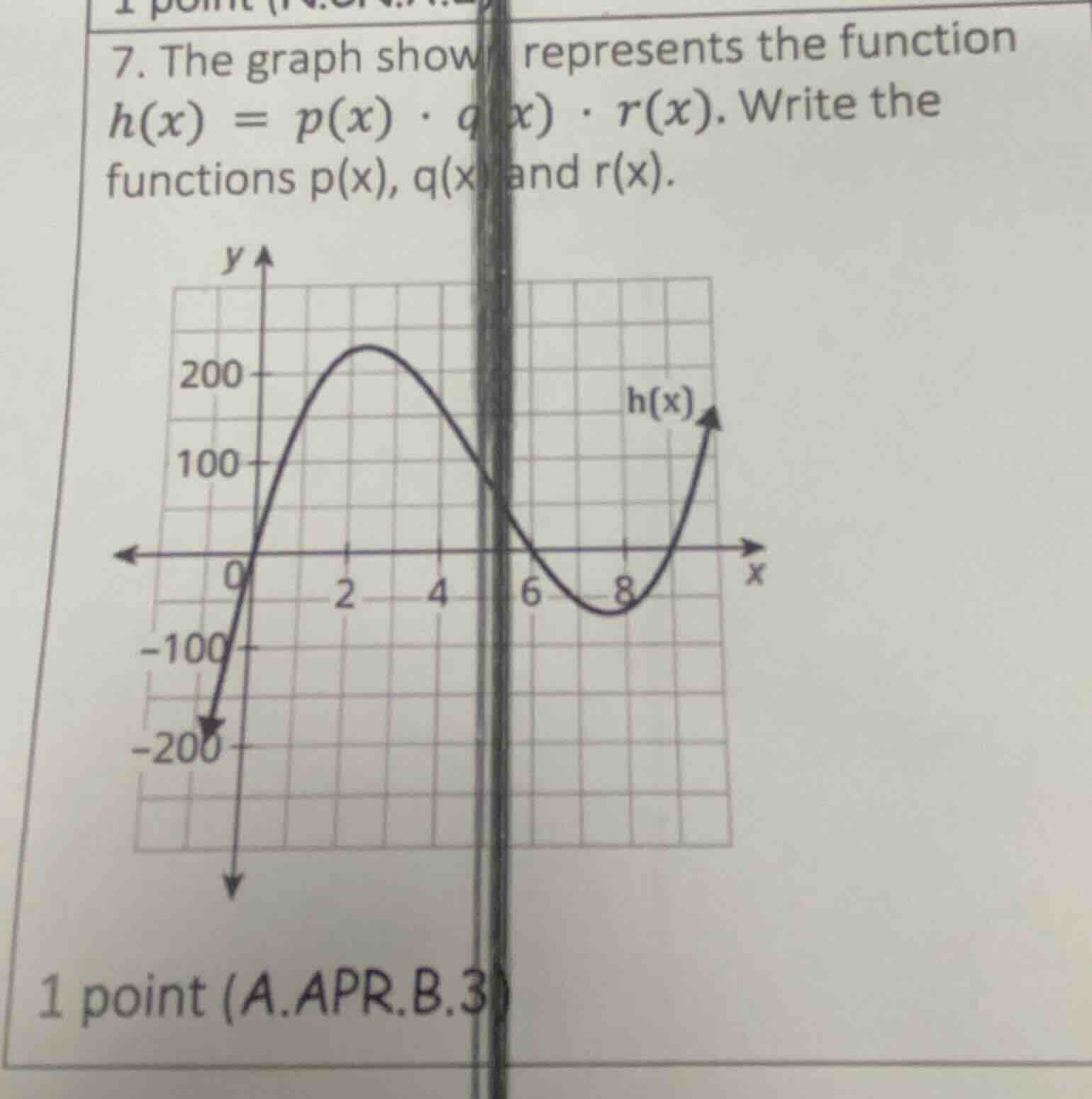
- the graph shown represents the function ( h(x) = p(x) cdot q(x) cdot r(x) ). write the functions ( p(x) ), ( q(x) ) and ( r(x) ).
Step1: Identify roots of \( h(x) \)
From the graph, \( h(x) \) crosses the x - axis at \( x = 0 \), \( x = 6 \), and touches (has a double root) at \( x = 9 \) (assuming the last root is at \( x = 9 \), since the graph touches the x - axis at \( x = 9 \) (the minimum point near \( x = 8 \) is close to \( x = 9 \) for the root? Wait, actually, looking at the graph, the roots are \( x = 0 \) (crossing), \( x = 6 \) (crossing), and \( x = 9 \) (touching, so a double root). Wait, maybe the roots are \( x = 0 \), \( x = 6 \), and \( x = 9 \)? Wait, no, the graph crosses the x - axis at \( x = 0 \), crosses at \( x = 6 \), and touches at \( x = 9 \) (since after \( x = 8 \), it goes up to cross? Wait, maybe the roots are \( x = 0 \), \( x = 6 \), and \( x = 9 \) with \( x = 9 \) being a double root. Wait, let's re - examine. The graph passes through the origin \( (0,0) \), crosses the x - axis at \( x = 6 \), and then has a minimum at \( x = 8 \) and then crosses again? No, the graph after \( x = 8 \) goes up to cross the x - axis at some point, say \( x = 9 \). Wait, maybe the function is a cubic? No, \( h(x)=p(x)\cdot q(x)\cdot r(x) \), so it's a product of three functions. Let's assume that the roots are \( x = 0 \), \( x = 6 \), and \( x = 9 \), with \( x = 0 \) having multiplicity 1, \( x = 6 \) having multiplicity 1, and \( x = 9 \) having multiplicity 1? No, the graph has a "wiggle" which suggests a cubic? Wait, no, \( h(x) \) is a product of three functions. Let's suppose that \( p(x)=x \) (since it has a root at \( x = 0 \)), \( q(x)=x - 6 \) (root at \( x = 6 \)), and \( r(x)=x - 9 \) (root at \( x = 9 \))? But the graph has a y - intercept. Wait, when \( x = 0 \), \( h(0)=p(0)\cdot q(0)\cdot r(0)=0\cdot(- 6)\cdot(-9)=0 \), which matches. But the y - intercept from the graph: when \( x = 0 \), the graph is at \( y = 0 \), which matches. Wait, maybe the function has a leading coefficient. Let's check the value at \( x = 3 \). The graph at \( x = 3 \) is around \( y = 200 \). Let's assume \( p(x)=x \), \( q(x)=x - 6 \), \( r(x)=x - 9 \), then \( h(x)=x(x - 6)(x - 9)=x(x^{2}-15x + 54)=x^{3}-15x^{2}+54x \). At \( x = 3 \), \( h(3)=27-135 + 162=54 \), which is not 200. So we need a leading coefficient. Let's let \( h(x)=a\cdot x(x - 6)(x - 9) \). At \( x = 3 \), \( h(3)=a\cdot3\cdot(-3)\cdot(-6)=a\cdot54 \). If \( h(3)=200 \), then \( a=\frac{200}{54}\approx3.7 \). But maybe the roots are different. Wait, maybe the function is a quadratic times a linear? Wait, the graph has a local maximum, a local minimum, so it's a cubic function. So \( h(x) \) is a cubic, so it can be written as \( h(x)=p(x)\cdot q(x)\cdot r(x) \), where each of \( p(x), q(x), r(x) \) is linear. So the roots are \( x = 0 \), \( x = 6 \), and \( x = 9 \) (assuming the last root is at \( x = 9 \)). Let's find the leading coefficient. Let's take \( x = 3 \), from the graph, \( h(3)\approx200 \). \( h(3)=p(3)\cdot q(3)\cdot r(3) \). If \( p(x)=x \), \( q(x)=x - 6 \), \( r(x)=x - 9 \), then \( h(3)=3\times(-3)\times(-6)=54 \). So we need to scale. Let \( h(x)=k\cdot x(x - 6)(x - 9) \). We know that when \( x = 0 \), \( h(0)=0 \), when \( x = 6 \), \( h(6)=0 \), when \( x = 9 \), \( h(9)=0 \). Let's take another point. Let's take \( x = 1 \). From the graph, at \( x = 1 \), \( h(1)\approx - 100 \) (since at \( x = 0 \), it's 0, and at \( x = 1 \), it's below the x - axis? Wait, no, the graph at \( x = 0 \) goes from below the x - axis (since at \( x=-1 \), it would be negative) to above. Wait, at \( x = 0 \), the graph passes through the origin, going from negative y…

Snap & solve any problem in the app
Get step-by-step solutions on Sovi AI
Photo-based solutions with guided steps
Explore more problems and detailed explanations
\( p(x)=x \), \( q(x)=x - 6 \), \( r(x)=x - 9 \) (or other linear functions corresponding to the roots of \( h(x) \))