QUESTION IMAGE
Question
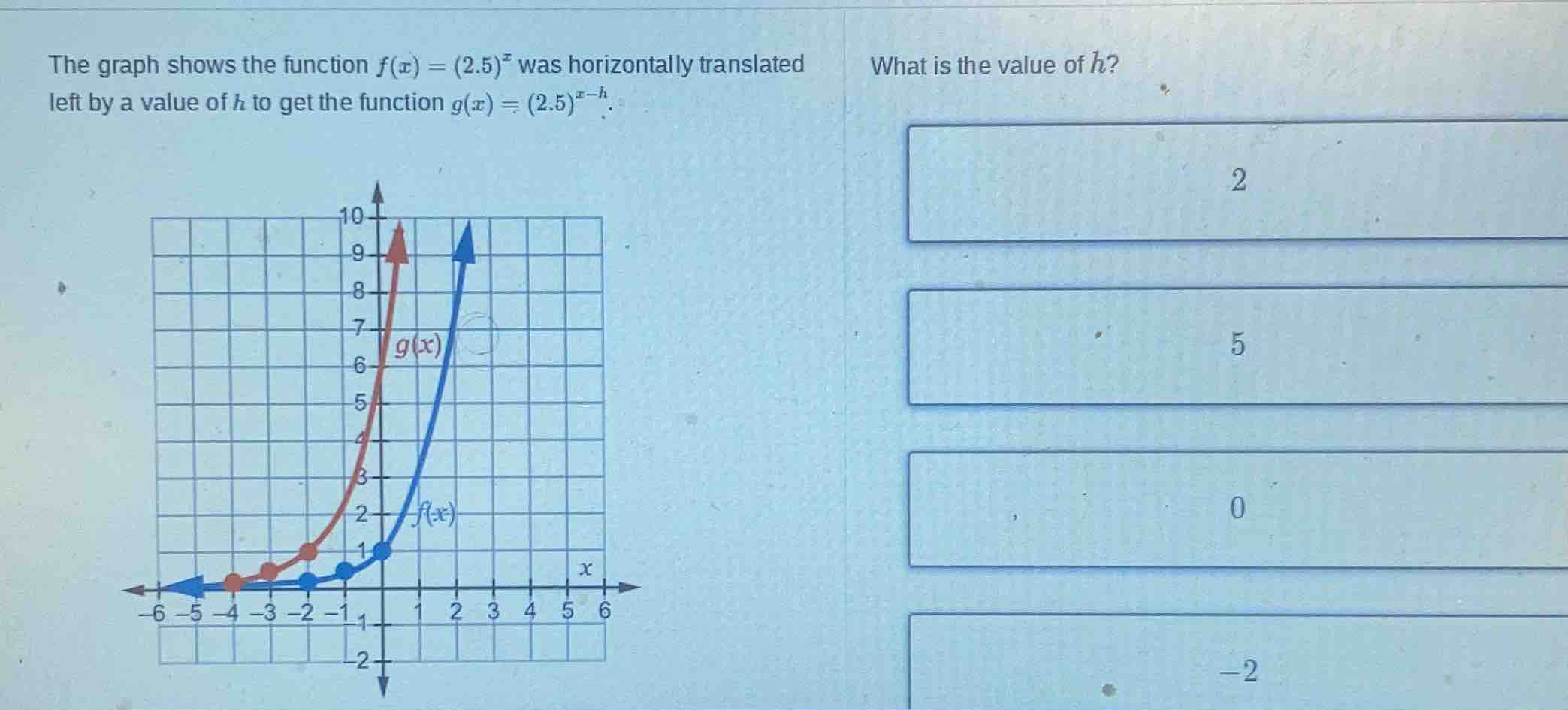
the graph shows the function $f(x) = (2.5)^x$ was horizontally translated left by a value of $h$ to get the function $g(x) = (2.5)^{x - h}$. what is the value of $h$? 2 5 0 $-2$
Step1: Recall horizontal translation rule
For a function \( y = f(x) \), a horizontal translation left by \( h \) units gives \( y = f(x + h) \). But here \( g(x)=(2.5)^{x - h} \) and \( f(x)=(2.5)^x \). So \( g(x)=f(x - h) \), and horizontal translation: if \( g(x) \) is left translation of \( f(x) \), then \( g(x)=f(x + |h|) \), so \( x - h=x + |h| \), which means \( -h = |h| \) (since left translation). Wait, alternatively, let's find a point on \( f(x) \) and \( g(x) \).
Step2: Find a point on \( f(x) \)
For \( f(x)=(2.5)^x \), when \( x = 0 \), \( f(0)=(2.5)^0 = 1 \). So the point \( (0,1) \) is on \( f(x) \).
Step3: Find the corresponding point on \( g(x) \)
Looking at the graph, the red graph \( g(x) \) passes through \( (-2,1) \)? Wait, no. Wait, blue is \( f(x) \), red is \( g(x) \). Wait, blue \( f(x) \) has a point at \( (0,1) \), and red \( g(x) \) has a point at \( (-2,1) \)? Wait, no, looking at the grid, the blue curve \( f(x) \) passes through \( (0,1) \), and the red curve \( g(x) \) passes through \( (-2,1) \)? Wait, no, let's check the x - coordinates. Wait, maybe another point. Wait, when \( x = 0 \), \( f(0)=1 \), and \( g(x) \) at \( x=-2 \) is 1? Wait, no, let's see the horizontal shift. The blue curve \( f(x)=(2.5)^x \) and red curve \( g(x)=(2.5)^{x - h} \). Let's take the y - intercept. For \( f(x) \), y - intercept is at \( (0,1) \). For \( g(x) \), let's find its y - intercept. Wait, when \( x = 0 \), \( g(0)=(2.5)^{-h} \). But from the graph, \( g(x) \) at \( x=-2 \) is equal to \( f(x) \) at \( x = 0 \)? Wait, no, let's see the shift. If \( f(x) \) is shifted left by \( h \) units to get \( g(x) \), then \( g(x)=f(x + h) \). But the formula given is \( g(x)=(2.5)^{x - h} \), so \( (2.5)^{x - h}=(2.5)^{x + h'} \) where \( h' \) is the left shift. So \( x - h=x + h' \implies -h = h' \). So \( h'=-h \), and since it's left shift, \( h' \) is positive, so \( -h>0 \implies h<0 \)? Wait, maybe better to use points. Let's take the point where \( f(x) \) is at \( (0,1) \), and \( g(x) \) is at \( (-2,1) \)? Wait, no, looking at the graph, the blue curve (f(x)) has a point at (0,1), and the red curve (g(x)) has a point at (-2,1)? Wait, no, the red curve at x=-2 is 1? Wait, no, let's check the x - axis. Wait, the blue curve (f(x)) passes through (0,1), and the red curve (g(x)) passes through (-2,1)? Wait, no, maybe the shift is 2 units left. So if \( f(x) \) is shifted left by 2 units, then \( g(x)=f(x + 2)=(2.5)^{x + 2} \). But the given \( g(x)=(2.5)^{x - h} \), so \( x - h=x + 2 \implies -h = 2 \implies h=-2 \)? Wait, no, wait the problem says "horizontally translated left by a value of h to get the function \( g(x)=(2.5)^{x - h} \)". Wait, the standard horizontal translation: \( y = f(x) \) shifted left by \( k \) units is \( y = f(x + k) \). So here \( g(x)=f(x + h) \) (since left by h), and \( f(x)=(2.5)^x \), so \( g(x)=(2.5)^{x + h} \). But the problem says \( g(x)=(2.5)^{x - h} \). So \( (2.5)^{x + h}=(2.5)^{x - h} \)? No, that can't be. Wait, maybe the problem has a typo, but looking at the options, and the graph, the shift from \( f(x) \) (blue) to \( g(x) \) (red) is 2 units left. So \( g(x)=f(x + 2)=(2.5)^{x + 2} \). But the given \( g(x)=(2.5)^{x - h} \), so \( x - h=x + 2 \implies -h = 2 \implies h=-2 \)? Wait, no, maybe I messed up. Wait, let's take a point on \( f(x) \): when \( x = 0 \), \( f(0)=1 \). On \( g(x) \), when does \( g(x)=1 \)? \( (2.5)^{x - h}=1 \implies x - h = 0 \implies x = h \). So the point \( (h,1) \) is on \( g(x) \). For \( f(x) \), the point \( (0,1) \) is on it.…

Snap & solve any problem in the app
Get step-by-step solutions on Sovi AI
Photo-based solutions with guided steps
Explore more problems and detailed explanations
\( \boldsymbol{-2} \)