QUESTION IMAGE
Question
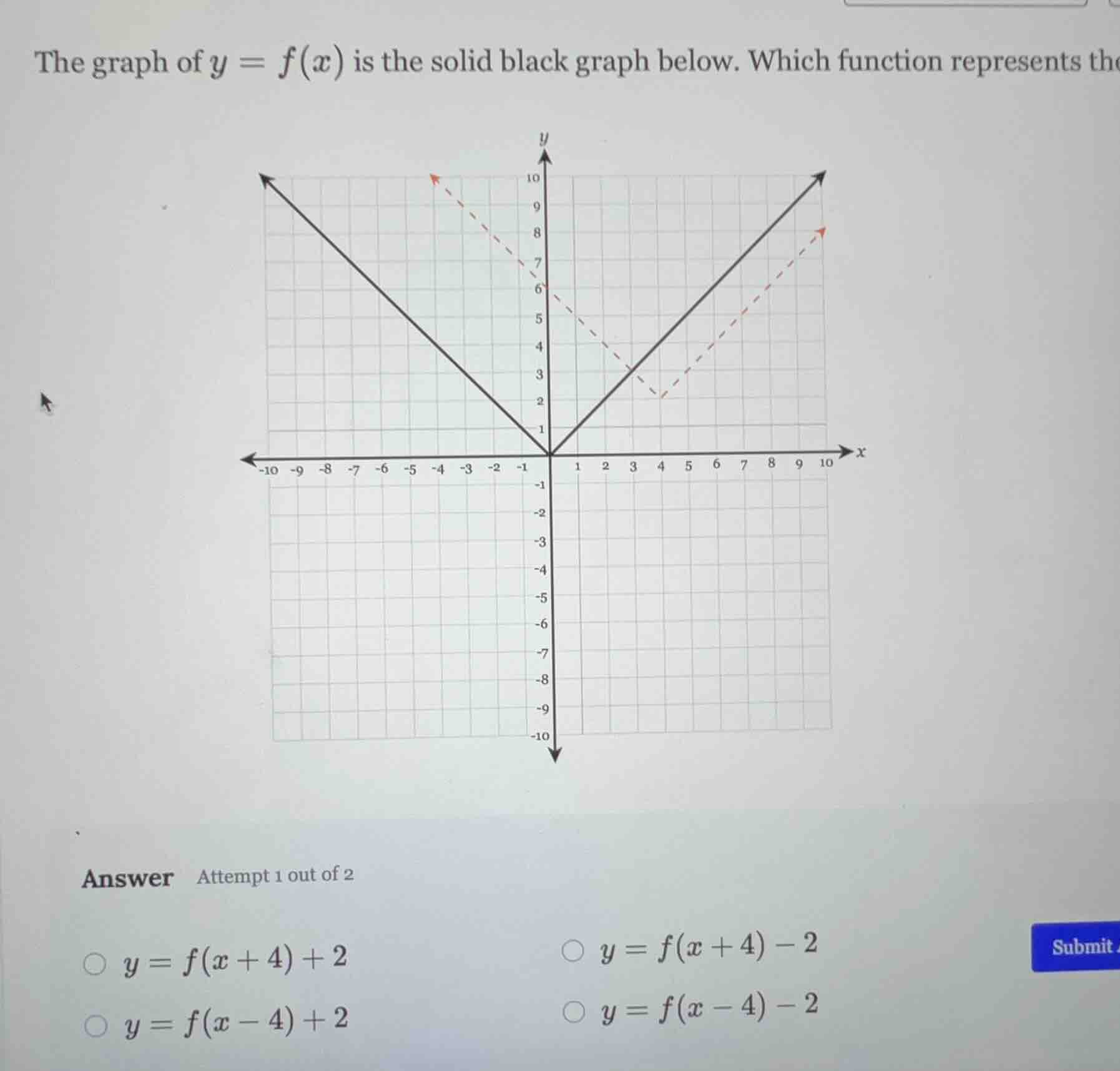
the graph of $y = f(x)$ is the solid black graph below. which function represents the the question seems incomplete but the main part is about the graph and function transformations with options: $y = f(x + 4) + 2$, $y = f(x + 4) - 2$, $y = f(x - 4) + 2$, $y = f(x - 4) - 2$
Step1: Analyze horizontal shift
The original graph \( y = f(x) \) has a vertex at the origin \((0,0)\). The dashed graph (transformed) seems to have a horizontal shift. For a function \( y = f(x - h) \), if \( h>0 \), it shifts right by \( h \) units; if \( h<0 \), it shifts left by \( |h| \) units. Here, the transformed graph's vertex (or key point) seems to shift right by 4 units? Wait, no, wait. Wait, looking at the dashed lines: the original solid is a V - shape at (0,0). The dashed lines: one is a line with y - intercept 6 (dashed left) and another. Wait, maybe better to take a point. Let's take the vertex of the solid graph: (0,0). For the transformed graph, let's see the vertex (or the point where the two lines meet) of the dashed? Wait, no, the options are about shifting \( f(x) \) to get the dashed? Wait, the problem says "the graph of \( y = f(x) \) is the solid black graph. Which function represents the [dashed?]". Wait, the dashed lines: one has a y - intercept of 6 and slope - 1, the other has a slope 1 and passes through (5,2)? Wait, no, let's use the transformation rules.
The general form of a horizontal shift is \( y=f(x - h) \) (shift right \( h \) units) or \( y = f(x+h)=f(x-(-h)) \) (shift left \( h \) units), and vertical shift is \( y=f(x)+k \) (shift up \( k \) units) or \( y = f(x)-k \) (shift down \( k \) units).
Let's find a point on \( f(x) \). For \( f(x) \), when \( x = 4 \), \( f(4) \) (on solid) is 4 (since the solid is \( y = |x| \), so \( f(4)=4 \)). Now, look at the dashed graph: let's find a point that corresponds. Suppose the dashed graph is \( y = f(x - 4)+2 \)? Wait, no. Wait, let's take the vertex. The solid vertex is (0,0). The dashed vertex (if we consider the V - shape) – wait, the dashed lines: one is a line with equation \( y=-x + 6 \) (since it has slope - 1 and y - intercept 6) and the other is \( y=x - 3 \)? No, maybe better to use the transformation.
Wait, the options are \( y = f(x + 4)+2 \), \( y = f(x + 4)-2 \), \( y = f(x - 4)+2 \), \( y = f(x - 4)-2 \).
Let's recall:
- Horizontal shift: \( f(x - h) \) shifts \( f(x) \) right by \( h \) units, \( f(x + h) \) shifts left by \( h \) units.
- Vertical shift: \( f(x)+k \) shifts up by \( k \) units, \( f(x)-k \) shifts down by \( k \) units.
Let's take a point on \( f(x) \), say \( (4,4) \) (since \( f(4)=|4| = 4 \)). Now, let's see what happens when we apply each transformation:
- For \( y = f(x - 4)+2 \): When \( x = 8 \), \( y=f(8 - 4)+2=f(4)+2=4 + 2=6 \). Let's check the dashed graph: does a point (8,6) lie on it? The dashed line with slope 1: if \( x = 8 \), \( y=8 - 2=6 \)? Wait, maybe.
Wait, the solid graph is \( y = |x| \). Let's see the dashed graph: one of the dashed lines has a y - intercept of 6 and slope - 1 (so equation \( y=-x + 6 \)), and the other has slope 1 and passes through (5,2) (since when \( x = 5 \), \( y = 2 \), so equation \( y=x - 3 \))? No, that doesn't make sense. Wait, maybe the dashed graph is obtained by shifting \( f(x)=|x| \) right by 4 units and up by 2 units. So \( f(x - 4)+2=|x - 4|+2 \). Let's check when \( x = 4 \), \( y=0 + 2=2 \)? No, wait, when \( x = 6 \), \( |6 - 4|+2=2 + 2=4 \)? No. Wait, maybe I got the direction wrong.
Wait, let's take the vertex of \( f(x) \) which is (0,0). If we apply \( y = f(x - 4)+2 \), the vertex shifts to (4,2). Let's see the dashed graph: does it have a vertex at (4,2)? Let's check the two dashed lines. The line with slope - 1: \( y=-x + 6 \), when \( x = 4 \), \( y=-4 + 6=2 \). The line with slope 1: \( y=x - 2 \)? Wait, when \( x = 4 \), \( y=4 - 2=…

Snap & solve any problem in the app
Get step-by-step solutions on Sovi AI
Photo-based solutions with guided steps
Explore more problems and detailed explanations
\( y = f(x - 4)+2 \) (the option: \( y = f(x - 4)+2 \))