QUESTION IMAGE
Question
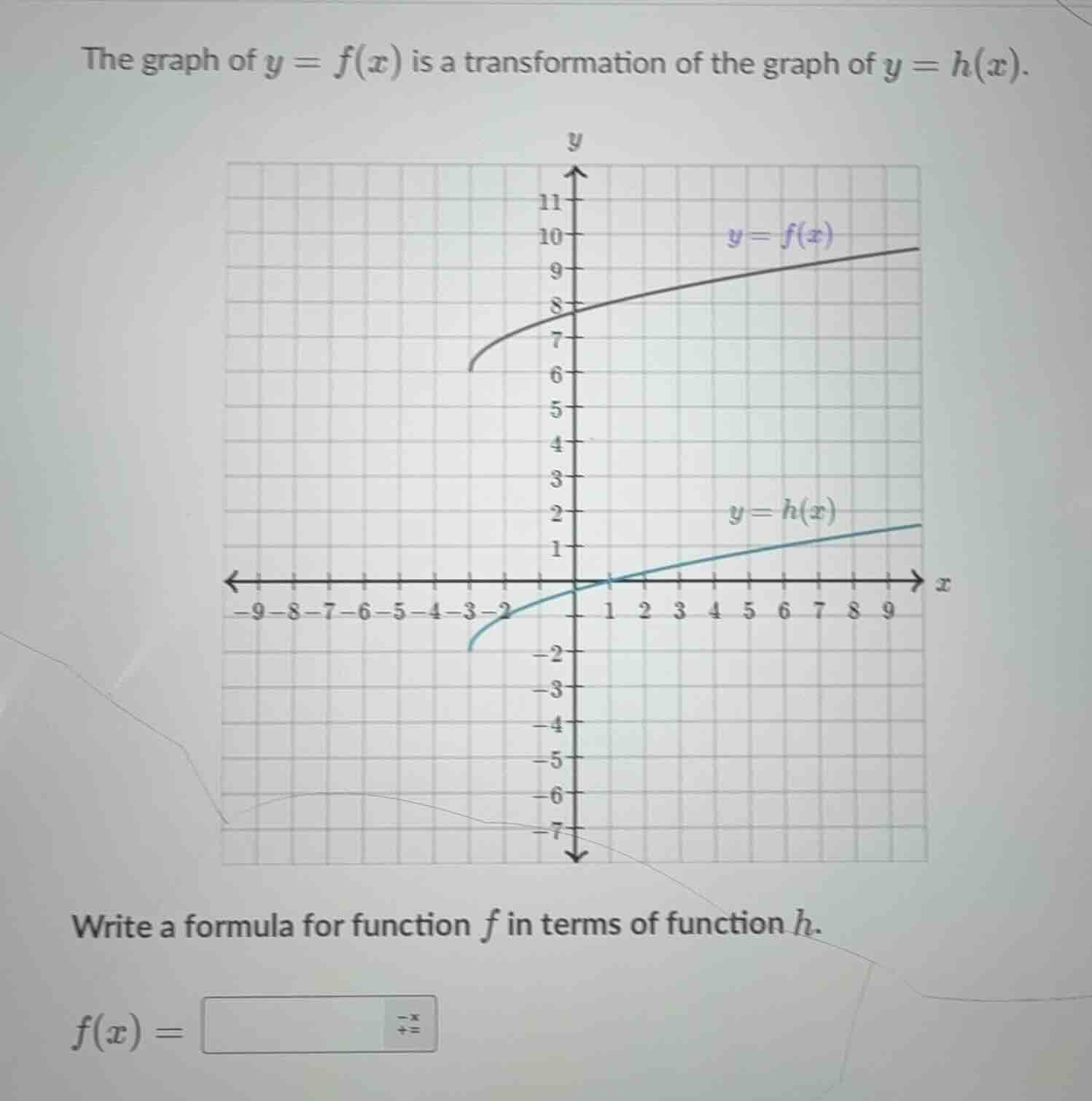
the graph of $y = f(x)$ is a transformation of the graph of $y = h(x)$.
graph of two functions $y = f(x)$ (purple) and $y = h(x)$ (blue) on a coordinate plane with x-axis from -9 to 9 and y-axis from -7 to 11
write a formula for function $f$ in terms of function $h$.
$f(x) = \square$
Step1: Analyze Vertical Shift
Observe the y - intercepts. The graph of \(y = h(x)\) passes through \((0,0)\), and the graph of \(y = f(x)\) passes through \((0,8)\). This suggests a vertical shift. Also, the shape of the graphs is similar, so we consider vertical transformation.
Looking at the vertical position, for any \(x\), the value of \(f(x)\) is \(h(x)\) plus 8? Wait, no, let's check the vertical shift. Wait, actually, when we look at the graphs, the graph of \(f(x)\) is the graph of \(h(x)\) shifted up by 8 units? Wait, no, let's take a point. For \(h(x)\), at \(x = 0\), \(h(0)=0\), and for \(f(x)\), at \(x = 0\), \(f(0) = 8\). Also, the general form of a vertical shift is \(f(x)=h(x)+k\), where \(k\) is the vertical shift. Since \(f(0)=h(0)+k\), and \(h(0) = 0\), \(f(0)=8\), so \(k = 8\). Wait, but also, let's check the horizontal shift? No, the horizontal positions of the key points (like the left - most point) seem to have the same horizontal position? Wait, the left - most point of \(h(x)\) and \(f(x)\) seem to be at the same \(x\) - value (around \(x=-3\) maybe? Wait, no, looking at the graph, the graph of \(f(x)\) is the graph of \(h(x)\) shifted up by 8 units. Because the transformation from \(h(x)\) to \(f(x)\) is a vertical shift. So the formula for \(f(x)\) in terms of \(h(x)\) is \(f(x)=h(x)+8\)? Wait, no, wait, let's check the y - values. The graph of \(h(x)\) at \(x = 0\) is 0, and \(f(x)\) at \(x = 0\) is 8. Also, the shape is the same, so it's a vertical shift. So the transformation is \(f(x)=h(x)+8\)? Wait, but let's confirm. If we have a function \(y = h(x)\), and we shift it up by \(k\) units, the new function is \(y=h(x)+k\). Here, when \(x = 0\), \(h(0) = 0\) and \(f(0)=8\), so \(k = 8\). So \(f(x)=h(x)+8\).
Wait, maybe I made a mistake. Wait, let's look at the graphs again. The graph of \(h(x)\) is a curve that passes through the origin, and \(f(x)\) is a curve that is 8 units above \(h(x)\) at every \(x\). So the vertical shift is 8 units up. So the formula for \(f(x)\) in terms of \(h(x)\) is \(f(x)=h(x)+8\).
Step2: Confirm the Transformation
To confirm, take a point on \(h(x)\), say \((x,h(x))\). After a vertical shift up by 8 units, the corresponding point on \(f(x)\) is \((x,h(x)+8)\), which matches the graph of \(f(x)\) as seen from the y - intercept and the overall shape.

Snap & solve any problem in the app
Get step-by-step solutions on Sovi AI
Photo-based solutions with guided steps
Explore more problems and detailed explanations
\(f(x)=h(x)+8\)