QUESTION IMAGE
Question
graphing quadratics wkst
date________ period__
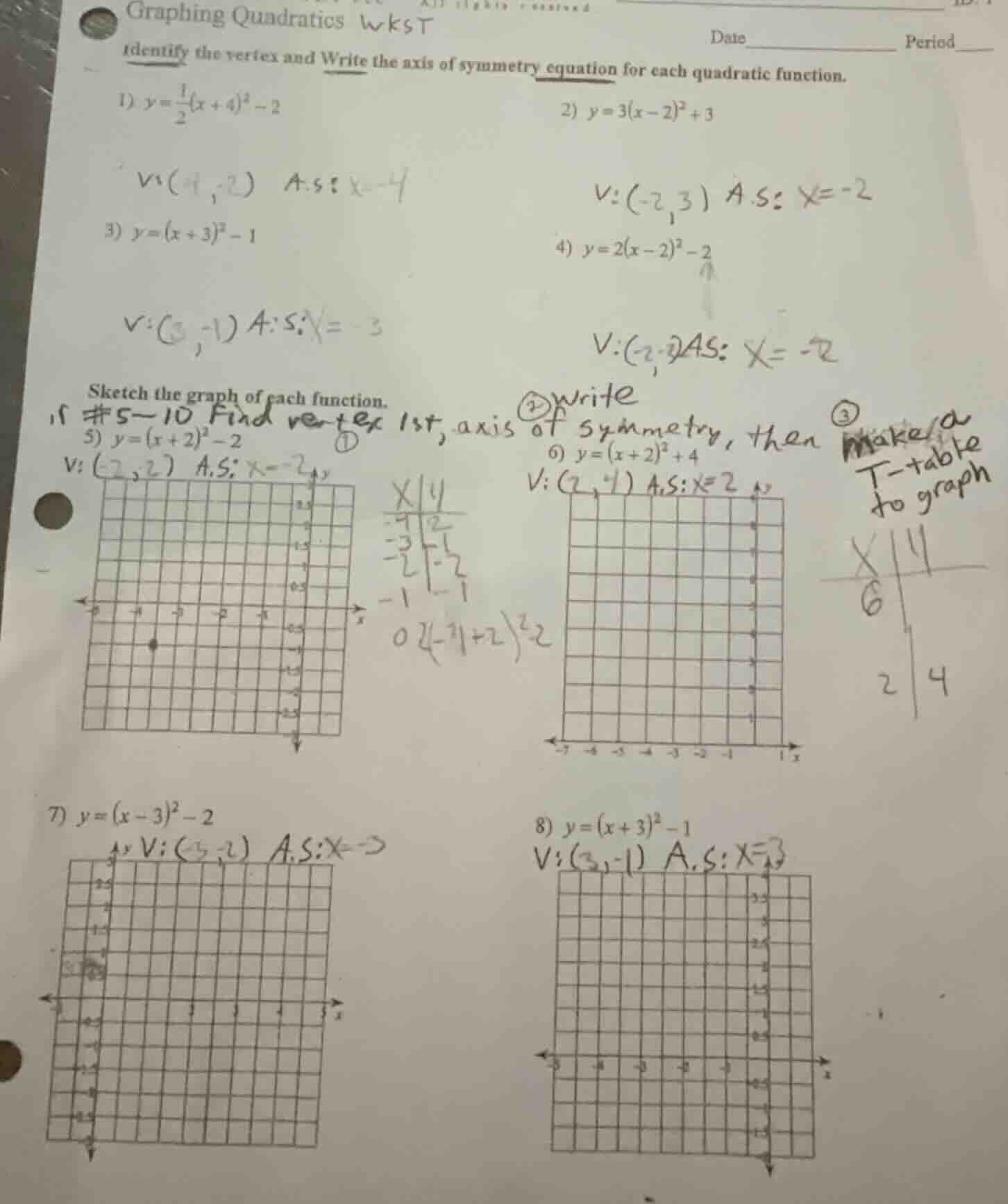
identify the vertex and write the axis of symmetry equation for each quadratic function.
- $y = \frac{1}{2}(x + 4)^2 - 2$
- $y = 3(x - 2)^2 + 3$
- $y = (x + 3)^2 - 1$
- $y = 2(x - 2)^2 - 2$
sketch the graph of each function.
- $y = (x + 2)^2 - 2$
- $y = (x + 2)^2 + 4$
- $y = (x - 3)^2 - 2$
- $y = (x + 3)^2 - 1$
To solve these problems, we use the vertex form of a quadratic function \( y = a(x - h)^2 + k \), where the vertex is \( (h, k) \) and the axis of symmetry is \( x = h \). Let's correct the errors and solve each problem properly:
Problem 1: \( y = \frac{1}{2}(x + 4)^2 - 2 \)
- Step 1: Identify \( h \) and \( k \)
Rewrite \( (x + 4) \) as \( (x - (-4)) \). Thus, \( h = -4 \) and \( k = -2 \).
- Step 2: Find the vertex
Vertex: \( (h, k) = (-4, -2) \).
- Step 3: Find the axis of symmetry
Axis of symmetry: \( x = h = -4 \).
Problem 2: \( y = 3(x - 2)^2 + 3 \)
- Step 1: Identify \( h \) and \( k \)
Here, \( h = 2 \) and \( k = 3 \).
- Step 2: Find the vertex
Vertex: \( (2, 3) \).
- Step 3: Find the axis of symmetry
Axis of symmetry: \( x = 2 \).
Problem 3: \( y = (x + 3)^2 - 1 \)
- Step 1: Identify \( h \) and \( k \)
Rewrite \( (x + 3) \) as \( (x - (-3)) \). Thus, \( h = -3 \) and \( k = -1 \).
- Step 2: Find the vertex
Vertex: \( (-3, -1) \).
- Step 3: Find the axis of symmetry
Axis of symmetry: \( x = -3 \).
Problem 4: \( y = 2(x - 2)^2 - 2 \)
- Step 1: Identify \( h \) and \( k \)
Here, \( h = 2 \) and \( k = -2 \).
- Step 2: Find the vertex
Vertex: \( (2, -2) \).
- Step 3: Find the axis of symmetry
Axis of symmetry: \( x = 2 \).
Problem 5: \( y = (x + 2)^2 - 2 \)
- Step 1: Identify \( h \) and \( k \)
Rewrite \( (x + 2) \) as \( (x - (-2)) \). Thus, \( h = -2 \) and \( k = -2 \).
- Step 2: Find the vertex
Vertex: \( (-2, -2) \).
- Step 3: Find the axis of symmetry
Axis of symmetry: \( x = -2 \).
Problem 6: \( y = (x + 2)^2 + 4 \)
- Step 1: Identify \( h \) and \( k \)
Rewrite \( (x + 2) \) as \( (x - (-2)) \). Thus, \( h = -2 \) and \( k = 4 \).
- Step 2: Find the vertex
Vertex: \( (-2, 4) \).
- Step 3: Find the axis of symmetry
Axis of symmetry: \( x = -2 \).
Problem 7: \( y = (x - 3)^2 - 2 \)
- Step 1: Identify \( h \) and \( k \)
Here, \( h = 3 \) and \( k = -2 \).
- Step 2: Find the vertex
Vertex: \( (3, -2) \).
- Step 3: Find the axis of symmetry
Axis of symmetry: \( x = 3 \).
Problem 8: \( y = (x + 3)^2 - 1 \)
- Step 1: Identify \( h \) and \( k \)
Rewrite \( (x + 3) \) as \( (x - (-3)) \). Thus, \( h = -3 \) and \( k = -1 \).
- Step 2: Find the vertex
Vertex: \( (-3, -1) \).
- Step 3: Find the axis of symmetry
Axis of symmetry: \( x = -3 \).
Final Answers (Vertex, Axis of Symmetry):
- Vertex: \( \boldsymbol{(-4, -2)} \), Axis of Symmetry: \( \boldsymbol{x = -4} \)
- Vertex: \( \boldsymbol{(2, 3)} \), Axis of Symmetry: \( \boldsymbol{x = 2} \)
- Vertex: \( \boldsymbol{(-3, -1)} \), Axis of Symmetry: \( \boldsymbol{x = -3} \)
- Vertex: \( \boldsymbol{(2, -2)} \), Axis of Symmetry: \( \boldsymbol{x = 2} \)
- Vertex: \( \boldsymbol{(-2, -2)} \), Axis of Symmetry: \( \boldsymbol{x = -2} \)
- Vertex: \( \boldsymbol{(-2, 4)} \), Axis of Symmetry: \( \boldsymbol{x = -2} \)
- Vertex: \( \boldsymbol{(3, -2)} \), Axis of Symmetry: \( \boldsymbol{x = 3} \)
- Vertex: \( \boldsymbol{(-3, -1)} \), Axis of Symmetry: \( \boldsymbol{x = -3} \)

Snap & solve any problem in the app
Get step-by-step solutions on Sovi AI
Photo-based solutions with guided steps
Explore more problems and detailed explanations
To solve these problems, we use the vertex form of a quadratic function \( y = a(x - h)^2 + k \), where the vertex is \( (h, k) \) and the axis of symmetry is \( x = h \). Let's correct the errors and solve each problem properly:
Problem 1: \( y = \frac{1}{2}(x + 4)^2 - 2 \)
- Step 1: Identify \( h \) and \( k \)
Rewrite \( (x + 4) \) as \( (x - (-4)) \). Thus, \( h = -4 \) and \( k = -2 \).
- Step 2: Find the vertex
Vertex: \( (h, k) = (-4, -2) \).
- Step 3: Find the axis of symmetry
Axis of symmetry: \( x = h = -4 \).
Problem 2: \( y = 3(x - 2)^2 + 3 \)
- Step 1: Identify \( h \) and \( k \)
Here, \( h = 2 \) and \( k = 3 \).
- Step 2: Find the vertex
Vertex: \( (2, 3) \).
- Step 3: Find the axis of symmetry
Axis of symmetry: \( x = 2 \).
Problem 3: \( y = (x + 3)^2 - 1 \)
- Step 1: Identify \( h \) and \( k \)
Rewrite \( (x + 3) \) as \( (x - (-3)) \). Thus, \( h = -3 \) and \( k = -1 \).
- Step 2: Find the vertex
Vertex: \( (-3, -1) \).
- Step 3: Find the axis of symmetry
Axis of symmetry: \( x = -3 \).
Problem 4: \( y = 2(x - 2)^2 - 2 \)
- Step 1: Identify \( h \) and \( k \)
Here, \( h = 2 \) and \( k = -2 \).
- Step 2: Find the vertex
Vertex: \( (2, -2) \).
- Step 3: Find the axis of symmetry
Axis of symmetry: \( x = 2 \).
Problem 5: \( y = (x + 2)^2 - 2 \)
- Step 1: Identify \( h \) and \( k \)
Rewrite \( (x + 2) \) as \( (x - (-2)) \). Thus, \( h = -2 \) and \( k = -2 \).
- Step 2: Find the vertex
Vertex: \( (-2, -2) \).
- Step 3: Find the axis of symmetry
Axis of symmetry: \( x = -2 \).
Problem 6: \( y = (x + 2)^2 + 4 \)
- Step 1: Identify \( h \) and \( k \)
Rewrite \( (x + 2) \) as \( (x - (-2)) \). Thus, \( h = -2 \) and \( k = 4 \).
- Step 2: Find the vertex
Vertex: \( (-2, 4) \).
- Step 3: Find the axis of symmetry
Axis of symmetry: \( x = -2 \).
Problem 7: \( y = (x - 3)^2 - 2 \)
- Step 1: Identify \( h \) and \( k \)
Here, \( h = 3 \) and \( k = -2 \).
- Step 2: Find the vertex
Vertex: \( (3, -2) \).
- Step 3: Find the axis of symmetry
Axis of symmetry: \( x = 3 \).
Problem 8: \( y = (x + 3)^2 - 1 \)
- Step 1: Identify \( h \) and \( k \)
Rewrite \( (x + 3) \) as \( (x - (-3)) \). Thus, \( h = -3 \) and \( k = -1 \).
- Step 2: Find the vertex
Vertex: \( (-3, -1) \).
- Step 3: Find the axis of symmetry
Axis of symmetry: \( x = -3 \).
Final Answers (Vertex, Axis of Symmetry):
- Vertex: \( \boldsymbol{(-4, -2)} \), Axis of Symmetry: \( \boldsymbol{x = -4} \)
- Vertex: \( \boldsymbol{(2, 3)} \), Axis of Symmetry: \( \boldsymbol{x = 2} \)
- Vertex: \( \boldsymbol{(-3, -1)} \), Axis of Symmetry: \( \boldsymbol{x = -3} \)
- Vertex: \( \boldsymbol{(2, -2)} \), Axis of Symmetry: \( \boldsymbol{x = 2} \)
- Vertex: \( \boldsymbol{(-2, -2)} \), Axis of Symmetry: \( \boldsymbol{x = -2} \)
- Vertex: \( \boldsymbol{(-2, 4)} \), Axis of Symmetry: \( \boldsymbol{x = -2} \)
- Vertex: \( \boldsymbol{(3, -2)} \), Axis of Symmetry: \( \boldsymbol{x = 3} \)
- Vertex: \( \boldsymbol{(-3, -1)} \), Axis of Symmetry: \( \boldsymbol{x = -3} \)