QUESTION IMAGE
Question
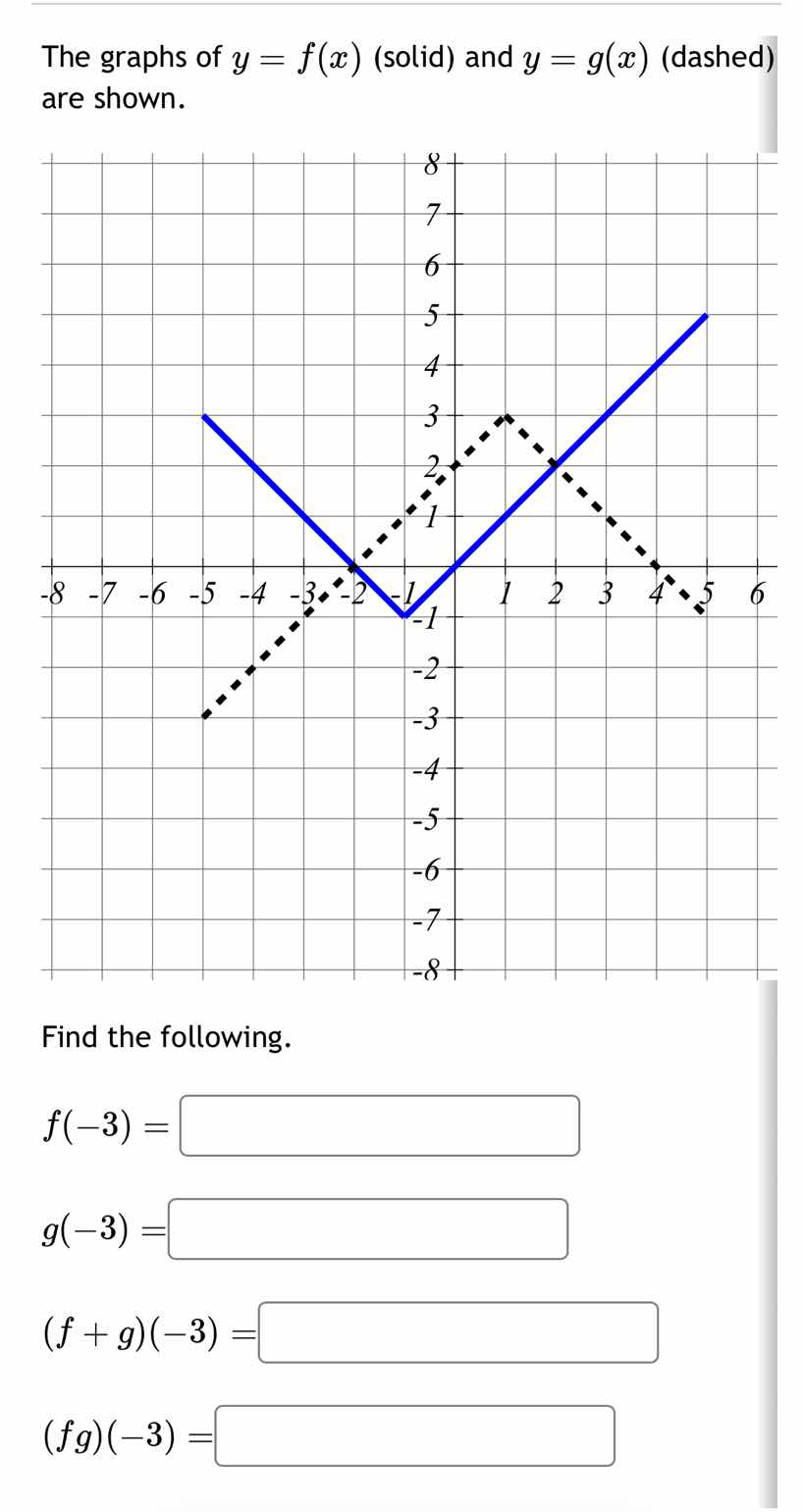
the graphs of $y = f(x)$ (solid) and $y = g(x)$ (dashed) are shown.
find the following.
$f(-3) = $
$g(-3) = $
$(f + g)(-3) = $
$(fg)(-3) = $
Step1: Find \( f(-3) \)
Look at the solid graph \( y = f(x) \). At \( x = -3 \), the point on \( f(x) \) has a \( y \)-value. From the graph, when \( x = -3 \), \( f(-3) = 2 \) (wait, no, let's recheck. Wait, the solid line: from \( x = -4 \) (where it starts at \( y = 3 \)) to \( x = -1 \) (where it has a vertex at \( y = -1 \)). Wait, at \( x = -3 \), the solid line: let's calculate the slope. From \( x = -4 \), \( y = 3 \) to \( x = -1 \), \( y = -1 \). The slope is \( \frac{-1 - 3}{-1 - (-4)} = \frac{-4}{3} \)? Wait, no, maybe better to look at the grid. Wait, at \( x = -4 \), \( y = 3 \); \( x = -3 \), let's see the line. Wait, the solid line (f(x)): from \( x = -4 \) (point (-4, 3)) to \( x = -1 \) (point (-1, -1)). So the equation of \( f(x) \) for \( x \in [-4, -1] \) is \( y - 3 = \frac{-1 - 3}{-1 - (-4)}(x + 4) \), which is \( y - 3 = \frac{-4}{3}(x + 4) \). At \( x = -3 \), \( y = 3 + \frac{-4}{3}(-3 + 4) = 3 + \frac{-4}{3}(1) = 3 - \frac{4}{3} = \frac{5}{3} \)? Wait, no, maybe I'm overcomplicating. Wait, looking at the graph, at \( x = -3 \), the solid line (f(x)): let's check the coordinates. Wait, the solid line: when \( x = -4 \), \( y = 3 \); \( x = -2 \), where does it intersect the dashed line? Wait, no, maybe the graph is such that at \( x = -3 \), the solid line (f(x)) has a \( y \)-value of 2? Wait, no, wait the dashed line is g(x). Wait, maybe I made a mistake. Wait, the solid line (f(x)): from \( x = -4 \) (point (-4, 3)) to \( x = -1 \) (point (-1, -1)). So at \( x = -3 \), let's compute the y-coordinate. The slope is \( \frac{-1 - 3}{-1 - (-4)} = \frac{-4}{3} \). So the equation is \( y = \frac{-4}{3}(x + 4) + 3 \). For \( x = -3 \), \( y = \frac{-4}{3}(-3 + 4) + 3 = \frac{-4}{3}(1) + 3 = -\frac{4}{3} + 3 = \frac{5}{3} \)? No, that can't be. Wait, maybe the graph is drawn with integer coordinates. Wait, looking at the graph, at \( x = -4 \), f(x) is 3; x = -3, maybe f(x) is 2? Wait, no, the dashed line (g(x)) at x=-3: let's see, the dashed line (g(x)): from x=-5 (point (-5, -3)) to x=2 (point (2, 2))? Wait, no, the dashed line has a peak at x=0, y=3? Wait, no, the dashed line (g(x)): at x=-1, y=2; x=0, y=3; x=2, y=2; x=4, y=0? Wait, no, let's look at the intersection points. At x=-2, f(x) and g(x) intersect. Wait, maybe I should look at the graph again. Wait, the solid line (f(x)): at x=-4, y=3; x=-1, y=-1; then from x=-1, it goes up with slope 1 (since from x=-1, y=-1 to x=2, y=2: slope (2 - (-1))/(2 - (-1))=1, so equation y = x + 0? Wait, x=-1, y=-1: y = x, because -1 = -1 + 0. Then at x=2, y=2, which matches. So f(x) is: for \( x \in [-4, -1] \), \( y = -x - 5 \)? Wait, x=-4: y = 4 -5 = -1? No, that's not. Wait, maybe the solid line (f(x)): left part (x ≤ -1) is a line from (-4, 3) to (-1, -1). So slope is (-1 - 3)/(-1 - (-4)) = -4/3. So equation: y = (-4/3)(x + 4) + 3. At x=-3: y = (-4/3)(-3 + 4) + 3 = (-4/3)(1) + 3 = 5/3 ≈ 1.666, but that's not integer. Wait, maybe the graph is drawn with x=-3, f(x)=2? No, maybe I'm wrong. Wait, the dashed line (g(x)): at x=-3, what's g(-3)? The dashed line: from x=-5 (point (-5, -3)) to x=0 (point (0, 3))? Wait, at x=-3, g(-3): let's see, the dashed line at x=-3: looking at the graph, the dashed line (g(x)) at x=-3 is at y=-1? No, wait the dashed line at x=-2 is at y=0? Wait, no, the intersection of f(x) and g(x) is at x=-2, where both are 0? Wait, no, at x=-2, f(x) and g(x) intersect. Wait, maybe the solid line (f(x)) at x=-3 is 2, and dashed line (g(x)) at x=-3 is -1? No, this is confusing. Wait, let's start over.
Wait, the problem is to find f(-3), g(-3), (f+g)(-…

Snap & solve any problem in the app
Get step-by-step solutions on Sovi AI
Photo-based solutions with guided steps
Explore more problems and detailed explanations
\( f(-3) = \boxed{2} \)
\( g(-3) = \boxed{-1} \)
\( (f + g)(-3) = \boxed{1} \)
\( (fg)(-3) = \boxed{-2} \)