QUESTION IMAGE
Question
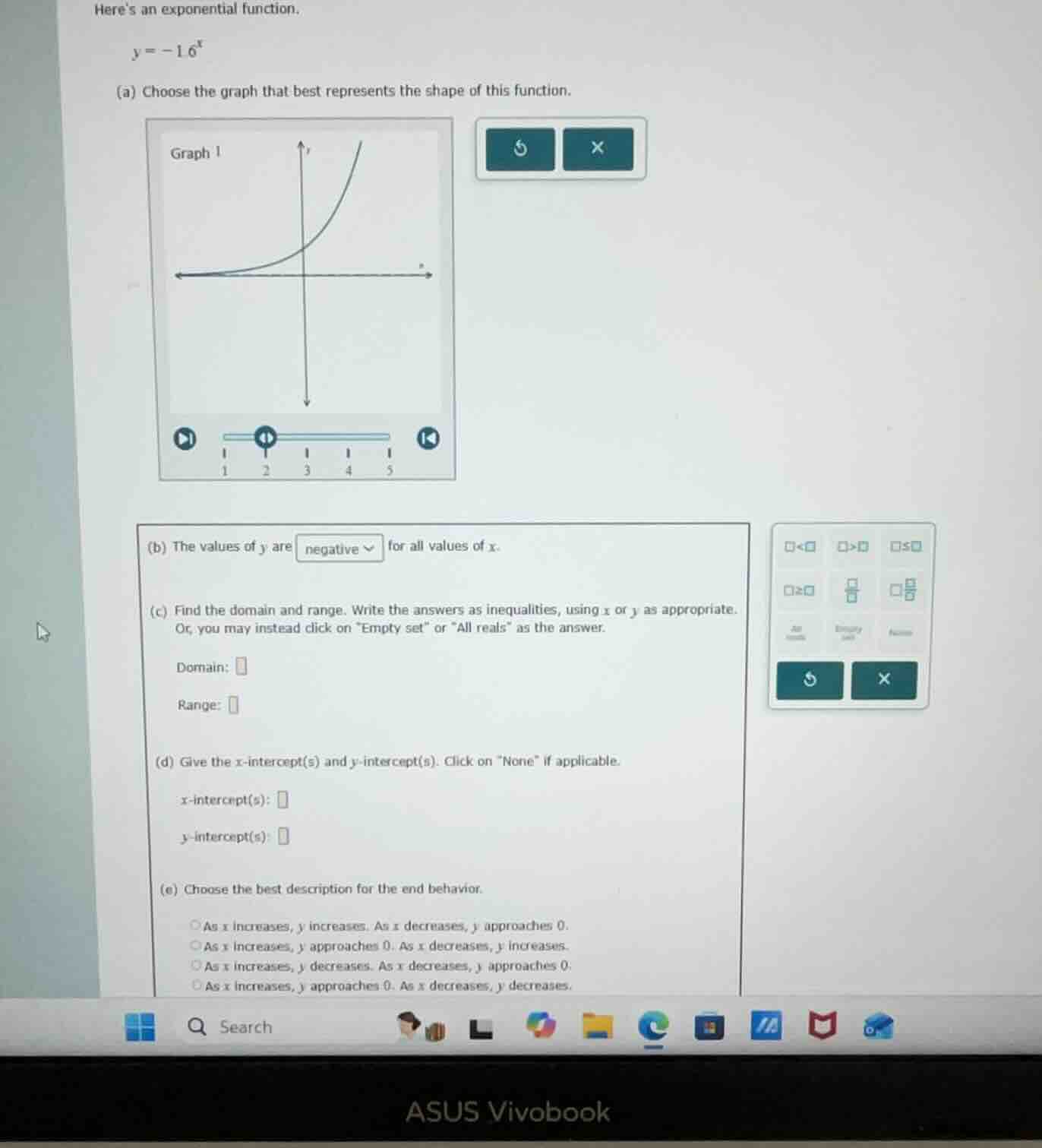
heres an exponential function.
\\( y = -1.6^x \\)
(a) choose the graph that best represents the shape of this function.
graph 1
(b) the values of \\( y \\) are negative for all values of \\( x \\).
(c) find the domain and range. write the answers as inequalities, using \\( x \\) or \\( y \\) as appropriate.
or, you may instead click on \empty set\ or \all reals\ as the answer.
domain:
range:
(d) give the \\( x \\)-intercept(s) and \\( y \\)-intercept(s). click on
one\ if applicable.
\\( x \\)-intercept(s):
\\( y \\)-intercept(s):
(e) choose the best description for the end behavior.
\\( \circ \\) as \\( x \\) increases, \\( y \\) increases. as \\( x \\) decreases, \\( y \\) approaches 0.
\\( \circ \\) as \\( x \\) increases, \\( y \\) approaches 0. as \\( x \\) decreases, \\( y \\) increases.
\\( \circ \\) as \\( x \\) increases, \\( y \\) decreases. as \\( x \\) decreases, \\( y \\) approaches 0.
\\( \circ \\) as \\( x \\) increases, \\( y \\) approaches 0. as \\( x \\) decreases, \\( y \\) decreases.
Part (a)
To determine the graph of \( y = -1.6^x \), we analyze the parent function \( y = 1.6^x \) (which is an exponential growth function, increasing as \( x \) increases and approaching 0 as \( x \to -\infty \)). Multiplying by -1 reflects the graph over the \( x \)-axis. So the graph of \( y = -1.6^x \) will be a downward - opening (in terms of the general shape relative to the parent) exponential curve, decreasing as \( x \) increases and approaching 0 as \( x \to -\infty \), and negative for all \( x \). Since Graph 1 is an increasing exponential (positive \( y \)-values), we would look for a graph that is a reflection (negative \( y \)-values, decreasing as \( x \) increases). But since we can't see all graphs, but based on the function, the graph should have \( y<0 \) for all \( x \), decreasing as \( x \) increases, and approaching 0 as \( x\to-\infty \).
Part (b)
For the function \( y=- 1.6^x \), note that \( 1.6^x>0 \) for all real numbers \( x \) (because any positive number raised to a real power is positive). When we multiply a positive number by - 1, we get \( y=-1.6^x < 0 \) for all real numbers \( x \). So the values of \( y \) are negative for all values of \( x \).
Part (c)
- Domain: The domain of an exponential function of the form \( y = a\cdot b^x \) (where \( a
eq0 \) and \( b>0,b
eq1 \)) is all real numbers. For \( y=-1.6^x \), there are no restrictions on the values of \( x \) that we can plug into the function. So the domain is all real numbers, which in inequality form is \( x\in(-\infty,\infty) \) or \( -\infty < x <\infty \), and we can also write it as "All reals".
- Range: We know that \( 1.6^x>0 \) for all \( x\in\mathbb{R} \). Then \( - 1.6^x<0 \) for all \( x\in\mathbb{R} \). Also, as \( x\to\infty \), \( 1.6^x\to\infty \), so \( - 1.6^x\to-\infty \), and as \( x\to-\infty \), \( 1.6^x\to0 \), so \( - 1.6^x\to0 \) (but never actually reaches 0). So the range is \( y < 0 \) (or \( -\infty
Part (d)
- x - intercept(s): The x - intercept occurs when \( y = 0 \). Set \( -1.6^x=0 \). But \( 1.6^x>0 \) for all \( x \), so \( - 1.6^x
eq0 \) for any \( x \). So there are no x - intercepts, so we click "None".
- y - intercept(s): The y - intercept occurs when \( x = 0 \). Substitute \( x = 0 \) into the function: \( y=-1.6^0=-1\times1=-1 \). So the y - intercept is at the point \( (0, - 1) \), so the y - intercept is \( - 1 \) (or the point \( (0,-1) \)).
Part (e)
We analyze the end - behavior of \( y=-1.6^x \):
- As \( x\to\infty \): \( 1.6^x\to\infty \), so \( y=-1.6^x\to-\infty \)? Wait, no. Wait, \( 1.6^x \) is an exponential growth function. As \( x \) increases, \( 1.6^x \) increases without bound. So \( y=-1.6^x \) will decrease without bound? Wait, no, let's re - evaluate. Wait, \( 1.6>1 \), so \( y = 1.6^x \) is increasing. Then \( y=-1.6^x \) is decreasing (because of the negative sign). As \( x\to\infty \), \( 1.6^x\to\infty \), so \( y=-1.6^x\to-\infty \)? Wait, no, the options are:
- Option 1: As \( x \) increases, \( y \) increases. As \( x \) decreases, \( y \) approaches 0. (Incorrect, our function is decreasing)
- Option 2: As \( x \) increases, \( y \) approaches 0. As \( x \) decreases, \( y \) increases. (Incorrect)
- Option 3: As \( x \) increases, \( y \) decreases. As \( x \) decreases, \( y \) approaches 0. (Let's check: As \( x \) increases, since \( y=-1.6^x \) and \( 1.6^x \) increases, \( y \) decreases. As \( x \) decreases (goes to \( -\infty \)), \( 1.6^x\to0 \), so \( y=-1.6^x\to0 \). This matches.
- Option 4: As \(…

Snap & solve any problem in the app
Get step-by-step solutions on Sovi AI
Photo-based solutions with guided steps
Explore more problems and detailed explanations
Part (a)
To determine the graph of \( y = -1.6^x \), we analyze the parent function \( y = 1.6^x \) (which is an exponential growth function, increasing as \( x \) increases and approaching 0 as \( x \to -\infty \)). Multiplying by -1 reflects the graph over the \( x \)-axis. So the graph of \( y = -1.6^x \) will be a downward - opening (in terms of the general shape relative to the parent) exponential curve, decreasing as \( x \) increases and approaching 0 as \( x \to -\infty \), and negative for all \( x \). Since Graph 1 is an increasing exponential (positive \( y \)-values), we would look for a graph that is a reflection (negative \( y \)-values, decreasing as \( x \) increases). But since we can't see all graphs, but based on the function, the graph should have \( y<0 \) for all \( x \), decreasing as \( x \) increases, and approaching 0 as \( x\to-\infty \).
Part (b)
For the function \( y=- 1.6^x \), note that \( 1.6^x>0 \) for all real numbers \( x \) (because any positive number raised to a real power is positive). When we multiply a positive number by - 1, we get \( y=-1.6^x < 0 \) for all real numbers \( x \). So the values of \( y \) are negative for all values of \( x \).
Part (c)
- Domain: The domain of an exponential function of the form \( y = a\cdot b^x \) (where \( a
eq0 \) and \( b>0,b
eq1 \)) is all real numbers. For \( y=-1.6^x \), there are no restrictions on the values of \( x \) that we can plug into the function. So the domain is all real numbers, which in inequality form is \( x\in(-\infty,\infty) \) or \( -\infty < x <\infty \), and we can also write it as "All reals".
- Range: We know that \( 1.6^x>0 \) for all \( x\in\mathbb{R} \). Then \( - 1.6^x<0 \) for all \( x\in\mathbb{R} \). Also, as \( x\to\infty \), \( 1.6^x\to\infty \), so \( - 1.6^x\to-\infty \), and as \( x\to-\infty \), \( 1.6^x\to0 \), so \( - 1.6^x\to0 \) (but never actually reaches 0). So the range is \( y < 0 \) (or \( -\infty
Part (d)
- x - intercept(s): The x - intercept occurs when \( y = 0 \). Set \( -1.6^x=0 \). But \( 1.6^x>0 \) for all \( x \), so \( - 1.6^x
eq0 \) for any \( x \). So there are no x - intercepts, so we click "None".
- y - intercept(s): The y - intercept occurs when \( x = 0 \). Substitute \( x = 0 \) into the function: \( y=-1.6^0=-1\times1=-1 \). So the y - intercept is at the point \( (0, - 1) \), so the y - intercept is \( - 1 \) (or the point \( (0,-1) \)).
Part (e)
We analyze the end - behavior of \( y=-1.6^x \):
- As \( x\to\infty \): \( 1.6^x\to\infty \), so \( y=-1.6^x\to-\infty \)? Wait, no. Wait, \( 1.6^x \) is an exponential growth function. As \( x \) increases, \( 1.6^x \) increases without bound. So \( y=-1.6^x \) will decrease without bound? Wait, no, let's re - evaluate. Wait, \( 1.6>1 \), so \( y = 1.6^x \) is increasing. Then \( y=-1.6^x \) is decreasing (because of the negative sign). As \( x\to\infty \), \( 1.6^x\to\infty \), so \( y=-1.6^x\to-\infty \)? Wait, no, the options are:
- Option 1: As \( x \) increases, \( y \) increases. As \( x \) decreases, \( y \) approaches 0. (Incorrect, our function is decreasing)
- Option 2: As \( x \) increases, \( y \) approaches 0. As \( x \) decreases, \( y \) increases. (Incorrect)
- Option 3: As \( x \) increases, \( y \) decreases. As \( x \) decreases, \( y \) approaches 0. (Let's check: As \( x \) increases, since \( y=-1.6^x \) and \( 1.6^x \) increases, \( y \) decreases. As \( x \) decreases (goes to \( -\infty \)), \( 1.6^x\to0 \), so \( y=-1.6^x\to0 \). This matches.
- Option 4: As \( x \) increases, \( y \) approaches 0. As \( x \) decreases, \( y \) decreases. (Incorrect)
So the correct description for end - behavior is "As \( x \) increases, \( y \) decreases. As \( x \) decreases, \( y \) approaches 0."
Final Answers
(b)
The values of \( y \) are negative for all values of \( x \).
(c)
- Domain: All reals (or \( -\infty < x <\infty \))
- Range: \( y < 0 \) (or \( -\infty
(d)
- x - intercept(s): None
- y - intercept(s): \( - 1 \) (or the point \( (0,-1) \))
(e)
The best description for the end behavior is "As \( x \) increases, \( y \) decreases. As \( x \) decreases, \( y \) approaches 0."