QUESTION IMAGE
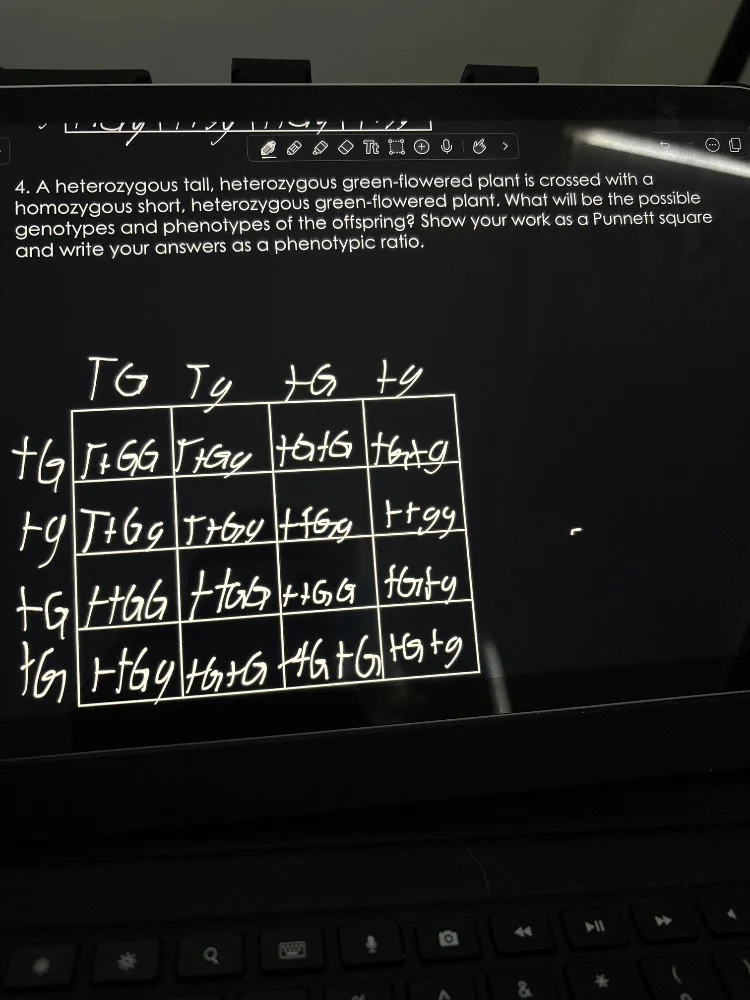
Question
- a heterozygous tall, heterozygous green-flowered plant is crossed with a homozygous short, heterozygous green-flowered plant. what will be the possible genotypes and phenotypes of the offspring? show your work as a punnett square and write your answers as a phenotypic ratio.
Step1: Define parent genotypes
Let \(T\) = tall (dominant), \(t\) = short (recessive); \(G\) = green flower (dominant), \(g\) = non-green flower (recessive).
Parent 1 (heterozygous tall, heterozygous green): \(TtGg\)
Parent 2 (homozygous short, heterozygous green): \(ttGg\)
Gametes of Parent 1: \(TG, Tg, tG, tg\)
Gametes of Parent 2: \(tG, tg, tG, tg\)
Step2: Build correct Punnett Square
| \(TG\) | \(Tg\) | \(tG\) | \(tg\) | |
|---|---|---|---|---|
| \(tg\) | \(TtGg\) | \(Ttgg\) | \(ttGg\) | \(ttgg\) |
| \(tG\) | \(TtGG\) | \(TtGg\) | \(ttGG\) | \(ttGg\) |
| \(tg\) | \(TtGg\) | \(Ttgg\) | \(ttGg\) | \(ttgg\) |
Step3: Classify phenotypes
- Tall, green flower: \(TtGG, TtGg\) (count = 6)
- Tall, non-green flower: \(Ttgg\) (count = 2)
- Short, green flower: \(ttGG, ttGg\) (count = 6)
- Short, non-green flower: \(ttgg\) (count = 2)
Step4: Simplify phenotypic ratio
Divide all counts by 2 to get the simplest whole-number ratio.

Snap & solve any problem in the app
Get step-by-step solutions on Sovi AI
Photo-based solutions with guided steps
Explore more problems and detailed explanations
Phenotypic ratio: 3 Tall, green-flowered : 1 Tall, non-green-flowered : 3 Short, green-flowered : 1 Short, non-green-flowered (or 3:1:3:1)